
Every November, thousands of homeowners pull out last year’s string lights, plug them into a weatherproof outlet, and hang them on gutters, trees, or railings—only to discover, weeks later, that half the strand flickers erratically—or worse, stops working entirely. Some assume the problem is a faulty bulb or a tripped breaker. Others blame the cold. But in many cases, the root cause is far simpler—and far more dangerous: using indoor-rated Christmas lights outdoors.
An adapter—whether a simple plug converter, a GFCI extension cord, or even a heavy-duty outdoor-rated power strip—does not change the fundamental design, materials, or safety certifications of the light string itself. Indoor lights lack the engineering safeguards required for exposure to rain, snow, UV radiation, temperature swings, and physical abrasion. This isn’t a matter of convenience or cost—it’s about electrical integrity, fire risk, and personal safety. Below, we break down exactly what happens when indoor lights meet the outdoors, how to identify safe alternatives, and what steps you must take before hanging a single bulb this season.
Why Indoor Lights Are Not Built for Outdoor Conditions
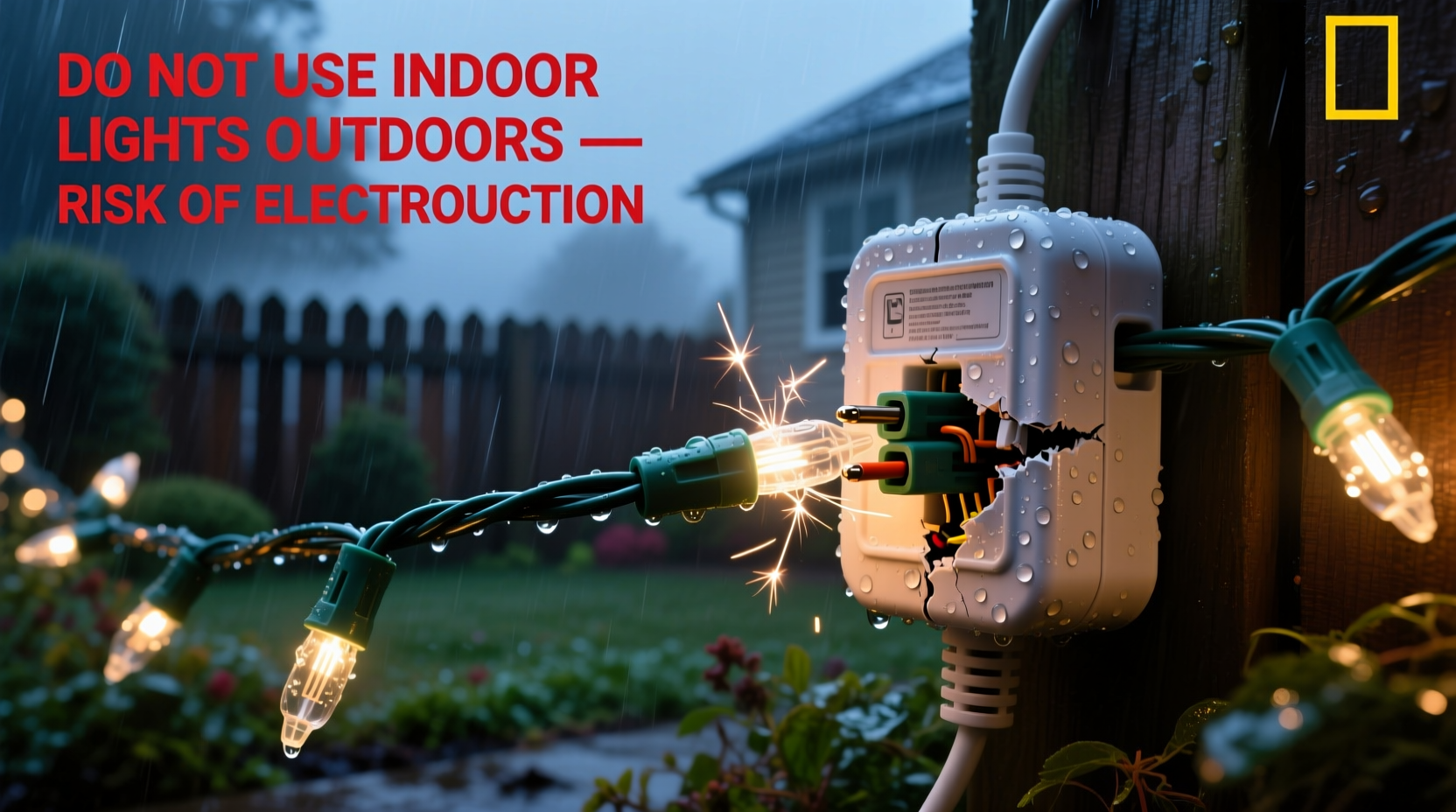
Indoor Christmas lights are engineered for controlled environments: dry, stable temperatures (typically 68–77°F), minimal dust, no moisture, and little mechanical stress. Their construction reflects those assumptions. The insulation on indoor wires is usually made from thin PVC that degrades rapidly under ultraviolet light. After just one season of sun exposure, that insulation becomes brittle, cracks easily, and exposes bare copper conductors. Moisture then migrates along the wire core, leading to short circuits, ground faults, and potential arcing—even if the strand appears intact.
Additionally, indoor sockets and connectors are not sealed. They lack gaskets, o-rings, or silicone-filled housings. A single splash of rainwater or overnight condensation inside a socket can create a conductive path between live and neutral contacts—especially dangerous when combined with grounded metal surfaces like aluminum gutters or wrought-iron railings. UL (Underwriters Laboratories) tests indoor lights only under dry, room-temperature conditions. Their certification mark carries no assurance of performance—or safety—outside those parameters.
“UL listing is location-specific. An ‘indoor-only’ rating means the product has been tested and certified *only* for interior use. Adding an adapter does not retroactively grant outdoor approval—it bypasses safety protocols.” — Dr. Lena Torres, Senior Electrical Safety Engineer, UL Solutions
The Hidden Risks of Using Adapters as a “Workaround”
Many believe that plugging indoor lights into a GFCI-protected outdoor outlet—or using a weather-resistant adapter—somehow “upgrades” their safety rating. It doesn’t. A GFCI prevents electrocution by cutting power if it detects current leakage (e.g., 5mA imbalance), but it cannot prevent the underlying failure modes that make indoor lights hazardous outdoors:
- Insulation breakdown caused by UV exposure and freeze-thaw cycles;
- Corrosion of internal solder joints due to humidity and salt air (especially near coastal areas);
- Thermal stress fractures in plastic housings when temperatures drop below 14°F (−10°C);
- Water ingress into controllers or rectifiers, causing erratic dimming, color shifts, or complete failure;
- Increased fire risk from overheating in enclosed spaces (e.g., wrapped around wooden posts or tucked under eaves where heat cannot dissipate).
Worse, adapters often introduce new points of failure. A corroded extension cord receptacle, a loose connection in a daisy-chained power strip, or an overloaded multi-outlet hub can generate heat at the junction point—creating a fire hazard independent of the lights themselves.
How to Tell Indoor From Outdoor Lights (Without the Box)
Most consumers rely on packaging labels—but what if the box is long gone? Here’s how to visually and physically distinguish indoor from outdoor-rated lights:
| Feature | Indoor Lights | Outdoor Lights |
|---|---|---|
| Labeling | No UL symbol; may say “Indoor Use Only,” “Not for Outdoor Use,” or nothing at all | Clear UL listing with “UL Listed for Outdoor Use” or “UL 588 Certified” and a snowflake icon (for cold-weather rating) |
| Wire Texture | Thin, flexible, glossy PVC—bends easily, feels slightly slick | Thicker, matte-textured, rubbery or thermoplastic elastomer (TPE) insulation—stiffens in cold but resists cracking |
| Bulb Base | Smooth, unsealed plastic socket; visible gaps around bulb stem | Rubberized or silicone-sealed base; often features a raised lip or gasket ring |
| Plug Type | Two-prong, non-polarized; no grounding pin | Three-prong grounded plug (standard for outdoor-rated strands); some feature locking connectors |
| Temperature Rating | Rated for 32–104°F (0–40°C) only | Rated for −22°F to 122°F (−30°C to 50°C); clearly marked on cord or packaging |
One quick field test: gently bend a 6-inch section of cord at room temperature. If it kinks sharply or makes a faint “crackling” sound, the insulation is already degraded—and unsafe for any use, indoors or out.
A Real-World Example: The Holiday Fire in Portland, OR
In December 2022, a residential fire in Portland’s Southeast neighborhood destroyed two attached townhomes and injured three people. Fire investigators traced the origin to a string of vintage LED mini-lights—purchased in 2018 and labeled “Indoor Use Only”—wrapped around a wooden porch railing. The homeowner had used a standard 100-foot outdoor extension cord with a built-in GFCI and a waterproof outlet cover.
What happened? Over Thanksgiving weekend, temperatures dropped below freezing while fog lingered for 36 hours. Condensation formed inside unsealed bulb sockets. When the homeowner turned on the lights after sunset, moisture bridged the contacts in the third socket from the plug end. Arcing occurred, igniting the adjacent dried pine boughs used in the display. The GFCI did not trip because the fault was not a ground leak—it was line-to-line arcing within the socket housing.
The lights had worked fine for three prior seasons—but each year of UV exposure weakened the insulation. The final failure wasn’t sudden; it was the culmination of cumulative degradation masked by temporary functionality. This case underscores a critical truth: perceived reliability is not evidence of safety.
Step-by-Step: How to Safely Light Your Exterior This Season
Follow this verified sequence before installing any outdoor lighting. Skipping even one step increases risk significantly.
- Inspect every strand: Look for cracked insulation, discolored sockets, bent or corroded pins, and frayed ends. Discard anything showing wear—even if it still “works.”
- Verify UL certification: Find the UL mark and confirm it explicitly states “Outdoor Use” or displays the snowflake symbol. If unsure, search the UL Product iQ database using the model number.
- Calculate load capacity: Outdoor outlets are typically 15-amp circuits. Each 100-bulb LED strand draws ~0.07 amps. Multiply strands × 0.07, then add 20% buffer. Never exceed 12 amps per circuit (80% of 15A).
- Use only outdoor-rated extension cords: Minimum 14-gauge for runs up to 100 feet; 12-gauge for longer distances. Ensure cords are rated for “hard service” (type SJOOW or SJTW) and have molded, water-resistant connectors.
- Install drip loops: Before plugging in, form a U-shaped loop in the cord just above the outlet—so water runs off the lowest point instead of tracking into the receptacle.
- Secure with insulated clips: Never use nails, staples, or metal hangers. Use UV-stable plastic clips designed for outdoor lighting—these prevent abrasion and maintain cord integrity over time.
- Test GFCI monthly: Press the “TEST” button on every outdoor GFCI outlet before first use and once per month thereafter. Reset if it trips. Replace units older than 10 years.
FAQ: Your Most Common Questions Answered
Can I use indoor lights on a covered porch or patio?
No—not safely. Even under a roof, covered porches experience high humidity, temperature fluctuations, wind-driven rain, and UV exposure through skylights or open sides. UL classifies “covered” as insufficient protection unless the space is fully enclosed, climate-controlled, and inaccessible to weather intrusion. If it’s not listed for outdoor use, treat it as indoor-only—regardless of shelter.
What if I seal indoor lights with silicone or tape?
This is strongly discouraged. Non-electrical-grade silicone can trap moisture inside sockets, accelerating corrosion. Electrical tape degrades rapidly under UV light and loses adhesion in cold weather—often peeling away and leaving exposed wires. No DIY sealing method meets UL requirements or provides reliable long-term protection. It creates a false sense of security while increasing hidden hazards.
Are LED indoor lights safer than incandescent ones for outdoor use?
No. While LEDs run cooler and consume less power, they do not eliminate the core risks: insulation degradation, moisture ingress, and connector failure. In fact, many LED strings use complex driver circuits housed in compact, non-ventilated plastic enclosures—making them more vulnerable to thermal stress and condensation damage than simpler incandescent designs. Safety depends on construction and certification—not bulb technology alone.
Conclusion: Prioritize Certification Over Convenience
Using indoor Christmas lights outdoors—with or without an adapter—is not a harmless shortcut. It’s a compromise with measurable consequences: reduced lifespan, unpredictable failures, increased insurance liability, and, in worst-case scenarios, property damage or injury. The $8–$12 premium for outdoor-rated lights pays for robust materials, rigorous testing, and peace of mind that no amount of seasonal cheer can replace.
This holiday season, take five minutes to audit your light collection. Separate indoor from outdoor. Replace worn or uncertified strands—not next year, but now. Invest in proper cords, secure mounting hardware, and GFCI protection designed for exterior use. These aren’t luxuries; they’re foundational elements of responsible home electrification.
Lighting your home should spark joy—not emergency calls. When you choose lights certified for where they’ll actually be used, you honor both tradition and safety. Hang them with confidence. Celebrate with clarity. And let your only surprise this December be the warmth of family—not the smell of burning insulation.




 浙公网安备
33010002000092号
浙公网安备
33010002000092号 浙B2-20120091-4
Comments
No comments yet. Why don't you start the discussion?