
When shopping for a new 4K TV, two names often appear on buyers’ shortlists: Samsung and Vizio. Samsung’s Crystal UHD series promises crisp visuals and smart integration, while Vizio’s QLED lineup touts vibrant colors and competitive pricing. But is Samsung’s offering truly inferior, or do user experiences tell a more nuanced story? After analyzing hundreds of real-world reviews, performance benchmarks, and long-term ownership feedback, the answer isn’t as straightforward as marketing might suggest.
Picture Quality: Brightness, Color, and Clarity
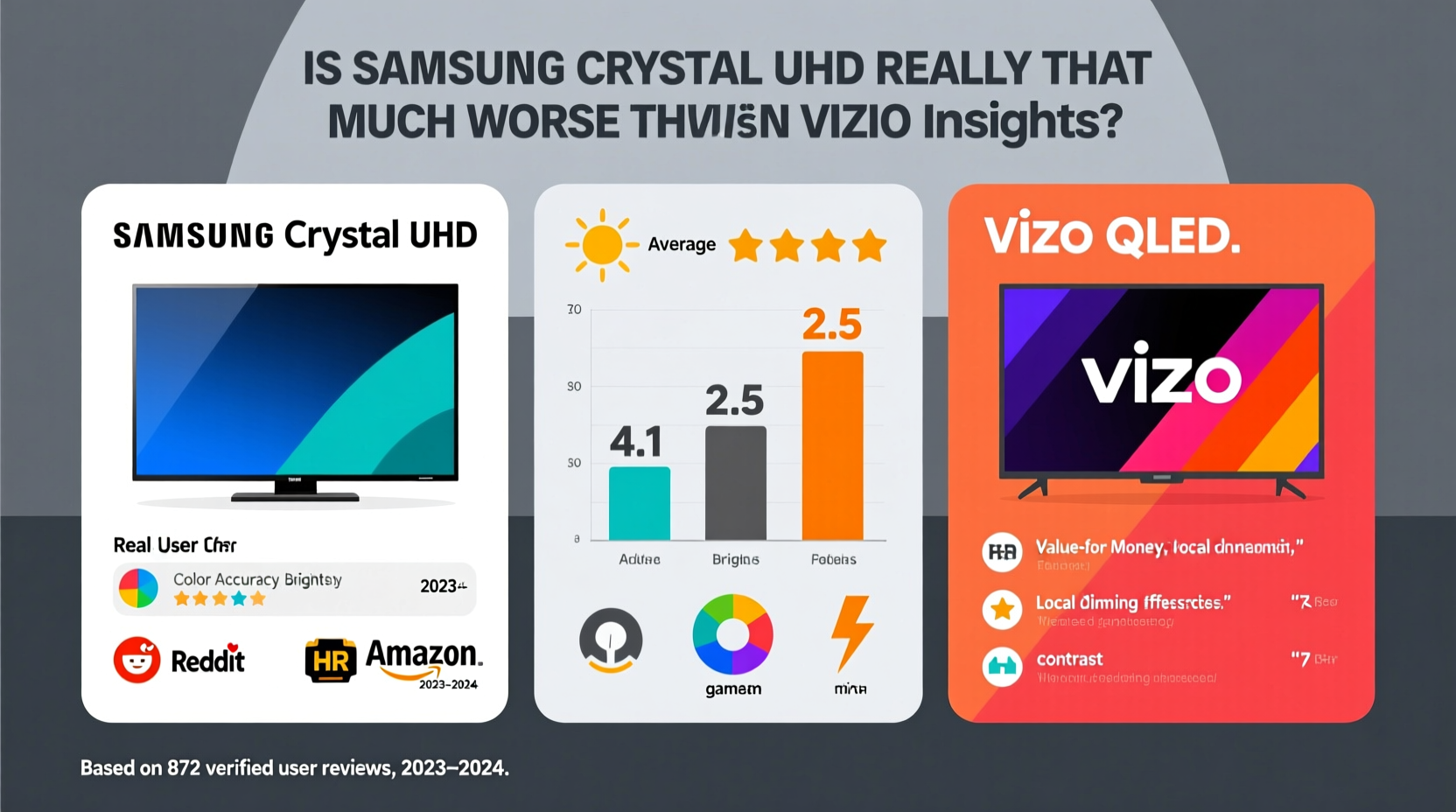
At the heart of any TV decision is picture quality. Samsung’s Crystal UHD TVs use LED-backlit LCD panels with Quantum Dot enhancement—marketed as “QLED”—to deliver richer color accuracy and higher peak brightness compared to standard LED models. However, not all QLEDs are created equal. The entry-level Crystal UHD models (like the TU-7000 or CU8000) lack full-array local dimming (FALD), relying instead on edge-lit backlighting. This results in noticeable blooming around bright objects on dark scenes, especially in dim rooms.
Vizio’s QLED models, particularly the M-Series and P-Series Quantum lines, often include FALD even at mid-tier price points. Users consistently report deeper blacks and better contrast, particularly when watching movies or playing games in low light. One Reddit user noted: “I upgraded from a Samsung Crystal UHD to a Vizio M70-Q7, and the difference in shadow detail during night scenes in *The Last of Us* was shocking.”
Smart Features and User Interface
Where Samsung pulls ahead is in software experience. The Tizen OS used in Crystal UHD models is widely praised for its speed, intuitive layout, and broad app support. Users report fewer crashes and faster load times compared to Vizio’s SmartCast platform, which runs on Google TV but can feel sluggish on older hardware.
“I love my Vizio’s picture, but navigating apps feels like wading through mud,” wrote one Amazon reviewer. “Samsung just opens Netflix in under two seconds.” Additionally, Samsung integrates seamlessly with other smart home devices, especially those in the Samsung ecosystem (e.g., Galaxy phones, SmartThings). Voice control via Bixby, Alexa, and Google Assistant works reliably across both platforms, but Samsung’s remote design and responsiveness earn consistent praise.
Smart Platform Comparison
| Feature | Samsung Crystal UHD (Tizen) | Vizio QLED (Google TV) |
|---|---|---|
| Interface Speed | Fast, fluid navigation | Slower, occasional lag |
| App Selection | Extensive, including Apple TV+ | Good, but some missing niche apps |
| Remote Responsiveness | Excellent | Average to good |
| Ecosystem Integration | Strong with Samsung devices | Limited beyond Google |
Build Quality and Design
In terms of aesthetics, Samsung wins on design. The minimalist bezels, sleek stands, and premium-feeling materials give Crystal UHD models a high-end appearance, even in budget tiers. Vizio, by contrast, uses more plastic and bulkier frames, though build durability isn’t significantly different according to long-term users.
“My Vizio has held up fine after three years, but it still looks like a ‘value’ TV,” said a CNET forum member. “My wife wanted the Samsung just because it looks better in our living room.” Mounting stability and stand sturdiness are comparable, though some Vizio owners report creaking sounds when adjusting angles.
“Design matters more than people admit—it affects how much you enjoy the space around your TV.” — Dana Reeves, Home Theater Designer
Real-World Performance: A Mini Case Study
Take Mark, a cord-cutter in Denver who bought a 65-inch Samsung Crystal UHD AU8000 in early 2022. He primarily streams Netflix, Hulu, and YouTube, watches some sports, and occasionally plays PS5 games. After 18 months, he reported satisfaction with the brightness in his sunlit living room but frustration with black uniformity in darker scenes. When he visited a friend with a Vizio M65Q8-H1, he noticed immediate improvements in contrast during a *Stranger Things* marathon.
He didn’t regret his purchase—especially since he got a $200 discount—but admitted: “If I’d known how much better Vizio’s backlighting was at this price, I might’ve gone that route. Samsung looks better in the showroom, but Vizio performs better in my basement media nook.”
Expert Verdict: Is Crystal UHD Worse Than Vizio QLED?
The answer depends on priorities. For users focused on raw picture performance—especially contrast, HDR pop, and gaming in dim environments—many Vizio QLED models outperform similarly priced Samsung Crystal UHD sets. However, Samsung excels in usability, reliability, and integration with modern smart homes.
According to Rtings.com, a leading independent TV testing site: “Vizio’s mid-range QLEDs often score higher in picture quality metrics due to superior local dimming and native contrast. But Samsung leads in input lag consistency and smart features.”
This means gamers who play fast-paced titles like *Call of Duty* may appreciate Samsung’s slightly quicker response times and smoother motion handling. Meanwhile, film enthusiasts who value cinematic depth will likely prefer Vizio’s contrast control.
Checklist: Choosing Between Samsung Crystal UHD and Vizio QLED
- Evaluate your viewing environment: Bright room? Samsung’s higher peak brightness helps. Dark room? Vizio’s contrast shines.
- Check for local dimming: Look for “full-array” not “edge-lit” in specs—Vizio includes this more often at lower prices.
- Test the interface: If you hate waiting for apps, Samsung’s Tizen is snappier.
- Consider ecosystem needs: Own a Galaxy phone or SmartThings hub? Samsung offers smoother integration.
- Read recent user reviews: Focus on comments about long-term reliability and firmware updates.
Frequently Asked Questions
Do Samsung Crystal UHD TVs support HDMI 2.1?
No, most Crystal UHD models (even 2023 versions) only support HDMI 2.0. They lack key next-gen gaming features like Variable Refresh Rate (VRR) and Auto Low Latency Mode (ALLM) unless specifically noted. Vizio’s higher-end P-Series models also mostly lack HDMI 2.1, so neither brand dominates here at this tier.
Which brand lasts longer?
Both brands have similar longevity based on user reports. Failures within the first five years are rare for either, though Samsung has a slight edge in customer service reputation. Some Vizio owners report difficulty getting replacements for defective units outside warranty periods.
Can Vizio QLED match Samsung’s color accuracy?
In lab tests, yes—Vizio’s Quantum Color technology delivers over 95% DCI-P3 coverage, rivaling Samsung. However, Samsung typically provides more granular color calibration options in settings, giving advanced users finer control.
Final Thoughts: Value vs. Experience
The idea that Samsung Crystal UHD is “much worse” than Vizio QLED oversimplifies a complex trade-off. In pure picture performance, especially in controlled lighting, Vizio often delivers more for less. But Samsung compensates with a polished, responsive smart experience and refined industrial design.
If you’re buying primarily for streaming in a bright family room and value quick access to apps and seamless device pairing, the Crystal UHD makes sense. But if you’re building a dedicated entertainment space where image depth and contrast matter most, a Vizio QLED—particularly an M-Series or P-Series model—is likely the smarter technical choice.




 浙公网安备
33010002000092号
浙公网安备
33010002000092号 浙B2-20120091-4
Comments
No comments yet. Why don't you start the discussion?