
For millions of music lovers, the choice between Spotify Premium and Apple Music isn’t just about price or catalog size—it’s about discovery. The right song at the right moment can transform a commute, energize a workout, or deepen a moment of reflection. At the heart of that experience lies the algorithm: the invisible engine that learns your tastes, anticipates your mood, and surfaces music you didn’t know you’d love. But when comparing Spotify Premium and Apple Music, is Spotify truly superior—specifically because of its recommendation system?
This question matters especially to listeners who value surprise and curation over manual playlist building. If you rely on personalized suggestions more than artist searches, the strength of the algorithm becomes a deciding factor. Let’s examine how each platform approaches music intelligence, what users actually experience, and whether Spotify’s edge in personalization justifies choosing it over Apple Music—even if everything else were equal.
The Role of Algorithms in Modern Music Discovery
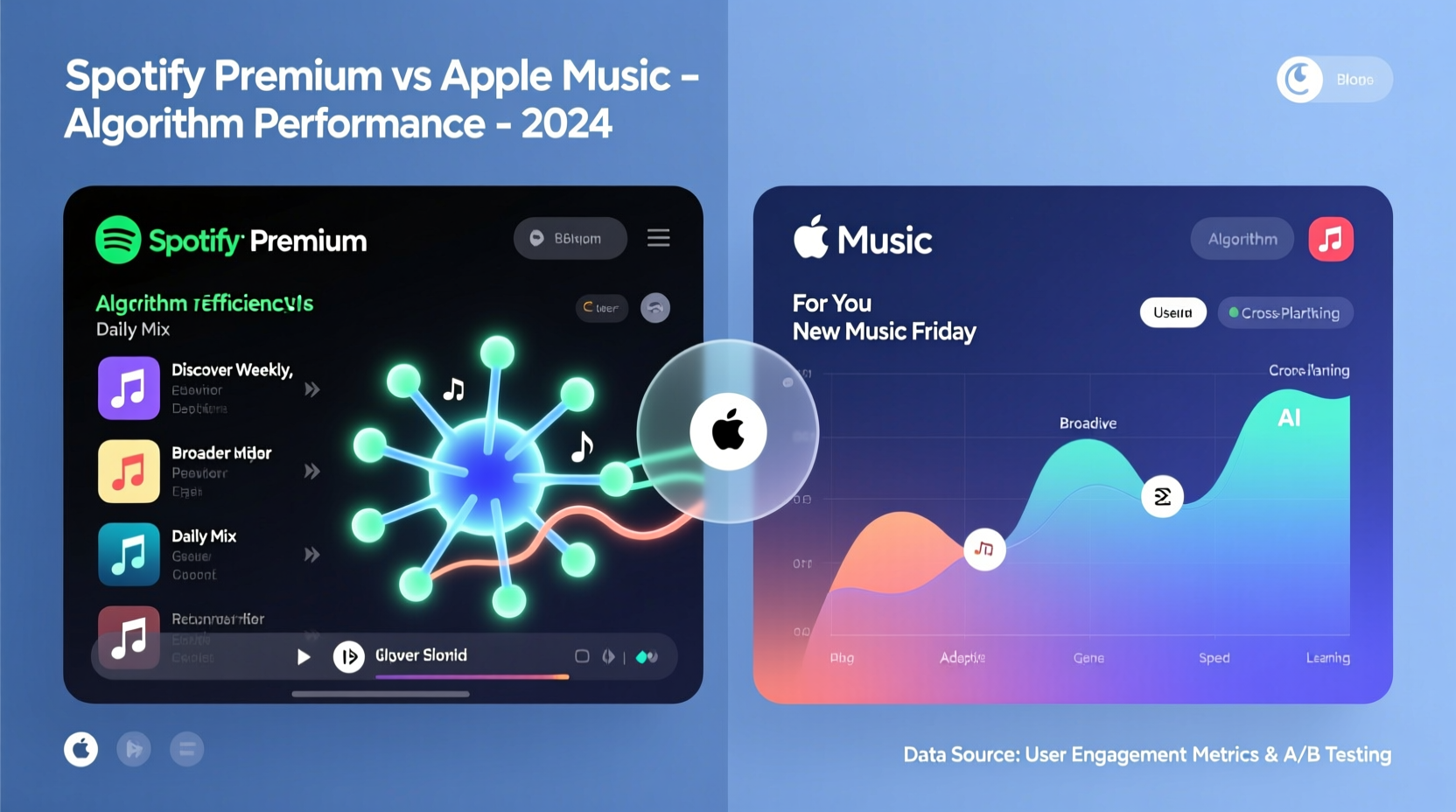
In 2024, most people don’t discover new music by flipping through radio stations or reading magazine reviews. Instead, they open an app and let algorithms do the work. These systems analyze listening history, skip rates, time of day, device type, and even acoustic properties of songs to build a dynamic profile of taste.
Spotify and Apple Music both use machine learning models, but their philosophies differ. Spotify leans heavily into data science, treating music as a vast behavioral dataset. Apple Music, rooted in human curation, integrates editorial input with algorithmic logic. The result? Two distinct experiences: one driven by pattern recognition, the other by expert taste guided by automation.
Consider this: Spotify generates six personalized playlists weekly for most users, including Discover Weekly, Release Radar, and Daily Mixes. Apple Music offers fewer algorithm-driven playlists—mainly “Favorites Mix,” “New Music Mix,” and “Radio Mix”—and emphasizes hand-curated playlists like “Today’s Hits” or genre-specific collections.
How Spotify’s Algorithm Excels at Personalization
Spotify’s recommendation engine is widely regarded as the industry leader. It combines collaborative filtering (comparing your behavior to similar users), natural language processing (analyzing blog posts, reviews, and social chatter about songs), and audio modeling (examining tempo, key, loudness, and instrumentation).
The standout feature is Discover Weekly, a 30-song playlist refreshed every Monday. Launched in 2015, it became a cultural phenomenon—not just for its accuracy, but for its ability to surface obscure tracks from niche genres that align perfectly with individual taste. Users often report finding underground artists they instantly connect with, thanks to subtle sonic similarities rather than popularity metrics.
A 2022 internal study by Spotify revealed that over 60% of streams on Discover Weekly come from tracks users had never listened to before. That level of effective discovery is rare. Moreover, Spotify tailors multiple versions of the same playlist based on region, language, and micro-genres, increasing relevance.
Daily Mixes go further by clustering your library into thematic groups—say, indie rock from the 2010s, chill lo-fi beats, or pop-punk throwbacks—and blending them with recommendations. This creates a seamless bridge between known favorites and new possibilities.
“Spotify doesn’t just play what you like—it predicts what you’ll love before you know it exists.” — Dr. Lena Park, Computational Musicologist at Berklee College of Music
Apple Music’s Approach: Human Touch Meets Machine Learning
Apple Music takes a different path. While it uses algorithms, its foundation is editorial curation. Real DJs and music experts at Apple create playlists, host radio shows (like Zane Lowe’s interviews), and select emerging artists for spotlight features.
Their algorithmic offerings are less frequent and less granular. The “New Music Mix” updates weekly and focuses on recently released tracks tailored to your preferences. “Favorites Mix” blends your top artists with similar ones. But unlike Spotify, there’s no equivalent to Discover Weekly—no deep-cut exploration of non-mainstream content.
Where Apple shines is context. Its “Spatial Audio” integration and lossless streaming appeal to audiophiles, and its curated playlists often feel more cohesive, like albums designed by tastemakers. For example, “Up Next” highlights rising artists across genres, giving exposure to voices that might not surface through pure data analysis.
However, reliance on human curation means slower adaptation. If your taste shifts dramatically—from classical to hyperpop, say—Apple Music may take weeks to catch up. Spotify, with its constant data ingestion, adjusts within days.
Side-by-Side Comparison: Algorithm Features at a Glance
| Feature | Spotify Premium | Apple Music |
|---|---|---|
| Personalized Weekly Playlist | Discover Weekly (30 songs, deep cuts) | New Music Mix (varies, newer releases) |
| Ongoing Personal Mixes | Daily Mix 1–6 (genre/taste-based) | Favorites Mix (updated weekly) |
| New Release Focus | Release Radar (weekly, personalized) | New Music Mix + My New Music Playlists |
| Algorithm Depth | High (NLP, audio analysis, user clusters) | Moderate (behavioral + editorial blend) |
| Human Curation Integration | Playlist collaborations, editorial picks | Strong (radio hosts, themed playlists) |
| Adaptability to Taste Shifts | Fast (days) | Slower (weeks) |
| Obscure Artist Discovery | Excellent | Limited |
Real User Experience: A Case Study in Algorithmic Impact
Jamila R., a 29-year-old graphic designer in Portland, switched from Apple Music to Spotify Premium after two years primarily using Apple. Her reason? “I wasn’t discovering anything new.”
“I loved the sound quality on Apple, and I followed some cool playlists,” she said. “But every week, it felt like the same loop. When I tried Spotify, Discover Weekly introduced me to three artists I now listen to daily—one was a Finnish folk-electronica project I’d never have found otherwise.”
Within a month, Jamila’s listening habits shifted. She spent less time searching and more time exploring. Spotify’s Blend feature, which merges your taste with a friend’s, also deepened her social connection to music. “It started showing us shared obsessions we didn’t even know we had,” she added.
This kind of transformation is common among users who prioritize discovery. For those who already know exactly what they want—classical collectors, podcast listeners, or fans of specific decades—Apple Music’s consistency may suffice. But for explorers, Spotify’s algorithm acts as a true co-pilot.
When Apple Music’s System Works Better
It’s important to acknowledge scenarios where Apple Music holds its ground—or even wins. If you value high-fidelity audio, Apple’s lossless and spatial audio options give it a technical edge. Audiophiles often report a warmer, more detailed sound profile.
Additionally, Apple Music excels in continuity for iPhone-centric households. Siri integration, Family Sharing, and seamless handoff between devices make it convenient. And for fans of mainstream pop, hip-hop, or country, Apple’s curated playlists like “A-List Pop” or “Rap Life” are well-maintained and timely.
Moreover, Apple’s algorithm avoids some pitfalls of hyper-personalization. Spotify can occasionally trap users in feedback loops—recommending endless variations of the same subgenre. Apple’s human-guided approach introduces diversity by design, nudging listeners toward broader trends rather than micro-niches.
Step-by-Step: How to Test Which Algorithm Suits You
You don’t need to commit long-term to judge which service’s algorithm works better for you. Follow this timeline over two weeks:
- Week 1: Reset & Observe (Spotify)
Create a free Spotify account. Listen actively for 3–4 days, skipping tracks you dislike and saving those you enjoy. Note the next Discover Weekly (released Monday) for relevance. - Day 5–7: Engage with Mixes
Check your Daily Mixes. Are they blending old favorites with compelling new suggestions? Rate accuracy from 1–10. - Week 2: Repeat on Apple Music
Start a free trial of Apple Music. Add favorite songs, follow playlists, and play music across times of day. Let it learn your habits. - Day 12–14: Evaluate New Music Mix & Favorites Mix
Are the songs surprising yet enjoyable? Do they reflect recent listens accurately? - Final Assessment
Compare: Which service made you say “I need to save this” more often? Which felt stagnant? Base your decision on emotional engagement, not features.
FAQ: Common Questions About Music Algorithms
Does Spotify sell my listening data to third parties?
No. Spotify does not sell personal listening data. It uses aggregated, anonymized data for ad targeting and product improvement, but individual histories are protected under GDPR and CCPA regulations.
Can I improve Apple Music’s recommendations?
Yes. Like any algorithm, it learns from interaction. Rate songs with thumbs up/down (via the “…” menu), add tracks to your library, and avoid skipping too quickly. Over time, accuracy improves.
Why does Spotify recommend songs I’ve already skipped?
This happens when the algorithm identifies strong acoustic or contextual matches despite your rejection. Clearing your cache, resetting preferences, or adjusting listening diversity can reduce repetition.
Conclusion: Algorithm Alone May Be Enough to Choose Spotify
If music discovery is central to your enjoyment—if you crave the thrill of finding a song that feels tailor-made—then yes, Spotify Premium is worth it over Apple Music for the algorithm alone. Its combination of data depth, adaptive learning, and innovative playlist formats consistently outperforms Apple’s more conservative, editorial-first model.
That doesn’t mean Apple Music is obsolete. For listeners who value sound quality, ecosystem integration, and trusted human curation, it remains a strong contender. But when it comes to the magic of surprise, the joy of stumbling upon something unknown yet deeply resonant, Spotify’s algorithm sets the standard.
The best music service isn’t the one with the most songs or the lowest price. It’s the one that makes you feel understood. And right now, Spotify listens a little closer.




 浙公网安备
33010002000092号
浙公网安备
33010002000092号 浙B2-20120091-4
Comments
No comments yet. Why don't you start the discussion?