
In an era where convenience is just a click away, digital subscriptions have become the backbone of modern consumption. From streaming platforms and meal kits to cloud storage and fitness apps, recurring payments quietly weave through our monthly budgets. While individually these charges may seem negligible—$9.99 here, $14.99 there—the cumulative effect can be staggering. This phenomenon, known as \"subscription fatigue,\" isn't just a buzzword; it's a growing financial and psychological burden affecting millions.
Subscription fatigue refers to the mental exhaustion and financial strain caused by managing too many recurring services, many of which are underused or forgotten. The ease of signing up often contrasts sharply with the difficulty of canceling, leading to what economists call \"passive spending.\" Over time, this can erode savings, distort budget priorities, and even contribute to financial anxiety.
The good news? You’re not powerless. With a systematic audit of your monthly spending, you can reclaim control, eliminate waste, and redirect funds toward goals that truly matter. This guide walks you through the reality of subscription fatigue, its hidden costs, and a practical framework to streamline your expenses.
The Hidden Cost of Convenience
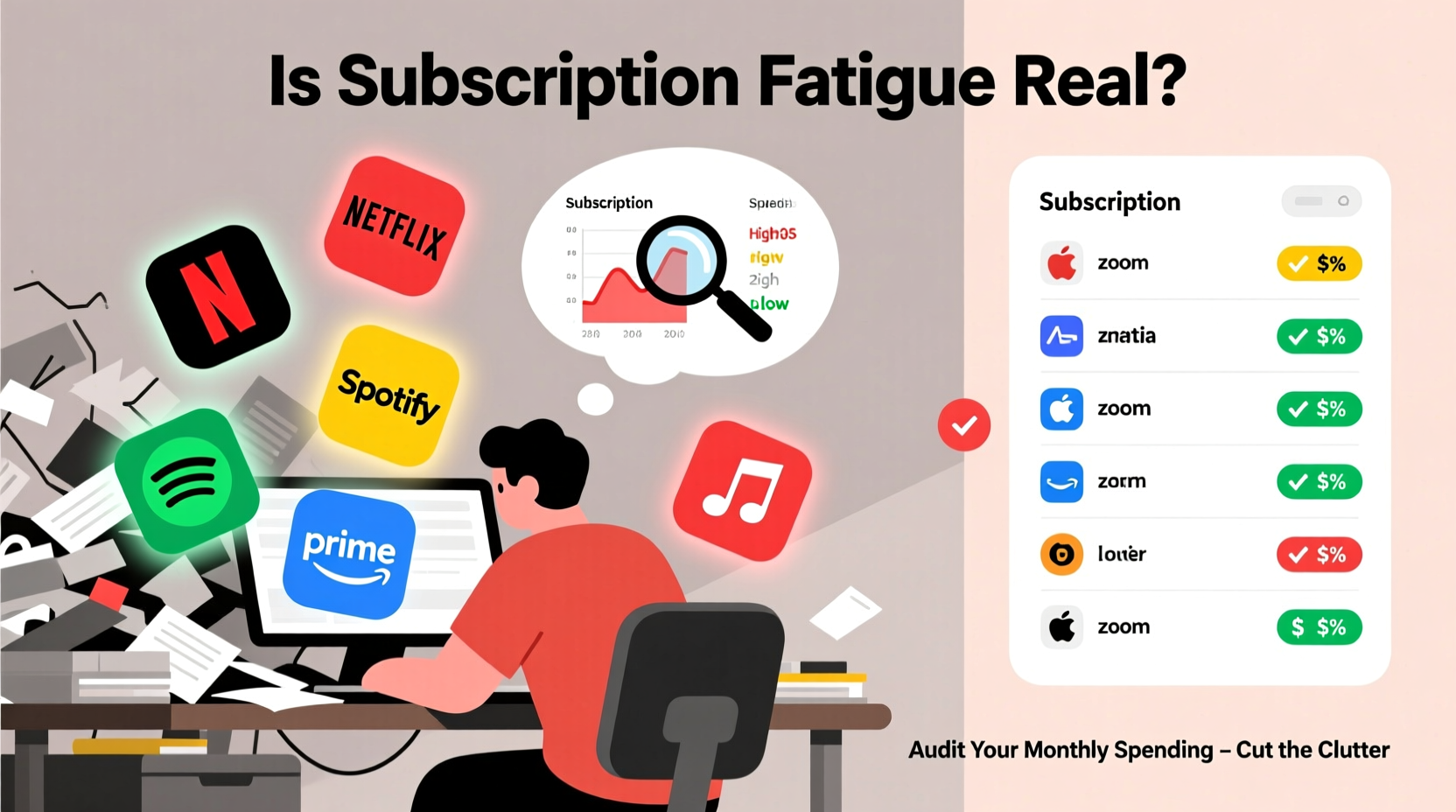
What makes subscription models so effective for businesses also makes them dangerous for consumers: frictionless access. Auto-renewals, free trials that convert to paid plans, and bundled offers create a perfect storm for overlooked spending. A 2023 study by McKinsey found that the average U.S. household spends over $500 per month on subscriptions—nearly 10% of median monthly income. Alarmingly, nearly 40% of that spending goes toward services used less than once a week.
This isn’t just about money. Subscription fatigue has cognitive consequences. Decision fatigue sets in when we're constantly reminded—via emails, notifications, or login prompts—that we’re paying for something. The guilt of unused memberships, the annoyance of tracking renewal dates, and the confusion over overlapping services (like having both Spotify and Apple Music) all contribute to mental clutter.
Step-by-Step Guide: How to Audit Your Monthly Subscriptions
A subscription audit isn’t just about cutting costs—it’s about aligning spending with actual value. Follow this five-step process to gain clarity and make intentional choices.
- Gather All Billing Statements
Collect bank statements, credit card summaries, and digital wallet histories (Apple Pay, Google Pay, PayPal) from the last three months. Use online banking tools to export transaction data if possible. - List Every Recurring Charge
Create a master list of every subscription. Include the service name, monthly cost, renewal date, payment method, and primary user (if shared). Don’t overlook app store subscriptions, domain renewals, or donation-based memberships. - Categorize and Evaluate Usage
For each item, ask: When did I last use this? Did I get my money’s worth? Is there overlap with another service? Rate each on a scale of 1–5 based on utility and satisfaction. - Identify Redundancies and Free Alternatives
Spot duplicates (e.g., multiple cloud storage plans) or services with robust free tiers (e.g., YouTube instead of a premium music app). Consider pausing rather than canceling some to test dependency. - Cancel, Consolidate, or Negotiate
Cancel low-value subscriptions immediately. For high-use services, explore family plans or annual discounts. Some providers will offer retention deals if you threaten to leave.
Common Subscription Traps (and How to Avoid Them)
Even financially savvy people fall into predictable traps. Awareness is the first defense.
- Free Trial Pitfalls: Many services require payment details upfront. If you forget to cancel before the trial ends, you’re automatically charged. Always set a reminder on the day the trial expires.
- Bundled Services: Providers like Amazon Prime or Disney+ bundle video, music, shipping, and gaming. While appealing, you may only use one component. Audit each layer separately.
- Shared Family Plans: These can save money but complicate accountability. Without clear communication, members may assume someone else canceled their share—or worse, keep using it after leaving the plan.
- App Store Blind Spots: iOS and Android subscriptions renew silently. Check your device settings regularly under “Subscriptions” to catch forgotten charges.
“Consumers underestimate subscription creep because the charges are small and automated. But over 18 months, $15/month becomes $270—enough for a flight, a new laptop, or three months of rent.” — Laura Simmons, Behavioral Economist at Northwestern University
Real Example: How Sarah Reduced Her Spending by 60%
Sarah, a 34-year-old graphic designer in Portland, noticed her checking account balance dwindling despite steady income. She wasn’t dining out more or shopping excessively, yet money disappeared each month.
After logging her transactions, she discovered 17 active subscriptions totaling $483. Among them: two streaming services ($32), a design software suite ($59), a meditation app ($13), a meal delivery box ($65), and a language-learning platform she hadn’t opened in six months ($18).
She audited each based on usage. The design tool was essential for work. Netflix stayed due to weekly viewing. But she canceled duplicate cloud storage, paused the meal kit during busy weeks, and switched to the free tier of her language app. She also negotiated a discounted annual rate on her meditation service, reducing it by 30%.
Within a month, Sarah cut her subscription spending to $192—a 60% reduction. She redirected the savings into an emergency fund and a Roth IRA, turning passive spending into long-term growth.
Subscription Audit Checklist
- Day 1: Export all bank and credit card statements from the last 90 days
- Day 2: Identify and list every recurring charge (include app stores and PayPal)
- Day 3: Categorize subscriptions (entertainment, productivity, lifestyle, etc.)
- Day 4: Rate each by usage frequency and perceived value (1–5 scale)
- Day 5: Cancel at least three low-value subscriptions
- Day 6: Switch two services to annual billing (if cheaper) or family plans
- Day 7: Set up alerts for renewal dates and schedule a quarterly review
Do’s and Don’ts of Subscription Management
| Do | Don’t |
|---|---|
| Use a spreadsheet or budgeting app to track all subscriptions | Assume free trials won’t lead to charges |
| Set calendar alerts for renewal dates | Keep multiple services that do the same thing |
| Negotiate with providers for better rates | Ignore small charges—they add up fast |
| Review your list quarterly | Share payment methods without clear agreements |
FAQ: Common Questions About Subscription Fatigue
How do I find hidden subscriptions I’ve forgotten about?
Start by reviewing bank and credit card statements line by line. Look for recurring charges from names like “*Apple.com/bill,” “*Google Services,” or “*Stripe.” Also check your email for receipts or welcome messages from services you may have signed up for temporarily. On mobile devices, go to Settings > [Your Name] > Subscriptions (iOS) or Play Store > Subscriptions (Android) to see active plans tied to your account.
Is it okay to keep subscriptions I rarely use?
Only if they bring meaningful value. Occasional use isn’t inherently wasteful—if a service provides peace of mind, professional backup, or emotional benefit (e.g., a journaling app during stressful times), it may be worth keeping. But if it’s purely inertia or “just in case,” consider canceling and reactivating later if needed. Most services allow easy reinstatement.
Can subscription fatigue affect my credit score?
Not directly. However, if recurring charges push your credit utilization high or cause missed payments due to insufficient funds, it can negatively impact your score. Additionally, failing to cancel trials may lead to unexpected charges that disrupt cash flow, increasing reliance on credit cards.
Regaining Control: A Sustainable Approach
Eliminating subscription fatigue isn’t a one-time purge—it’s a shift in mindset. The goal isn’t austerity but intentionality. Every dollar spent should serve a purpose, whether it’s entertainment, education, or efficiency.
Build sustainability into your system. Designate one day per quarter for a “subscription sweep.” Use tools like Rocket Money, Truebill, or Monarch Money to automatically flag recurring charges. Share family plans with clear contribution rules. And most importantly, give yourself permission to cancel without guilt. Letting go of unused services isn’t failure; it’s financial maturity.
Remember, convenience should simplify life—not complicate it. By auditing your spending, you’re not just saving money. You’re reclaiming time, focus, and peace of mind.




 浙公网安备
33010002000092号
浙公网安备
33010002000092号 浙B2-20120091-4
Comments
No comments yet. Why don't you start the discussion?