
The Nintendo Switch has redefined how we play games—blending home console power with portable freedom. Since its 2017 debut, it’s evolved through hardware revisions, OLED upgrades, and a growing library of must-play titles. Now, with whispers of a “Switch Pro” circulating for years and a refreshed base model released in 2023, gamers face a real dilemma: Should you buy the current Switch now, or hold out for a more powerful successor?
This decision isn’t just about specs. It involves timing, budget, gaming habits, and how much future-proofing matters to you. Let’s examine the facts, separate hype from reality, and give you a clear roadmap to make the right choice.
Understanding the Current Lineup: What’s Available Today
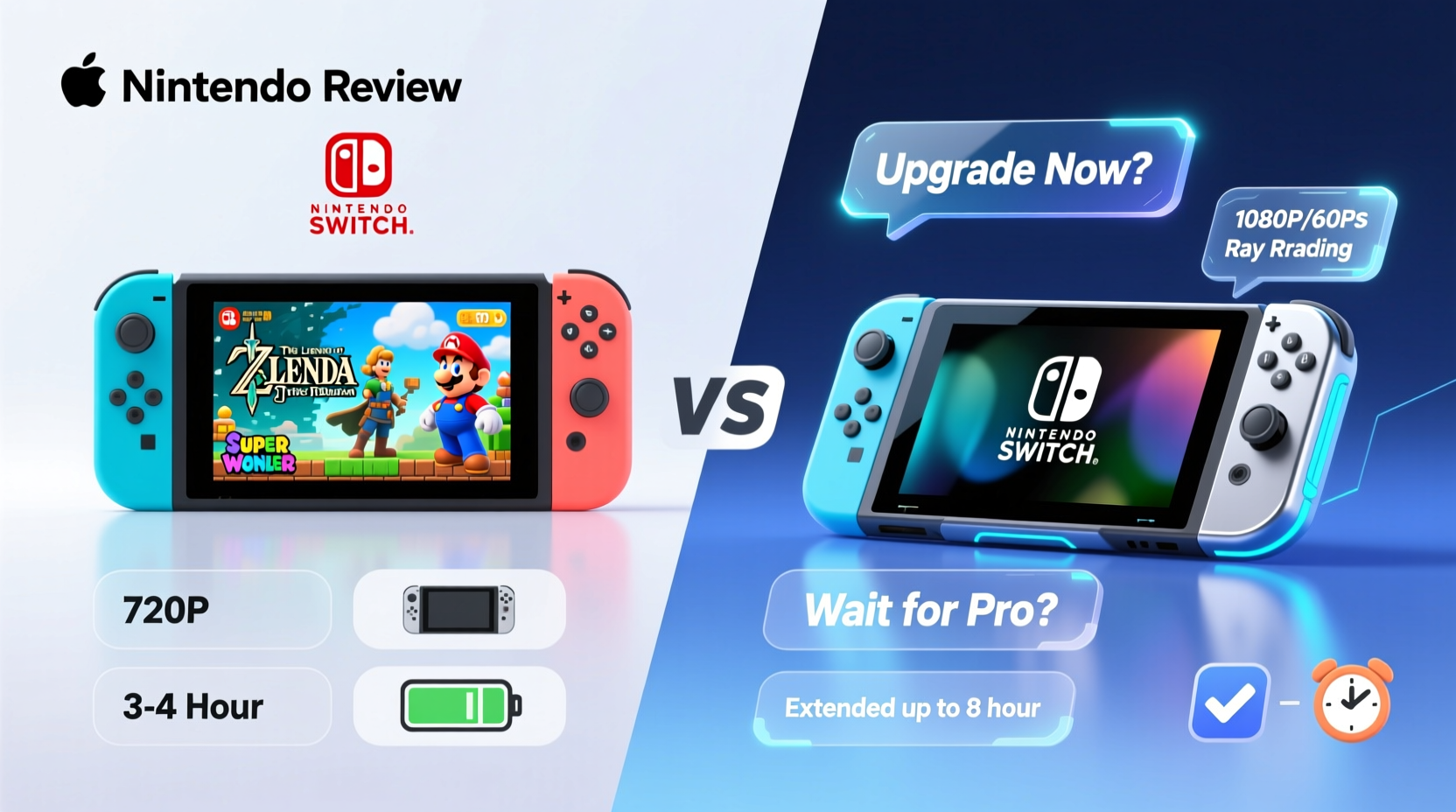
As of 2024, Nintendo offers two primary models: the standard Nintendo Switch (revised 2023) and the Nintendo Switch OLED. There is no official “Pro” model yet, despite persistent rumors and speculation.
- New Base Model (2023): This version replaced the original gray model with slightly improved battery life (up to 9 hours), but otherwise mirrors the 2017 design. It lacks the OLED screen and LAN port of the premium variant.
- Switch OLED (2021): Features a vibrant 7-inch OLED display, larger internal storage (64GB), a wider adjustable stand, and a wired LAN port on the dock. Battery life is similar to the revised base model.
Both systems run the same software, support all existing games (with rare exceptions like Labo VR requiring the original camera), and offer seamless cloud saves via Nintendo Switch Online.
What We Know About the “Switch Pro” Rumors
Rumors of a more powerful Switch successor have circulated since 2020. Referred to unofficially as the “Switch Pro” or “Switch 2,” expectations include:
- Enhanced GPU performance (potentially NVIDIA-based chip)
- Support for 4K resolution in docked mode
- Improved handheld brightness and HDR support
- Larger internal storage (128GB+)
- Potential redesign with better ergonomics or detachable Joy-Cons
However, as of mid-2024, Nintendo has not announced any such device. Industry analysts suggest a launch window between late 2024 and early 2025. Bloomberg’s Jason Schreier, a reliable source on Nintendo developments, reported that a successor is in development but will maintain backward compatibility with existing games.
“Nintendo’s next system will likely be an evolution, not a revolution—focusing on performance gains while preserving the hybrid concept.” — Jason Schreier, Bloomberg
That means your current game library, save files, and accessories may carry over. But until an official announcement, these remain educated guesses.
Performance Comparison: Is the Upgrade Necessary?
Let’s compare what you get today versus what’s expected from a future model.
| Feature | Current Switch (OLED) | Expected “Pro” Model |
|---|---|---|
| CPU/GPU Performance | Maxwell-based Tegra X1 (2015 architecture) | Updated NVIDIA chip, ~2–3x graphics boost |
| Resolution (Docked) | Up to 1080p | Targeting 4K output |
| Handheld Display | 7\" OLED, 720p | Potential HDR, higher brightness |
| Internal Storage | 64GB | 128GB or more |
| Backward Compatibility | N/A | Expected full support |
| Estimated Price | $209.99 (OLED) | $349–$399 (rumored) |
The current Switch performs admirably for its class. Games like The Legend of Zelda: Tears of the Kingdom, Metroid Dread, and Hollow Knight: Silksong push its limits but deliver polished experiences. However, some third-party ports suffer from lower frame rates and resolution compared to PlayStation or Xbox equivalents.
If you primarily play first-party Nintendo titles, the current hardware remains more than capable. The real benefit of a “Pro” model would be smoother performance in demanding indie and multiplatform games, especially those using Unreal Engine 5 or aiming for 60fps across modes.
Real-World Example: Sarah’s Dilemma
Sarah, a college student and avid gamer, wanted a portable system for dorm life and travel. She hesitated when friends told her a “better Switch” was coming. After researching forums and release cycles, she bought the OLED model during a holiday sale for $280 with three free games.
Over nine months, she logged 200+ hours in Tears of the Kingdom, played local co-op with friends using the built-in tabletop mode, and streamed indie titles from her PC via Remote Play. When asked if she regrets not waiting, she says: “I got exactly what I needed—a reliable, fun system. If a Pro comes out later, I can upgrade then. But I didn’t want to miss out on playing now.”
Her story reflects a key truth: enjoyment starts when you begin playing, not when you stop waiting.
Step-by-Step Guide: How to Decide What’s Right for You
Use this practical timeline to evaluate your options:
- Assess Your Gaming Needs (Week 1): Are you a casual player who enjoys Mario Kart and Animal Crossing? Or do you crave high-fidelity ports and competitive online play? The former doesn’t require cutting-edge hardware.
- Check Your Budget (Week 1): The OLED model costs $209. A rumored Pro could exceed $350. Factor in extra controllers, cases, and games. Can you afford to wait—and potentially pay more?
- Monitor Official Channels (Ongoing): Follow Nintendo Direct announcements. If a new console is imminent, they’ll tease it months in advance. Silence suggests at least a 6–12 month wait.
- Evaluate Game Releases (Now – 6 Months): Upcoming exclusives like Metroid Prime 4 or a potential Star Fox reboot may be timed for new hardware. But major titles often launch across both systems.
- Decide by Holiday Season (If Waiting): Historically, Nintendo announces new hardware in fall. If nothing surfaces by October 2024, a 2025 release becomes more likely—making a current purchase reasonable.
Checklist: Buy Now or Wait?
Answer these questions to guide your decision:
- ✅ Do you want to play Switch-exclusive games like Zelda, Fire Emblem, or Pikmin? → Buy now
- ✅ Do you travel often or play in short bursts? → Buy now (portability is unmatched)
- ✅ Are you frustrated by low frame rates in games like Bloodstained or Control? → Consider waiting
- ✅ Is 4K gaming important to you on your TV? → Wait for Pro
- ✅ Can you stretch your budget to $350+ later? → You can afford to wait
- ✅ Are you excited by current deals or bundles? → Buying now adds immediate value
If most of your answers are “buy now,” don’t delay. If three or more point to waiting, patience may reward you.
Frequently Asked Questions
Will my games and save data work on a future Switch Pro?
Based on Nintendo’s history and insider reports, yes—backward compatibility is expected. Your digital purchases and cloud saves should transfer seamlessly, assuming Nintendo maintains its current infrastructure.
Can I upgrade my current Switch’s storage?
Absolutely. Both current models support microSDXC cards up to 2TB. This effectively solves the 64GB limitation. Many users opt for 512GB cards under $50, making storage less of a bottleneck than performance.
Is the OLED model worth the extra cost over the base Switch?
Yes, if you value visual quality. The OLED screen offers deeper blacks, richer colors, and better visibility in sunlight. The improved kickstand and LAN port add meaningful utility. For $50 more, it’s the best consumer-ready option available today.
Final Verdict: Balancing Value, Timing, and Enjoyment
The new Nintendo Switch—particularly the OLED model—is absolutely worth buying today if you want to play great games without delay. Its library is stronger than ever, its portability is unmatched, and its price point delivers real value. Waiting for a “Pro” model makes sense only if you prioritize technical performance, future 4K gaming, or believe a significant leap is arriving within six months.
But consider this: The original Switch launched without Zelda: Breath of the Wild being complete. Critics questioned its power. Yet, it became one of the best-selling consoles of all time because it offered something unique—freedom to play anywhere, with anyone. That philosophy hasn’t changed.
Nintendo’s strength lies in gameplay innovation, not raw horsepower. Whether it’s solving puzzles in Tetris 99, exploring vast landscapes in Pikmin 4, or racing friends in Mario Kart 8 Deluxe, the joy is in the experience, not the spec sheet.
“The Switch isn’t about competing on resolution. It’s about removing barriers between you and play.” — Reggie Fils-Aimé, Former President of Nintendo of America
If you’re ready to dive into one of the richest game libraries in modern console history, the time to buy is now. If you're holding out for higher fidelity and don't mind missing months of play, keep an eye on Nintendo’s announcements—but don’t assume a Pro model will change everything.
Conclusion: Make Your Move With Confidence
The question isn’t whether the new Switch is perfect—it’s whether it’s good enough to bring you joy. For millions of players, the answer is a resounding yes. You don’t need the fastest processor to feel wonder in Hyrule or laughter during a family game night.
If you’ve been thinking about joining the Switch community, stop waiting. Pick up the OLED model on sale, grab a microSD card, and download a game that excites you. The best time to start playing was yesterday. The second-best time is right now.




 浙公网安备
33010002000092号
浙公网安备
33010002000092号 浙B2-20120091-4
Comments
No comments yet. Why don't you start the discussion?