
For years, holiday lighting has been a balancing act between spectacle and simplicity. Many homeowners rely on basic smart plugs to automate their Christmas lights—plugging in strands, setting schedules, and calling it a night. But with the release of Philips Hue’s new synchronized outdoor lighting system, a more immersive experience is now possible. The question isn’t whether the tech works—it does—but whether the upgrade justifies the cost and complexity for the average user.
The answer depends on your expectations, budget, and how much you value ambiance over automation. While smart plugs offer convenience, Hue’s ecosystem delivers choreography: lights that pulse with music, shift colors in sequence, and respond to motion or sunrise. But does syncing your roofline to Mariah Carey’s “All I Want for Christmas Is You” warrant a $200+ investment when a $15 plug can turn your lights on at dusk?
Understanding the Core Differences
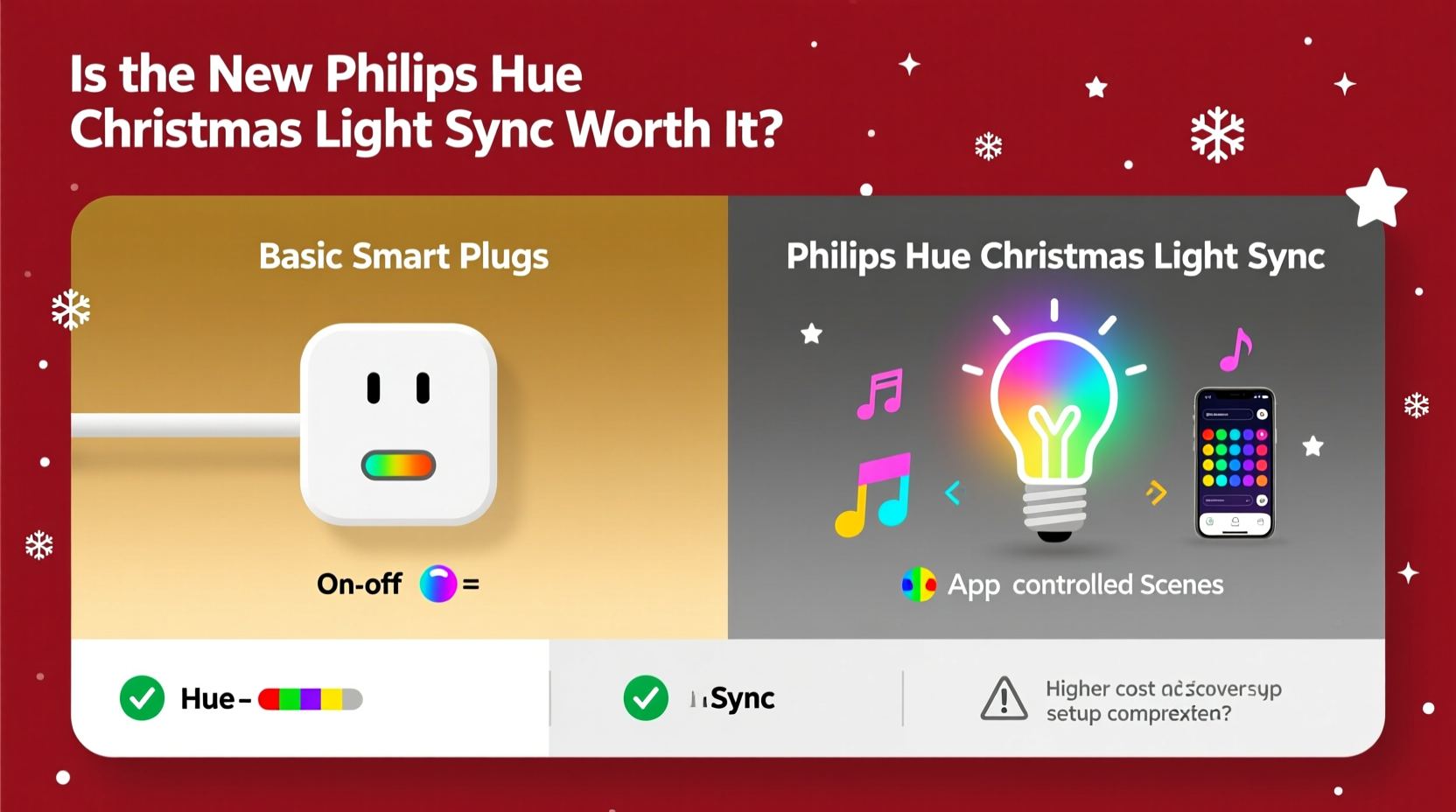
At first glance, both systems control when your lights turn on. But their capabilities diverge sharply beyond that.
Basic smart plugs are simple on/off switches controlled via Wi-Fi and an app. You set timers, use voice commands through Alexa or Google Assistant, or trigger them remotely. They work with any string of lights—incandescent, LED, colored, white—and require no special bulbs. Their strength lies in universality and affordability.
In contrast, the new Philips Hue Christmas light sync feature relies on a full ecosystem: Hue Bridge, compatible outdoor light strips or string lights, and the Hue app. It enables dynamic color transitions, brightness gradients, and audio-reactive effects. These aren't just scheduled lights—they're animated displays calibrated to mood, music, or motion.
The fundamental difference isn’t automation—it’s expression. A smart plug gives you timing. Hue gives you theater.
“Lighting is no longer just functional—it's emotional. Synchronized lighting transforms homes into experiences.” — David Lin, Smart Home Lighting Designer at IllumiTech Studios
Performance Breakdown: What Syncing Actually Delivers
To evaluate whether Hue’s sync is worth it, consider what it adds beyond basic control:
- Music synchronization: Lights react in real time to audio played through your phone or speaker, pulsing with basslines or fading with melodies.
- Scene presets: Choose from pre-designed effects like “Falling Snow,” “Twinkling Stars,” or “Warm Glow” that go beyond static colors.
- Multi-zone control: Control different sections of your display independently—eaves, trees, porch railings—with unique behaviors.
- Geofencing & ambient triggers: Lights activate based on your location, sunset/sunrise, or even weather conditions (via integrations).
- Scheduling with nuance: Not just “on at 5 PM,” but “fade in over 30 minutes at dusk, then switch to party mode at 7.”
These features transform seasonal lighting from a routine task into a curated event. For families who host holiday gatherings, or enthusiasts who enjoy decorating as a creative outlet, this level of control adds tangible enjoyment.
Cost Comparison: Plug-and-Play vs. Full Ecosystem
Let’s compare typical setups:
| Component | Smart Plug Setup | Philips Hue Setup |
|---|---|---|
| Controller | Kasa Smart Plug ($15) | Hue Bridge ($60) + Hue App (free) |
| Outdoor Lights | Generic LED string lights ($20) | Hue Lightstrip Outdoor + Power Supply ($120) |
| Expansion (per additional strand) | $20 per string | $45–$80 per extension kit |
| Music Sync | Not supported | Yes, via Bluetooth audio input |
| Total (basic setup) | $35 | $180+ |
The price gap is significant. For less than the cost of a single Hue lightstrip, you could buy five smart plugs and ten sets of traditional lights. However, Hue’s durability and energy efficiency offset some long-term costs. Hue LEDs last up to 25,000 hours and consume about 30% less power than standard strings. Plus, they’re built for all-weather outdoor use with IP67 ratings.
Still, the upfront investment is steep. Unless you plan to expand your display over multiple seasons or integrate with a broader smart home system, the ROI is questionable.
Real-World Example: The Johnson Family Upgrade
The Johnsons in suburban Minneapolis had used basic timer plugs for their holiday lights for eight years. Their setup included three roofline strings and two tree wraps—nothing elaborate. Last November, their teenage daughter convinced them to try the Hue Outdoor Lightstrip after seeing a TikTok of a house synced to “Jingle Bell Rock.”
They installed a 6.6-foot strip along their front eave, connected it to a Hue Bridge, and paired it with a portable Bluetooth speaker. On launch night, they played holiday music while the lights pulsed in rhythm—shifting from red to green with each beat, dimming during verses, flaring on choruses.
Neighbors stopped to watch. Kids across the street pointed. The local Nextdoor group lit up with comments. For the Johnsons, it was no longer just decoration—it was entertainment.
But by January, enthusiasm waned. The music sync required manual activation. The app occasionally disconnected. And replacing the entire system if one segment failed felt daunting. Still, they kept it. “It made December feel magical,” said Mark Johnson. “Worth every penny for those four weeks.”
Their experience reflects a key insight: Hue’s value isn’t in daily utility, but in momentary delight.
When the Upgrade Makes Sense (And When It Doesn’t)
Consider these scenarios before investing:
Upgrade if you…
- Host annual holiday parties or open houses.
- Already use other Hue products indoors (bulbs, lamps).
- Enjoy customizing scenes and experimenting with lighting design.
- Want to integrate with Apple Home, Google Home, or Alexa routines.
- Plan to reuse the system for year-round ambiance (e.g., garden lighting).
Stick with smart plugs if you…
- Only want reliable on/off scheduling.
- Use multiple different light types (novelty shapes, icicle strands).
- Have a tight holiday budget.
- Prefer simple, one-app control without bridges or hubs.
- Don’t mind manually swapping out lights each season.
Step-by-Step: Evaluating Your Needs
Follow this timeline to decide whether Hue sync is right for you:
- Week 1: Audit your current setup. List your lights, outlets, and control methods. Note pain points (e.g., forgotten turn-ons, tangled cords).
- Week 2: Define your goals. Do you want reliability, beauty, interactivity, or all three? Rank them.
- Week 3: Research compatibility. Confirm your Wi-Fi range outdoors, check Hue’s outdoor rating requirements, and ensure your phone supports Bluetooth LE for sync.
- Week 4: Test a hybrid model. Keep one section on a smart plug, install one Hue strip. Compare ease of use and visual impact.
- December: Evaluate joy vs. effort. During the season, track how often you change scenes, use music sync, or receive compliments. Was it worth the hassle?
- January: Decide. Based on usage and satisfaction, choose to expand, revert, or maintain.
Frequently Asked Questions
Can I use Philips Hue sync with non-Hue lights?
No. Music sync and advanced effects only work with official Hue outdoor products connected through the Hue Bridge. Third-party Zigbee lights may function for basic on/off but won’t support dynamic scenes.
Do I need the Hue Bridge for sync?
Yes. While some Hue bulbs work directly via Bluetooth, outdoor sync features—including multi-light coordination and scheduling—require the Hue Bridge. Without it, you lose nearly all advanced functionality.
Are Hue outdoor lights durable in extreme weather?
Yes. Hue Outdoor Lightstrips have an IP67 rating, meaning they’re dust-tight and can withstand immersion in water up to 1 meter for 30 minutes. They’re tested for temperatures from -4°F to 122°F (-20°C to 50°C), making them suitable for most climates.
Final Checklist Before Upgrading
- ✅ Confirm outdoor Wi-Fi or Ethernet access near installation point.
- ✅ Purchase Hue Bridge if you don’t already own one.
- ✅ Measure total linear feet of lighting needed.
- ✅ Buy appropriate connectors and mounting clips for outdoor surfaces.
- ✅ Test audio sync indoors first to understand latency and responsiveness.
- ✅ Plan storage method for off-season (coiled neatly, dry, temperature-stable).
Conclusion: Magic Has a Price—Is Yours Ready to Pay It?
The Philips Hue Christmas light sync isn’t a practical upgrade—it’s an emotional one. It doesn’t solve a problem so much as elevate an experience. If your goal is simply to have lights on when it gets dark, a $15 smart plug remains the smarter choice. But if you crave wonder—if you want your home to shimmer like snowfall or dance like a disco ball under the stars—then Hue offers something rare: digital craftsmanship that feels human.
Technology like this isn’t judged solely by cost-per-feature. It’s measured in smiles from passersby, in children pausing to watch the lights breathe with a carol, in the quiet pride of creating something beautiful. For some, that’s priceless.
If you’re on the fence, start small. Try one strip. Host one synced evening. Let the lights speak for themselves. You’ll know within minutes whether the magic is real—and whether it belongs on your roof next December.




 浙公网安备
33010002000092号
浙公网安备
33010002000092号 浙B2-20120091-4
Comments
No comments yet. Why don't you start the discussion?