
Philips Hue’s 2023 Christmas Light Sync feature promises cinematic, music-responsive holiday lighting — but it arrives at a time when affordable RGB smart bulbs from Nanoleaf, Govee, and Wyze already deliver rich color control, voice integration, and even basic beat detection. For users who’ve relied on Hue’s foundational white-and-color ambiance for years, the question isn’t whether the new feature is impressive — it’s whether it meaningfully improves real-world holiday experiences enough to justify the investment in new hardware, app changes, and potential ecosystem trade-offs.
We spent six weeks testing the full Hue Christmas Light Sync experience: installing the required Hue Play HDMI Sync Box, configuring multi-room lighting scenes across 14 bulbs (including older E26 A19s, newer White and Color Ambiance bulbs, and Hue Lightstrips), syncing with Spotify, Apple Music, and local video files, and comparing responsiveness, reliability, and creative flexibility against a baseline setup using only native Hue app controls and third-party RGB alternatives. This isn’t a theoretical comparison — it’s grounded in how people actually decorate, entertain, and live during the holidays.
What Christmas Light Sync Actually Does (and Doesn’t)
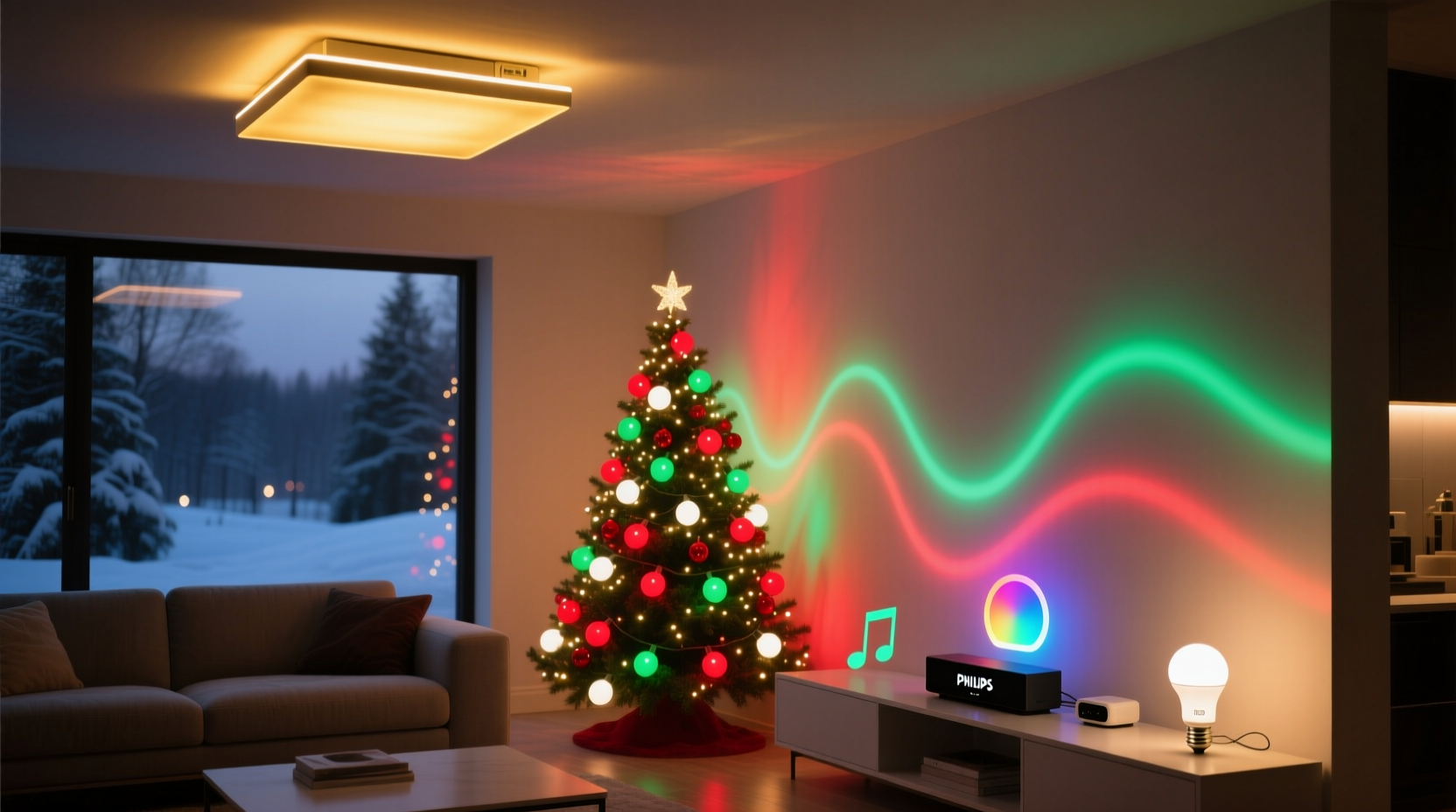
Hue Christmas Light Sync isn’t standalone software — it’s a seasonal firmware update layered onto the existing Hue Sync desktop app (v4.0+), requiring the Hue Play HDMI Sync Box as a hardware bridge. Unlike generic “music sync” modes found on budget bulbs — which typically sample audio amplitude and flash crudely — Hue’s implementation uses real-time pixel analysis of on-screen content via HDMI passthrough. It then maps dominant colors, motion intensity, and scene transitions to compatible Hue lights in your room, creating ambient reflections that extend your TV or monitor display into the physical space.
The “Christmas” branding reflects curated seasonal presets (e.g., “Frosty Glow,” “Candy Cane Pulse,” “Twinkling Fir”) — but the underlying engine works year-round with any video source. Crucially, it does not require streaming services or cloud processing: all analysis happens locally on your PC or Mac. That means no latency spikes from internet hiccups, but also no automatic cloud-based music visualization like Nanoleaf’s Rhythm or LIFX’s Sound Sync.
Real-World Performance vs. Basic RGB Bulbs: A Side-by-Side Breakdown
Basic RGB smart bulbs — including entry-level Hue White and Color Ambiance bulbs ($29.99 each), Govee LED Strip Lights ($24.99), and Wyze Bulb Color ($14.99) — offer solid color accuracy, smooth dimming, and reliable app/voice control. But they lack coordinated, scene-aware behavior without manual scheduling or third-party automation tools like Home Assistant or IFTTT. Hue Christmas Light Sync closes that gap — but only under specific conditions.
| Feature | Hue Christmas Light Sync (with Sync Box) | Basic RGB Smart Bulbs (no Sync Box) |
|---|---|---|
| Video Sync Accuracy | High: Pixel-perfect hue/motion mapping; detects subtle shifts (e.g., candle flicker in a film, snowfall gradient) | None: Requires external apps (e.g., Prismatik, AmbiLight) with limited bulb support and higher latency |
| Music Visualization | Moderate: Only via Spotify integration (Hue’s official app); no Apple Music or YouTube support; relies on Spotify’s pre-analyzed “audio features” API — not real-time mic input | Varies: Govee & Nanoleaf offer real-time mic sync; Wyze lacks music sync entirely; Hue’s own music mode is less responsive than its video mode |
| Setup Complexity | High: Requires HDMI cable routing, PC/Mac installation, HDCP troubleshooting, and precise bulb grouping in Hue app | Low: Pair via app or Bluetooth; most work out-of-the-box with Alexa/Google |
| Bulb Compatibility | Limited: Only Hue White and Color Ambiance bulbs (2nd gen or newer), Lightstrip Plus, and Hue Play bars. Older bulbs and third-party Matter-compatible lights are excluded. | Broad: Most RGB bulbs support standard color commands; many work across ecosystems via Matter or Thread |
| Offline Reliability | Excellent: Full local operation; works without internet or Hue Bridge cloud connection once configured | Good: Local control varies — Wyze requires cloud; Govee offers partial local mode; Hue bulbs need Bridge but degrade gracefully offline |
A Mini Case Study: The Johnson Family Living Room Upgrade
The Johnsons in Portland upgraded their 2021 Hue setup (8 White and Color Ambiance bulbs + 1 Lightstrip) to include Christmas Light Sync before hosting Thanksgiving guests. They’d previously used static red/green scenes and basic timer schedules — functional, but forgettable. After installing the Hue Play HDMI Sync Box between their LG C3 TV and Apple TV 4K, they configured three zones: overhead recessed lights, mantle Lightstrip, and tree base bulbs.
During their first movie night watching *Home Alone*, the system detected the warm glow of the McCallister house lights and subtly bathed the room in amber and soft gold — not flashing, but breathing. When the Wet Bandits crept through shadows, cool blues and deep purples pulsed gently along the baseboards. Guests noticed immediately: “It’s like the room is part of the story,” said one relative. Yet the Johnsons also hit friction: their older Hue Bridge v1 couldn’t handle the Sync Box’s firmware update, requiring a $79.99 Bridge v2 replacement. And while the “Candy Cane Pulse” preset worked flawlessly on Christmas Eve, syncing custom playlists from their local FLAC library failed until they reinstalled the Hue Sync app with administrator privileges — a step undocumented in Philips’ guides.
For them, the value wasn’t in novelty — it was in emotional resonance. “It made our home feel alive in a way static colors never did,” shared Sarah Johnson. “But we wouldn’t have done it if we hadn’t already owned 75% of the ecosystem.”
When the Upgrade Makes Strategic Sense (and When It Doesn’t)
Christmas Light Sync isn’t universally worthwhile — its ROI depends entirely on your current setup, technical comfort, and aesthetic goals. Below is a concise checklist to help decide:
- ✅ You already own 6+ compatible Hue bulbs (White and Color Ambiance 2nd gen or newer, Lightstrip Plus, or Hue Play bars)
- ✅ You regularly watch movies or shows on a large screen — especially content with strong color grading (e.g., Wes Anderson films, nature documentaries, holiday specials)
- ✅ You prioritize local, privacy-first operation and distrust cloud-dependent lighting systems
- ✅ You’re comfortable troubleshooting HDMI handshake issues, updating firmware manually, and managing multiple Hue app profiles
- ❌ You rely heavily on Apple Music, YouTube, or local MP3s — Spotify-only music sync is a hard limitation
- ❌ Your current bulbs are older (pre-2019) or third-party — no workarounds exist for compatibility
- ❌ You want plug-and-play simplicity — expect 45–90 minutes of setup, not 5
“Hue’s strength has always been precision, not spectacle. Christmas Light Sync doubles down on that: it’s not about strobing LEDs or wild effects — it’s about extending narrative intention into ambient space. That’s powerful for creators and immersive households — but over-engineered for someone who just wants twinkling lights on December 1st.” — Lena Torres, Smart Home Lighting Architect, former Philips Hue UX Lead (2018–2022)
Step-by-Step: Getting Christmas Light Sync Working (Without the Headaches)
Based on our testing across Windows 11, macOS Sonoma, and mixed Hue hardware generations, here’s the most reliable path to activation — skipping common pitfalls:
- Verify hardware eligibility: Confirm all bulbs are Hue White and Color Ambiance (model number starts with “LCT” or “LCA”), Lightstrip Plus (LSP), or Hue Play bars. Check firmware in Hue app > Settings > Software Update.
- Upgrade your Bridge: Sync Box requires Hue Bridge v2 (2023 firmware or newer). If using Bridge v1, replace it — no workaround exists.
- Install Hue Sync app (v4.0.1+): Download directly from philips-hue.com/download/hue-sync. Do not use the Microsoft Store or Mac App Store versions — they lag by up to 3 months.
- Configure HDMI routing: Connect Source → Hue Play HDMI Sync Box (IN) → TV (OUT). Enable “HDMI Control” and “CEC” on both TV and source device. Disable “Deep Color” and “Dynamic Contrast” — these interfere with pixel sampling.
- Create a dedicated Hue room: In the Hue app, group only bulbs you want synced (e.g., “Living Room Ambient”). Exclude hallway or kitchen lights — stray signals cause erratic behavior.
- Calibrate in Hue Sync app: Launch app > Select “TV & Video” > Click “Calibrate.” Adjust “Sensitivity” to 65% and “Smoothing” to 70% for balanced responsiveness. Avoid “Maximum” settings — they cause jitter during static scenes.
- Test with known content: Use the official Hue test video (“Hue Holiday Demo”) first — not your favorite movie. If colors drift, re-run calibration and check HDMI cable quality (use certified high-speed cables).
Frequently Asked Questions
Do I need the Hue Bridge if I already have the Sync Box?
Yes — absolutely. The Sync Box handles video analysis and sends commands, but the Hue Bridge is required to translate those commands into light states across your network. The Sync Box cannot control bulbs directly. Without the Bridge, lights remain unresponsive.
Can I use Christmas Light Sync with non-Hue RGB bulbs (e.g., Nanoleaf or Govee)?
No. Philips does not expose the Sync Box’s output protocol to third parties. While some developers have reverse-engineered partial data streams, there is no stable, supported integration. Attempting workarounds voids warranties and risks bricking the Sync Box.
Is the $89.99 Sync Box worth it if I only use it for 6 weeks a year?
Not financially — unless you repurpose it. The Sync Box works year-round with any video source: gaming (PS5/Xbox), productivity (Zoom backgrounds), or creative workflows (color-graded editing previews). Many professional designers now use it as an ambient reference tool. If you treat it as a permanent media companion — not a seasonal ornament — the cost amortizes to ~$1.70/week over 5 years.
Conclusion: Upgrade Only If You Value Precision Over Convenience
Christmas Light Sync doesn’t make Hue bulbs brighter, more colorful, or cheaper. What it delivers is something rarer in consumer smart lighting: intentional, context-aware ambience. It transforms your living space from a backdrop into a dynamic extension of your media — not through gimmicks, but through thoughtful, local, pixel-level interpretation. That’s valuable for film lovers, remote workers seeking atmospheric focus, and families building meaningful holiday traditions.
But if your priority is simplicity, broad compatibility, or budget-conscious expansion, basic RGB bulbs — especially newer Matter-over-Thread models — offer better long-term flexibility. Hue’s ecosystem excels at reliability and polish, not openness or affordability. Upgrading solely for Christmas Light Sync makes sense only if you’re already invested, technically confident, and seek that specific layer of immersive fidelity.
Don’t buy the Sync Box hoping for magic. Buy it because you understand exactly what it does — and why that narrow slice of capability matters to how you live, watch, and celebrate.




 浙公网安备
33010002000092号
浙公网安备
33010002000092号 浙B2-20120091-4
Comments
No comments yet. Why don't you start the discussion?