
For long-time Samsung users who started with the Galaxy S8, the decision to move to a modern mid-range device like the Galaxy A32 isn’t as straightforward as it seems. The S8 was a flagship in 2017—sleek, powerful, and packed with innovation. The A32, released in 2021, belongs to Samsung’s budget-friendly A-series. On paper, this might look like a step down in prestige, but real-world usability tells a more nuanced story. Whether the A32 is an upgrade or a downgrade depends on what you value most: raw performance and build quality, or longevity, battery life, and modern features.
Design and Build: Premium vs. Practical
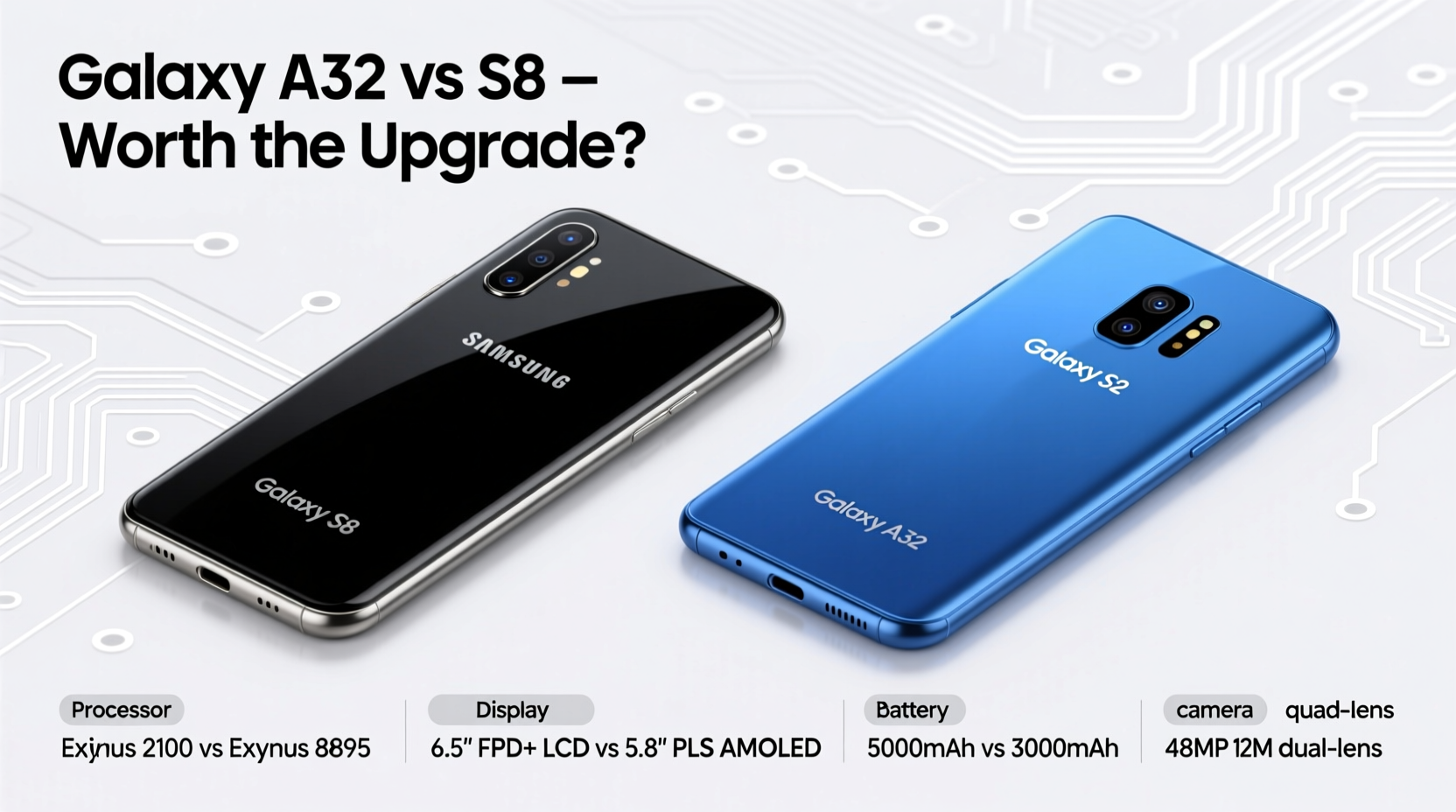
The Galaxy S8 set a benchmark for smartphone design. Its curved glass back, aluminum frame, and edge-to-edge Infinity Display made it a standout. It felt luxurious and compact in hand, despite its 5.8-inch screen. The A32, by contrast, uses plastic for both the frame and back. While this makes it lighter and less prone to shattering, it lacks the premium feel of the S8.
However, the A32 compensates with practicality. It's larger (6.4 inches), which benefits media consumption and multitasking. It also includes a headphone jack and expandable storage via microSD—features dropped in many modern flagships, including later S-series models. If you prioritize durability over elegance, the A32’s rugged build may actually serve you better in daily use.
Performance Comparison: Flagship Power vs. Modern Efficiency
The S8 launched with Qualcomm’s Snapdragon 835 (or Exynos 8895 in some regions), a top-tier chipset at the time. Even today, that processor outperforms the MediaTek Helio G80 in the A32 in raw computing power. Apps launched faster, multitasking was smoother, and gaming performance was significantly stronger.
But benchmarks don’t tell the whole story. The A32 runs Android 11 (upgradable to Android 13) with One UI 5, offering a far more modern software experience than the S8’s outdated Android 9 (with no further major updates). While the S8 once delivered snappy performance, aging hardware and software limitations now result in lag, app crashes, and compatibility issues with newer apps.
The A32’s 4GB or 6GB RAM configurations handle everyday tasks like browsing, messaging, and streaming reliably. It won’t compete with high-end phones in intensive workloads, but for average users, it feels responsive and stable.
“Modern mid-range phones often provide a better user experience than aging flagships, even if their specs appear weaker.” — David Kim, Mobile Analyst at TechPulse Insights
Display and Audio: Clarity vs. Size
The S8’s 5.8-inch Quad HD+ Super AMOLED display remains impressive. With a resolution of 1440 x 2960 pixels, it offered exceptional clarity, deep blacks, and vibrant colors. The A32 uses a larger 6.4-inch Full HD+ Super AMOLED screen, but at 1080 x 2400 pixels, the pixel density is lower. While still sharp, the image isn't quite as crisp.
Where the A32 wins is screen size and aspect ratio. The taller 20:9 format improves scrolling and video viewing. It also supports brighter outdoor visibility and adaptive refresh rate (though capped at 60Hz). Additionally, the A32 retains stereo speakers, matching the S8’s dual front-firing audio setup. Both deliver balanced sound, but the A32 benefits from newer audio tuning and Bluetooth 5.0 for improved wireless audio performance.
Battery Life and Charging: Night and Day Difference
This is where the A32 clearly surpasses the S8. The older flagship came with a 3000mAh battery—modest even for its time. After years of charging cycles, most S8 batteries have degraded significantly, often struggling to last a full day.
The A32 packs a 5000mAh battery, easily delivering 1.5 to 2 days of moderate use. It supports 15W fast charging, though the charger included is typically 10W. Still, going from the S8’s limited endurance to the A32’s all-day-plus reliability is a transformative upgrade for most users.
| Feature | Samsung Galaxy S8 | Samsung Galaxy A32 |
|---|---|---|
| Battery Capacity | 3000 mAh | 5000 mAh |
| Charging Speed | Fast Charging (15W) | 15W Fast Charging (10W adapter included) |
| Estimated Daily Use | ~12 hours (new), now ~6–8 | ~18–48 hours depending on usage |
| Charge Cycles (Typical Lifespan) | 500–800 (mostly depleted now) | Fresh, up to 80% after 500 cycles |
Camera Capabilities: Single Lens vs. Versatility
The S8 featured a single 12MP rear camera with Dual Pixel autofocus and excellent low-light performance for its era. Photos were natural, dynamic, and well-balanced. However, it lacked ultra-wide, macro, or depth sensors.
The A32 introduces a quad-camera array: 64MP main, 8MP ultra-wide, 5MP macro, and 2MP depth. While the main sensor captures more detail in good light, image processing can oversharpen or over-saturate. Low-light performance is inconsistent. That said, the ability to shoot wide-angle landscapes or close-up macros adds creative flexibility the S8 never had.
Front cameras are comparable—S8’s 8MP shooter handled selfies well, while the A32’s 13MP front camera offers higher resolution and better portrait modes.
Real-World Example: Maria’s Upgrade Journey
Maria used her Galaxy S8 for nearly five years. By 2022, the phone struggled to load maps, frequently froze during calls, and the battery died by noon. She considered buying another flagship but found the prices steep. Instead, she opted for the A32 at a third of the cost.
She missed the sleek design initially but quickly appreciated the longer battery life and larger screen for reading recipes and video calls. The extra camera lenses helped her capture group photos at family events without stepping back. Though games loaded slightly slower, she noticed fewer app crashes thanks to updated software support. For Maria, the A32 wasn’t just a replacement—it was a functional upgrade tailored to her current lifestyle.
Software and Security: The Hidden Advantage
One of the most overlooked aspects of upgrading is software support. The S8 received three major Android updates (up to Android 9) and monthly security patches until 2020. Today, it receives nothing—making it vulnerable to malware and incompatible with modern banking or productivity apps.
The A32, meanwhile, is eligible for four years of security updates and two major OS upgrades (up to Android 13). This means continued access to new features, improved privacy controls, and protection against emerging threats. For anyone using their phone for email, shopping, or mobile banking, this is a critical advantage.
Checklist: Is the A32 Right for You?
- ✅ Need a phone that lasts all day (or longer) on a single charge
- ✅ Want access to newer apps and services without performance hiccups
- ✅ Value multiple camera options for social media or casual photography
- ✅ Prefer a larger screen for videos, reading, or multitasking
- ✅ Are on a tight budget but want reliable, up-to-date software
- ❌ Prioritize top-tier build quality and flagship performance
- ❌ Play graphics-intensive games regularly
Frequently Asked Questions
Can the A32 run the same apps as the S8 did?
Yes—and more. While the S8 struggles with newer versions of apps like WhatsApp, Google Maps, or TikTok due to outdated architecture, the A32 handles them smoothly thanks to its modern Android version and optimized chipset.
Is the A32 waterproof like the S8?
No. The S8 has IP68 water and dust resistance. The A32 only has a basic splash-resistant coating (not officially rated). Avoid exposing it to water.
Will my accessories work with the A32?
Most wired headphones will work since the A32 has a headphone jack. However, S8-specific cases, docks, or DeX stations are not compatible due to different dimensions and lack of DeX support.
Final Verdict: A Smart Step Forward for Most Users
Technically, the Galaxy A32 is not a “better” phone than the S8 in every spec. It doesn’t match the original’s premium materials or peak processing power. But when judged by real-world usability in 2024, it’s a clear upgrade for the average user.
The combination of vastly superior battery life, ongoing software support, modern camera versatility, and dependable daily performance makes the A32 a sensible choice for anyone transitioning from an aging S8. It represents a shift from flagship luxury to practical longevity—a tradeoff that makes sense for users whose needs have evolved from tech enthusiasm to everyday reliability.




 浙公网安备
33010002000092号
浙公网安备
33010002000092号 浙B2-20120091-4
Comments
No comments yet. Why don't you start the discussion?