
Switching between smartphone ecosystems is never a small decision—especially when moving from Apple’s tightly integrated iOS world to Samsung’s Android-powered flagship experience. The iPhone 14 Pro Max set a high bar with its Dynamic Island, powerful A16 Bionic chip, and excellent camera system. Now, with the Samsung Galaxy S25 expected to launch with cutting-edge hardware, AI enhancements, and refined design, many iPhone users are asking: is it truly worth making the switch?
This isn’t just about specs on paper. It’s about real-world usability, long-term value, ecosystem compatibility, and whether the benefits outweigh the friction of changing platforms. For iPhone 14 Pro Max owners considering a shift, the answer depends on priorities: raw power, customization, photography style, software longevity, or seamless integration with existing devices.
Performance and Hardware: Power Meets Efficiency
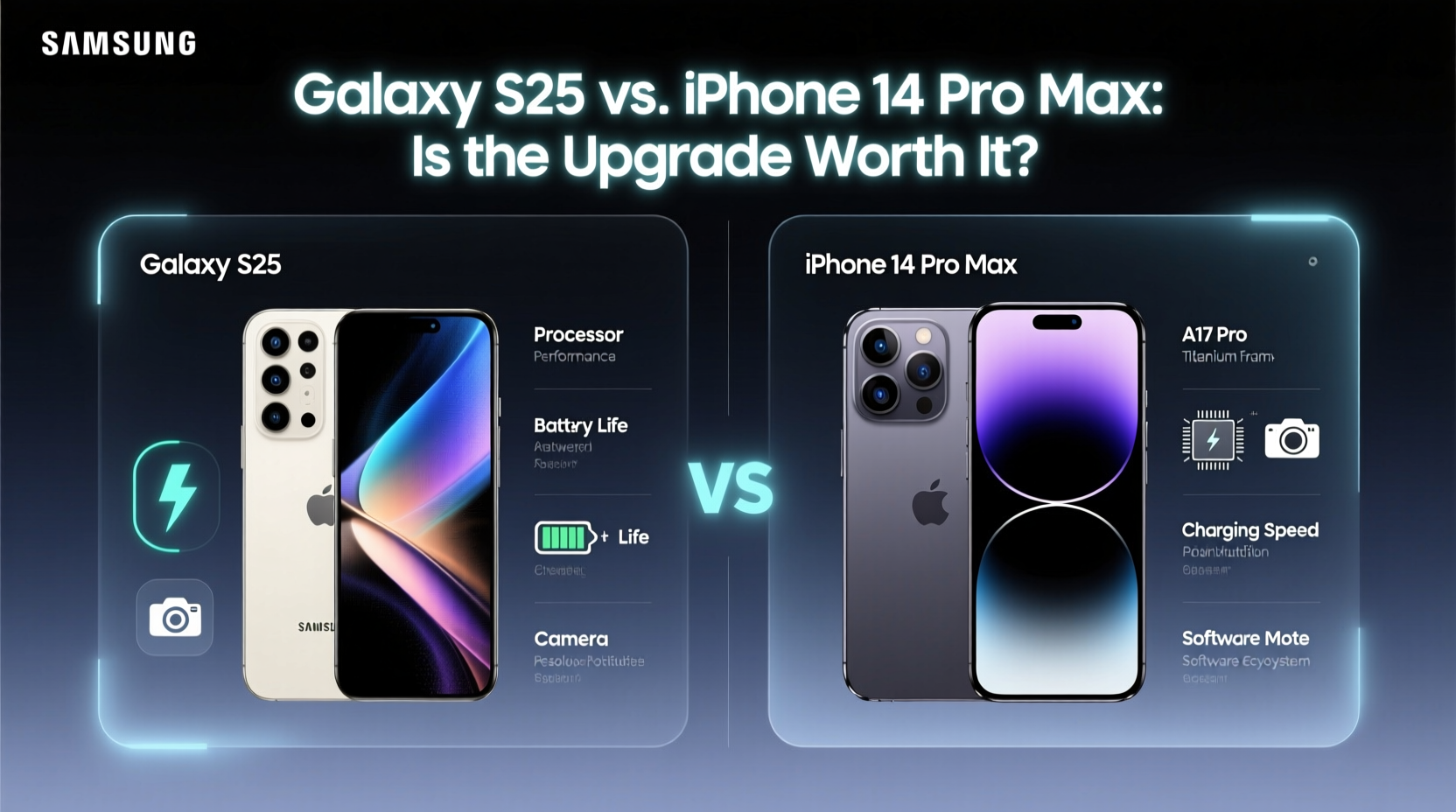
The Galaxy S25 is rumored to debut with the Snapdragon 8 Gen 3 (or possibly Gen 4 in select regions), built on a 4nm or even 3nm process. This translates to faster CPU and GPU performance, improved thermal efficiency, and significant gains in AI processing—critical for next-gen camera features and voice assistants.
In contrast, the iPhone 14 Pro Max runs on Apple’s A16 Bionic, which still holds up remarkably well in 2024. While it lacks some of the dedicated AI cores found in newer Android chips, its single-core performance remains competitive, and iOS optimization ensures smooth day-to-day operation.
Samsung has also been improving thermal management in recent models, reducing throttling during sustained workloads—a common pain point on earlier Galaxy flagships. Early benchmarks suggest the S25 may outperform the iPhone 14 Pro Max in multi-core tasks by 20–30%, thanks to better core scaling and memory bandwidth.
Camera Comparison: Different Philosophies, Similar Results
Photography is where personal preference plays a major role. The iPhone 14 Pro Max delivers natural color science, reliable Smart HDR, and excellent video stabilization—ideal for creators who prioritize consistency and dynamic range.
The Galaxy S25, building on the S24 series’ improvements, is expected to feature a 200MP main sensor with advanced pixel binning, improved low-light algorithms, and enhanced AI-driven scene optimization. Samsung tends to boost saturation and contrast more aggressively, producing punchier images that stand out on social media but can sometimes appear overprocessed.
“Samsung has closed the gap in photo realism, but Apple still leads in video quality and color accuracy for professional use.” — David Lin, Mobile Imaging Analyst at TechVision Labs
One area where the S25 may pull ahead is zoom capability. With a potential 5x or 10x periscope telephoto lens and AI-enhanced digital zoom, it could surpass the iPhone’s 3x optical limit—making it better suited for wildlife, concerts, or distant subjects.
Ecosystem and Software Experience
Moving from iPhone to Android means reevaluating your digital ecosystem. The iPhone 14 Pro Max integrates seamlessly with Macs, iPads, AirPods, and Apple Watch. Handoff, iMessage, FaceTime, and iCloud sync create a cohesive experience that’s hard to replicate.
Samsung counters with its own ecosystem: Galaxy Buds, Galaxy Watch, and DeX for desktop-like productivity. The new Galaxy AI suite—featuring real-time call translation, note summarization, and generative photo editing—offers compelling functionality not yet matched on iOS.
However, switching means adjusting to Google’s services: Gmail, Google Photos, Google Drive, and the Play Store. While these are robust, they lack the uniform polish of Apple’s apps. Messaging is another hurdle: iMessage’s blue bubbles disappear, replaced by RCS (if enabled) or standard SMS, which can feel like a downgrade in group chats.
| Feature | iPhone 14 Pro Max | Samsung Galaxy S25 (Expected) |
|---|---|---|
| Chipset | A16 Bionic | Snapdragon 8 Gen 3/4 |
| RAM | 6GB | 12GB |
| Display | 6.7\", 120Hz LTPO OLED | 6.8\", 120Hz QHD+ Dynamic AMOLED |
| Battery Life | ~12 hours screen-on time | ~14–16 hours screen-on time |
| Charging | 20W wired, 15W MagSafe | 45W wired, 15W wireless |
| Software Updates | 5 years (iOS 16–21) | 7 years (One UI 6–12) |
| Main Camera | 48MP, f/1.78 | 200MP, f/1.7 with OIS |
| Zoom | 3x optical, 15x ultra-fine | 5x–10x optical, 100x digital (AI-enhanced) |
Real-World Example: Sarah’s Cross-Platform Switch
Sarah, a freelance photographer and longtime iPhone user, upgraded from her iPhone 14 Pro Max to a pre-release Galaxy S25 unit for travel work in Southeast Asia. She needed longer battery life, better zoom for landscapes, and faster charging in remote areas.
“The first week was rough,” she admits. “I missed iMessage, and syncing my iPad was a hassle. But the 10x zoom on temple carvings? Unbeatable. The battery lasted two full days with moderate use, and 45W charging meant I could top up during breakfast.”
She now uses Google Messages with RCS and backs up to Google Photos with unlimited 16MP uploads. “It wasn’t seamless, but for my workflow, the S25 gives me more creative flexibility. I’ve kept my MacBook, but I’m using Samsung DeX more often for quick edits.”
Should You Upgrade? A Step-by-Step Decision Guide
Deciding whether to switch requires evaluating both technical and lifestyle factors. Follow this timeline to make an informed choice:
- Week 1: Audit Your Current Usage
Track how you use your iPhone 14 Pro Max. Note pain points: battery life, slow charging, limited zoom, or app limitations. - Week 2: Test Android Devices
Visit a Samsung store or borrow a friend’s Galaxy S24. Try navigating One UI, using Google Assistant, and testing camera modes. - Week 3: Evaluate Ecosystem Impact
List your connected devices. Will switching disrupt your smartwatch, headphones, or laptop workflow? Can you replace iMessage with WhatsApp or Telegram? - Week 4: Compare Pricing and Trade-In Value
Check what your iPhone 14 Pro Max is worth on trade-in platforms. Factor in carrier deals, early upgrade programs, or Samsung’s promotional offers. - Final Decision: Weigh Innovation vs. Stability
If you value cutting-edge hardware, customization, and AI features, the S25 is compelling. If you prefer stability, long-term iOS support, and ecosystem cohesion, staying put may be smarter.
Frequently Asked Questions
Will my iPhone accessories work with the Galaxy S25?
No, Lightning cables, MagSafe chargers, and most cases are incompatible. You’ll need USB-C cables, Qi2-compatible wireless chargers, and new cases designed for the S25.
Does the Galaxy S25 have better battery life than the iPhone 14 Pro Max?
Yes, based on early reports and hardware trends. The S25’s larger battery (likely 5000mAh vs. 4323mAh), efficient chipset, and optimized display settings typically deliver 2–4 extra hours of screen-on time.
Can I transfer my data easily from iPhone to Galaxy S25?
Samsung’s Smart Switch app supports direct transfers over Wi-Fi or cable. Most photos, messages, contacts, calendars, and notes move smoothly. However, iMessages remain green bubbles, and some app data (like in-app purchases) won’t carry over.
Final Verdict: Who Should Make the Switch?
The Samsung Galaxy S25 is a technological leap forward—not just in hardware, but in AI integration and long-term software support. For iPhone 14 Pro Max users who crave faster charging, superior zoom, extended update coverage (7 years), and deeper customization, the upgrade makes strong sense.
But if you rely heavily on iMessage, FaceTime, or Apple’s ecosystem synergy, the transition comes with real trade-offs. The S25 excels in raw performance and innovation, while the iPhone 14 Pro Max continues to deliver polished reliability.




 浙公网安备
33010002000092号
浙公网安备
33010002000092号 浙B2-20120091-4
Comments
No comments yet. Why don't you start the discussion?