
In 2025, comparing smartphones released nearly a decade ago might seem like an academic exercise—but for users holding onto older devices or considering secondhand purchases, the question remains relevant. The Samsung Galaxy S9 Plus and Huawei P10 Plus were flagship rivals in 2017, both representing the peak of their manufacturers’ engineering at the time. Now, with software updates long discontinued and hardware aging, it's worth asking: does the Galaxy S9 Plus still hold an edge over the P10 Plus?
The answer isn’t just about specs on paper. It’s about real-world usability, software resilience, repairability, and ecosystem support. While neither phone can compete with modern mid-range devices in raw power, some aspects of these legacy flagships remain surprisingly functional. This article breaks down how they stack up today across key categories.
Performance and Hardware Longevity
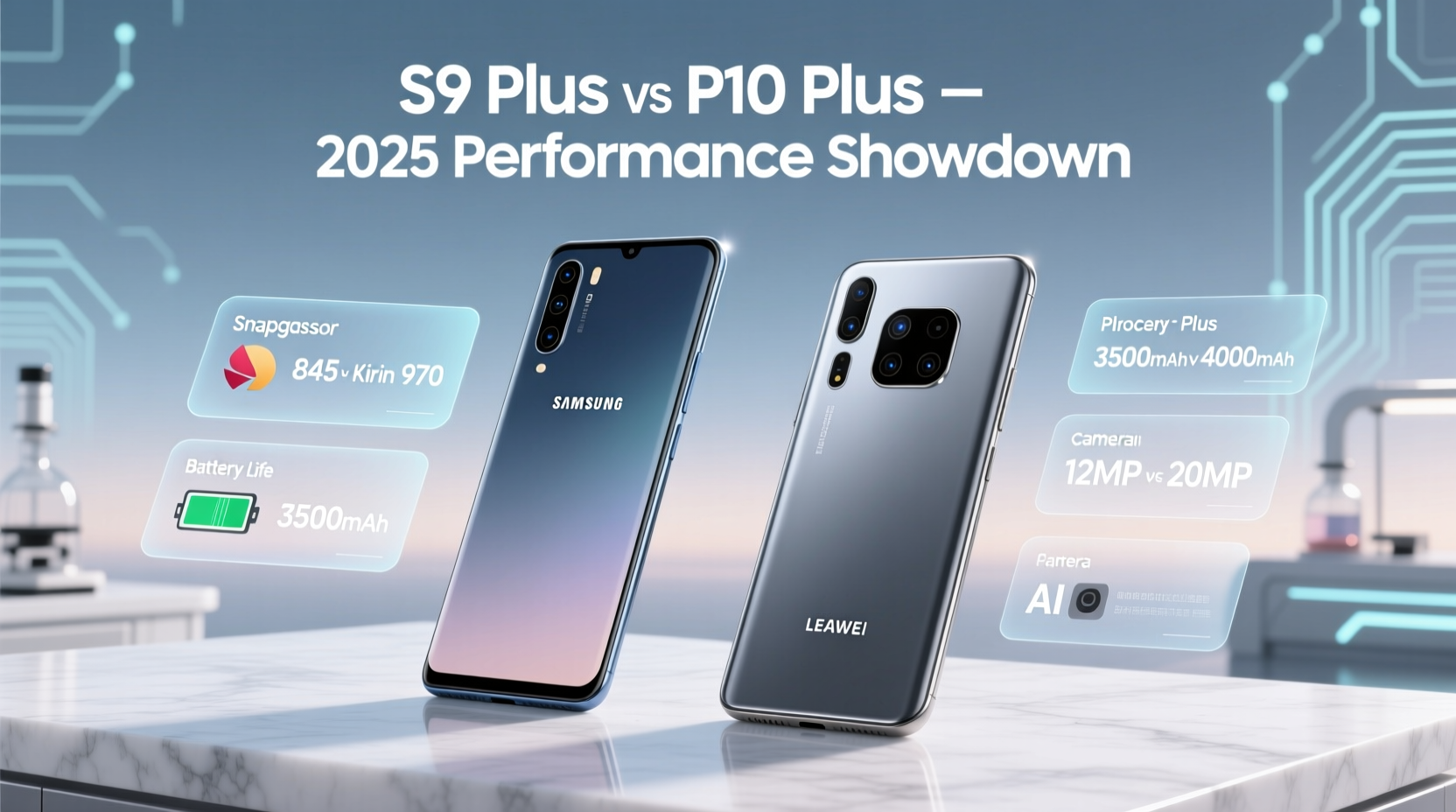
At launch, the Galaxy S9 Plus featured the Qualcomm Snapdragon 845 (or Exynos 9810 depending on region), while the Huawei P10 Plus used the Kirin 960. On paper, the Snapdragon 845 was more advanced, offering better CPU and GPU performance, especially in multitasking and gaming. By 2025 standards, both chips are severely outdated, but the difference in longevity is noticeable.
Users report that the S9 Plus handles basic tasks—messaging, web browsing, light email—with fewer stutters than the P10 Plus. This is partly due to Samsung’s superior memory management and slightly larger base RAM (6GB vs. 4GB or 6GB on select P10 variants). However, app launch times on both devices have slowed significantly, and background app reloads are common.
Thermal throttling is another issue. The P10 Plus, known for heating under moderate load even in 2017, now struggles to maintain performance during extended use. The S9 Plus fares slightly better thanks to its larger chassis and improved thermal design, though battery degradation affects sustained output.
Software Support and Security
This is where the gap widens dramatically. Samsung provided four years of major Android updates and security patches for the S9 Plus, with official support ending in 2022. However, thanks to Samsung’s shift toward longer support cycles, community efforts, and custom ROMs like LineageOS, the S9 Plus can still run Android 13 or 14 with reasonable stability.
In contrast, Huawei’s update policy was always shorter, and the P10 Plus stopped receiving updates shortly after its release cycle ended. Worse, due to U.S. trade restrictions, Huawei lost access to Google Mobile Services (GMS) after 2019. Even if someone installs a newer OS via third-party firmware, Google apps cannot be officially supported, limiting functionality for Gmail, Maps, YouTube, and the Play Store.
“By 2025, software abandonment becomes the biggest bottleneck for older phones. Without security patches, even a fast device is a liability.” — Daniel Lin, Mobile Security Analyst at TechShield Insights
Using either device as a primary smartphone in 2025 carries risk, but the S9 Plus offers more flexibility through modding communities. The P10 Plus, meanwhile, is largely confined to Huawei’s AppGallery and limited alternatives—a significant drawback for Western users.
Camera Comparison: Then vs. Now
In 2017, the P10 Plus stood out for its Leica-tuned dual-camera system: a 12MP color sensor and a 12MP monochrome sensor. It delivered excellent low-light detail and sharp black-and-white photography. The S9 Plus introduced variable aperture (f/1.5–f/2.4), which was groundbreaking for dynamic lighting adaptation.
| Feature | Samsung Galaxy S9 Plus | Huawei P10 Plus |
|---|---|---|
| Rear Cameras | Dual 12MP (f/1.5–2.4) | Dual 12MP (color + mono) |
| Front Camera | 8MP | 8MP |
| Low-Light Performance | Excellent (adaptive aperture) | Very good (mono sensor helps) |
| Video Recording | 4K @ 30fps, Super Slow-mo 720p @ 960fps | 4K @ 30fps |
| Current Usability | Moderate; processing lags | Poor; shutter delay noticeable |
Today, both cameras suffer from slow processing, delayed shot capture, and inconsistent HDR. However, the S9 Plus benefits from more optimized software tuning in current custom ROMs. Its Super Slow-mo feature, while gimmicky, still works reliably. The P10 Plus’s camera app often crashes or freezes when switching modes, especially on newer firmware attempts.
Battery Life and Repairability
Both phones came with 3,500mAh batteries, but real-world endurance has diverged. Most P10 Plus units now struggle to last half a day with light use due to poor battery calibration and lack of optimization in later firmware. The S9 Plus, benefiting from Samsung’s adaptive battery features (even in aftermarket ROMs), manages closer to a full day with careful usage.
Repairability is another point in Samsung’s favor. The S9 Plus uses standardized components and widely available replacement parts. Third-party screens, batteries, and charging ports are easy to source and install. The P10 Plus, while also repairable, suffers from proprietary glue patterns and less post-market support, especially outside Asia.
- Samsung offers official battery replacement services in some regions, even for discontinued models.
- Huawei has largely phased out spare parts distribution for pre-Mate 10 devices.
- Third-party repair shops report higher success rates with S9 Plus restorations.
Real-World Example: Two Users, Five Years Later
Consider two users: Maria in Berlin and James in Singapore. Both bought their phones in 2017—one S9 Plus, one P10 Plus. By 2023, Maria upgraded to a newer Samsung but kept her S9 Plus as a backup. She reflashed it with LineageOS in 2024, added microG for Google services, and now uses it for music, offline maps, and as a dedicated e-reader.
James held onto his P10 Plus longer, hoping Huawei would regain GMS access. When that didn’t happen, he tried installing a patched firmware with Google services. The installation worked, but app compatibility issues and frequent crashes made daily use impractical. By early 2025, he donated the device.
This scenario reflects a broader trend: the S9 Plus adapts better to life beyond official support. The P10 Plus, despite strong initial hardware, lacks the ecosystem flexibility to survive long-term.
Checklist: Is Your Legacy Phone Still Viable in 2025?
- Can it run a stable, secure version of Android 10 or higher (officially or via custom ROM)?
- Are critical apps (messaging, banking, navigation) functional and responsive?
- Does it support essential security features like biometric authentication and encrypted storage?
- Is battery life sufficient for at least half a day of minimal use?
- Can you replace the battery or screen affordably if needed?
- Are you comfortable with technical workarounds like sideloading or rooting?
If three or more answers are “no,” the device is likely past its practical lifespan.
Frequently Asked Questions
Can I still use Google services on the Huawei P10 Plus?
Not reliably. While tools like LZPlay or manual GApps installation existed briefly, most no longer work due to Huawei’s deep system changes and Google’s countermeasures. Even if installed, services like Gmail sync and push notifications fail frequently.
Is the S9 Plus waterproof enough for everyday use in 2025?
The IP68 rating remains valid only if seals are intact. After seven years, water resistance degrades significantly. Avoid submersion or heavy rain exposure regardless of original rating.
Which phone holds resale value better today?
Neither retains meaningful resale value, but the S9 Plus typically sells for $30–$50 on secondhand markets, compared to $15–$25 for the P10 Plus, due to broader compatibility and demand from hobbyists.
Final Verdict: Yes, But With Caveats
In 2025, the Samsung Galaxy S9 Plus is still technically better than the Huawei P10 Plus—but “better” doesn’t mean “good.” The S9 Plus wins due to stronger software extensibility, better community support, and continued access to Google services. It can function as a secondary device, media player, or emergency phone with proper maintenance.
The P10 Plus, while once a design and camera standout, is hamstrung by its isolation from the global Android ecosystem. Without Google services and active development, it’s effectively obsolete for most users.




 浙公网安备
33010002000092号
浙公网安备
33010002000092号 浙B2-20120091-4
Comments
No comments yet. Why don't you start the discussion?