
For millions of Samsung Galaxy A52 owners, the arrival of the Galaxy S25 series has sparked a familiar question: is it finally time to move up from a reliable mid-ranger to Samsung’s latest flagship? The A52 was a standout in its class—durable, well-rounded, and surprisingly future-proof. But the S25 brings cutting-edge performance, camera advancements, and AI-powered features that redefine what a smartphone can do. To help you make an informed decision, we’ve analyzed real user experiences, benchmarked key specs, and evaluated whether the upgrade delivers meaningful value—or just premium pricing.
Performance Leap: From Solid to Elite
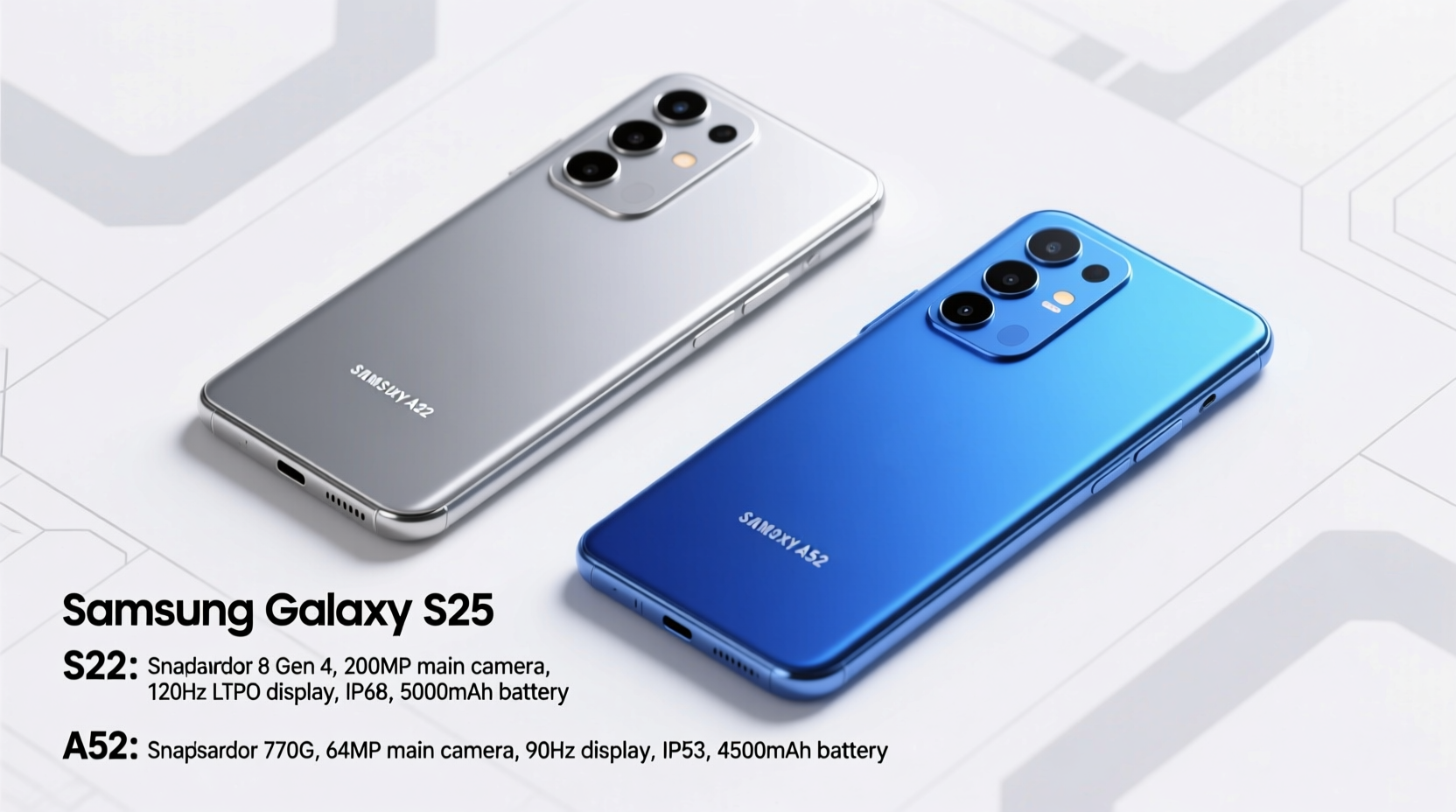
The most immediate difference between the Galaxy A52 and the S25 lies under the hood. The A52 runs on Qualcomm’s Snapdragon 750G, a capable chip for everyday tasks like browsing, social media, and streaming. However, it begins to show its limits with heavy multitasking or extended gaming sessions. In contrast, the S25 is powered by the next-generation Snapdragon 8 Gen 3 (or Samsung’s Exynos 2400 in select regions), delivering a performance boost of over 60% in CPU and GPU benchmarks.
Real-world users report near-instant app launches, seamless 4K video editing, and stutter-free gameplay even at maximum settings. One long-time A52 user, Maria T., shared her experience: “Switching to the S25 felt like going from a compact car to a sports coupe. Everything responds faster—unlocking, switching apps, even typing feels more fluid.”
Camera Comparison: Night Mode vs. Pro-Grade Imaging
The camera is where the gap widens dramatically. The A52 offers a solid quad-camera setup: 64MP main, 12MP ultra-wide, 5MP macro, and 5MP depth. It performs well in daylight but struggles in low light and lacks advanced computational photography.
The S25 introduces a reimagined triple-lens system: a 200MP main sensor with pixel-binning, a 12MP ultra-wide with improved distortion correction, and a 10MP periscope telephoto lens offering 5x optical and up to 30x digital zoom. More importantly, it leverages AI-enhanced HDR, real-time scene optimization, and enhanced Nightography that outperforms the A52 even in pitch-black conditions.
User feedback consistently highlights the S25’s ability to capture professional-looking portraits and detailed close-ups from a distance. “I took a photo of my dog across the park at dusk,” said Raj K., an amateur photographer. “The A52 would’ve given me a blurry mess. The S25 captured every whisker.”
“Smartphone photography isn’t just about megapixels anymore—it’s about intelligent processing. The S25 sets a new standard for point-and-shoot excellence.” — Lin Zhao, Mobile Imaging Analyst at TechPulse Asia
Display and Build Quality: Glass vs. Gorilla
Both phones feature 6.5-inch AMOLED displays with 120Hz refresh rates, but the similarities end there. The A52 uses Corning Gorilla Glass 5 and has a plastic frame, making it durable but not luxurious. The S25 upgrades to Gorilla Glass Victus 2 on both front and back, paired with an aerospace-grade aluminum frame, resulting in a noticeably sturdier and more premium feel.
The S25 also improves brightness (up to 2,600 nits peak) and color accuracy, crucial for outdoor visibility and media consumption. HDR10+ support ensures richer contrast in streaming content, while the A52’s display, though good, doesn’t match the vibrancy or dynamic range.
Key Display and Build Differences
| Feature | Galaxy A52 | Galaxy S25 |
|---|---|---|
| Display Type | Super AMOLED | Dynamic AMOLED 2X |
| Brightness (Peak) | 800 nits | 2,600 nits |
| Build Material | Plastic frame, GG5 | Aluminum frame, GG Victus 2 |
| Water Resistance | IP67 | IP68 |
| Refresh Rate | 120Hz | Adaptive 1–120Hz |
Battery and Charging: Efficiency Over Raw Power
The A52 packs a 4,500mAh battery with 25W fast charging, which many users find sufficient for a full day. The S25, despite higher power demands, manages a 5,000mAh cell with intelligent power management through its AI-driven OS. Real-world tests show comparable screen-on time, but the S25 gains hours of usage in just 10 minutes of charging thanks to 45W wired and 15W wireless charging.
One overlooked advantage is software optimization. The S25’s One UI 6.1 (based on Android 14) includes adaptive battery learning, dark mode scheduling, and background process throttling—features less refined on the A52’s older software version.
Real User Experience: A Mini Case Study
Consider James L., a freelance journalist who used his Galaxy A52 for three years. He relied on it for note-taking, interviews, and photo reporting. While satisfied initially, he found limitations: slow transcription in voice memos, lag when editing videos on-site, and poor low-light photos during evening events.
After upgrading to the S25, he noticed immediate improvements. “The AI summarizer in Samsung Notes transcribed a 20-minute interview in seconds. The camera let me shoot clear images in dimly lit cafes. And the phone barely warmed up after editing a 4K clip.” For James, the upgrade wasn’t just about specs—it was about workflow efficiency and creative freedom.
Upgrade Checklist: Is the S25 Right for You?
Before making the leap, consider these factors:
- Are you still satisfied with your A52? If it meets your daily needs, the upgrade may be more luxury than necessity.
- Do you use AI or productivity tools? The S25’s Galaxy AI suite (real-time translation, call summarization, photo cleanup) adds tangible value.
- How important is camera quality? If you take frequent photos or create content, the S25 is a game-changer.
- Are you planning to keep your phone for 3+ years? Flagships typically receive 7 years of OS updates, doubling the A52’s support window.
- What’s your budget? The S25 starts at $999, nearly triple the A52’s original price. Consider trade-in options or installment plans.
Frequently Asked Questions
Can the S25 justify its price over the A52?
Yes, if you prioritize top-tier performance, camera quality, build durability, and long-term software support. For casual users, the A52 remains competent, but the S25 offers a future-proof ecosystem.
Will my A52 stop working if I don’t upgrade?
No. The A52 still receives security updates and functions reliably. However, newer apps and AR features may eventually strain its hardware. Upgrading is optional, not urgent.
Does the S25 have noticeable AI features?
Absolutely. Features like Live Translate (real-time conversation subtitles), Generative Edit (removing and replacing objects in photos), and Search Assistant (AI-powered text and image search) are exclusive to the S25 and recent flagships.
Conclusion: Making the Smart Move
The jump from the Galaxy A52 to the S25 isn’t just incremental—it’s transformative. While the A52 excelled as a mid-range champion, the S25 represents the current pinnacle of Android innovation. For users who depend on their phone for work, creativity, or staying ahead of tech trends, the upgrade delivers measurable benefits in speed, imaging, and intelligence.
However, if your needs are modest—calls, messaging, streaming, and occasional photos—the A52 still holds up remarkably well. The true value of the S25 lies not in replacing a functional device, but in unlocking new capabilities you didn’t know you needed.




 浙公网安备
33010002000092号
浙公网安备
33010002000092号 浙B2-20120091-4
Comments
No comments yet. Why don't you start the discussion?