
Anime has grown from a niche cultural export to a global phenomenon, captivating audiences across age groups and continents. Beyond entertainment, an increasing number of viewers are turning to anime as a tool for language acquisition and mental stimulation. But is this effective? Can something as seemingly casual as watching animated Japanese series actually contribute to real cognitive development and linguistic proficiency? The answer, supported by research in neuroscience, education, and psycholinguistics, is a resounding yes—when approached intentionally.
The immersive nature of anime, combined with its rich linguistic and cultural context, makes it a surprisingly powerful medium for both passive exposure and active learning. When used strategically, anime can enhance vocabulary retention, improve listening comprehension, and even strengthen memory and attention span. This article explores the science behind these benefits, offers practical strategies for maximizing gains, and addresses common misconceptions about using entertainment media for serious learning.
The Cognitive Advantages of Watching Anime
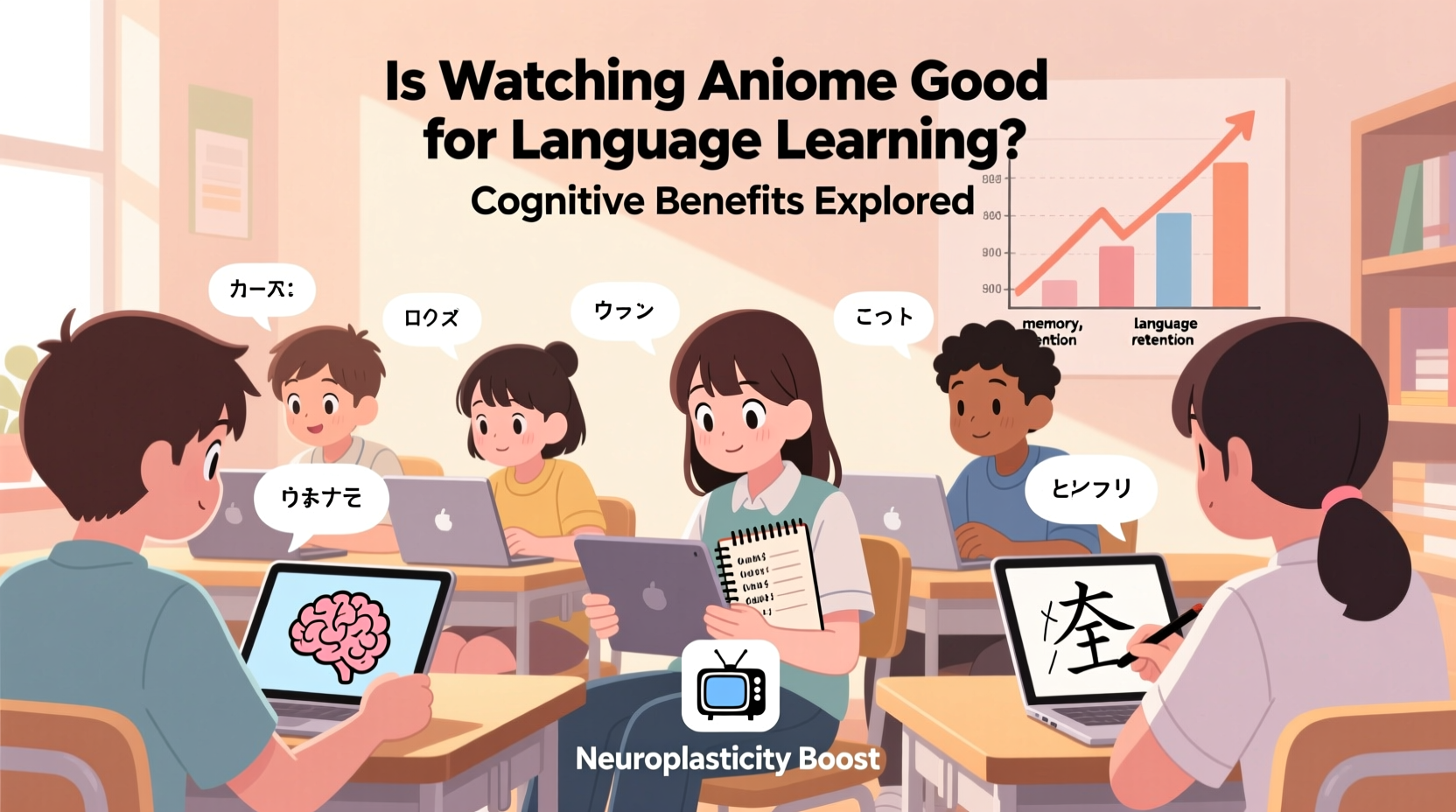
Cognitive benefits from consuming media like anime go beyond simple enjoyment. Studies in cognitive psychology show that engaging with narrative-driven content activates multiple regions of the brain, including those responsible for language processing, emotional regulation, and memory consolidation.
One key factor is emotional engagement. Because anime often features dramatic story arcs, expressive characters, and high-stakes scenarios, viewers become emotionally invested. This emotional investment increases dopamine release, which enhances attention and strengthens memory formation. According to Dr. Paul Howard-Jones, a professor of neuroscience and education at the University of Bristol, “Emotionally charged experiences—even fictional ones—lead to more durable learning because they stimulate neural pathways linked to long-term memory.”
Additionally, anime typically uses exaggerated facial expressions and gestures, which help viewers infer meaning from context. This visual scaffolding supports language learners by reducing reliance on direct translation and encouraging pattern recognition—a core skill in second-language acquisition.
Language Learning Through Immersive Viewing
Traditional language instruction often emphasizes grammar drills and vocabulary lists, but real fluency develops through immersion—the process of absorbing language in context. Anime provides a form of \"passive immersion,\" where learners encounter authentic speech patterns, colloquialisms, and natural intonation without being in a Japanese-speaking environment.
Unlike scripted dialogues in textbooks, anime dialogue reflects real-world usage. Characters use contractions, slang, honorifics, and situational language (e.g., formal vs. casual speech), exposing learners to the full spectrum of Japanese communication. For example, hearing phrases like “Yappari” (I knew it) or “Dame!” (No good!) repeatedly in emotional contexts helps cement their meaning far more effectively than rote memorization.
Moreover, repetition across episodes reinforces learning. A study published in the Journal of Educational Psychology found that repeated exposure to spoken language in meaningful contexts significantly improves auditory discrimination and word recognition in non-native speakers. Since many anime series span dozens of episodes, recurring phrases and grammatical structures appear frequently, offering built-in review opportunities.
How Context Enhances Vocabulary Retention
Vocabulary learned in isolation is quickly forgotten. However, when words are encountered in vivid, narrative-rich settings—as they are in anime—retention improves dramatically. This phenomenon is known as contextual encoding.
For instance, if a character shouts “Kuso!” after failing a mission, the viewer associates the word not just with “damn,” but with frustration, urgency, and consequence. This layered understanding makes the word easier to recall and use appropriately later. Similarly, technical terms in sci-fi anime (like *mecha* or *ki*) or school-related vocabulary in slice-of-life series become memorable due to their repeated visual and narrative association.
Strategies for Effective Language Learning via Anime
While simply watching anime can yield incidental learning, intentional strategies amplify results. Passive viewing leads to limited progress; active engagement transforms entertainment into education.
- Select appropriate content: Choose shows aligned with your proficiency level. Beginners benefit from slower-paced, everyday conversation series like Shirokuma Cafe or Chi’s Sweet Home. Intermediate learners can handle fast-paced dialogue in series like Death Note or My Hero Academia.
- Use dual subtitles strategically: Start with English subtitles to grasp the plot, then switch to Japanese subtitles (if available) to connect spoken sounds with written kana/kanji. Eventually, remove subtitles entirely.
- Pause and repeat: When you hear a new phrase, pause and repeat it aloud. Mimicking pronunciation builds muscle memory and improves accent.
- Maintain a vocab journal: Record new words, their context, and example sentences. Review weekly.
- Shadowing technique: Play short clips and speak along with the character, matching tone, speed, and intonation. This improves speaking fluency and listening accuracy.
Checklist: Maximize Your Anime Study Sessions
- ☐ Choose one episode per session for focused learning
- ☐ Watch once for comprehension, once for language analysis
- ☐ Note down 5–10 new words or phrases
- ☐ Look up grammar points used in dialogue
- ☐ Practice shadowing key lines
- ☐ Review notes before next session
Common Pitfalls and How to Avoid Them
Despite its advantages, anime-based learning comes with risks. Misuse can lead to frustration, inaccurate language assumptions, or stagnation.
| Do’s | Don’ts |
|---|---|
| Use anime as a supplement to structured learning (apps, classes) | Rely solely on anime for grammar and vocabulary |
| Watch a variety of genres to encounter diverse vocabulary | Stick only to fantasy or action shows with unnatural speech |
| Verify meanings with dictionaries or native speakers | Assume all slang or archaic terms are commonly used |
| Re-watch episodes to deepen understanding | Binge entire seasons without reflection or review |
One major pitfall is overestimating comprehension. Subtitles create an illusion of understanding. A viewer may follow the plot but miss nuances like verb conjugations, politeness levels, or implied meaning. To counter this, engage in active recall: after each episode, summarize the plot in Japanese or explain a character’s motivation using newly learned vocabulary.
“Learners who combine media immersion with deliberate practice show faster progression in listening and speaking skills.” — Dr. Naomi Kato, Applied Linguist, Osaka University
Real Example: From Beginner to Conversational in 18 Months
Tyler, a university student from Canada, began studying Japanese with no prior experience. Instead of relying only on classroom instruction, he integrated anime into his daily routine. He started with beginner-friendly shows like Tanoshii Moomin Ikka (the Japanese version of Moomin), using English subtitles. After two months, he switched to Japanese subtitles and began noting recurring phrases.
He implemented a strict schedule: 30 minutes of textbook study followed by one 20-minute anime episode with active note-taking. Every weekend, he rewatched one episode using the shadowing method. Within six months, he could understand basic dialogue without subtitles. By month 12, he was holding simple conversations with language partners online. At 18 months, he passed the JLPT N4 exam and traveled to Japan for a homestay program, where locals praised his natural pronunciation and listening ability.
Tyler credits his success not to anime alone, but to treating it as a learning tool rather than pure entertainment. “I didn’t just watch,” he says. “I listened, repeated, questioned, and reviewed. The stories kept me motivated, but the discipline made the difference.”
Broader Cognitive Benefits Beyond Language
The advantages of watching anime extend beyond linguistic growth. Regular engagement with complex narratives enhances several cognitive functions:
- Improved attention span: Following multi-episode arcs requires sustained focus, training the brain to maintain concentration over time.
- Enhanced theory of mind: Anime characters often express subtle emotions and social dynamics, helping viewers develop empathy and social cognition.
- Better multitasking: Processing audio, visuals, and subtitles simultaneously strengthens working memory and information integration.
- Creative thinking: Exposure to imaginative worlds and unconventional storytelling fosters divergent thinking and problem-solving flexibility.
A 2020 study from Kyoto University found that participants who regularly watched narrative-driven animation showed greater activation in the prefrontal cortex during reasoning tasks compared to those who consumed only factual content. This suggests that fiction-based media like anime may stimulate higher-order thinking more effectively than informational programming.
Frequently Asked Questions
Can watching anime really help me learn Japanese fluently?
Yes, but only as part of a broader strategy. Anime exposes you to authentic speech and cultural context, which accelerates listening and vocabulary skills. However, achieving fluency also requires grammar study, speaking practice, and writing exercises. Think of anime as a powerful supplement—not a standalone solution.
Should I watch anime with or without subtitles?
Start with subtitles in your native language to understand the plot. Then transition to Japanese subtitles (if available) to link sound and text. Eventually, aim to watch without any subtitles. This phased approach balances comprehension with challenge, optimizing learning efficiency.
Are some anime better for learning than others?
Absolutely. Slice-of-life, school, and comedy genres tend to use everyday language and clear pronunciation. Avoid shows heavy in fantasy jargon, archaic speech, or rapid-fire dialogue until you're more advanced. Recommended titles include March Comes in Like a Lion, Barakamon, and Yuru Camp△.
Conclusion: Turn Entertainment Into Growth
Watching anime is more than a pastime—it can be a dynamic component of language development and cognitive enrichment. When approached with purpose, it bridges the gap between formal education and real-world application, making learning engaging, memorable, and sustainable. The emotional resonance of stories, the repetition of natural speech, and the visual support of animation create a unique ecosystem for deep learning.
The key lies in intentionality. Replace passive binging with active viewing. Combine entertainment with reflection, repetition, and practice. Use anime not as an escape from learning, but as a gateway into it.




 浙公网安备
33010002000092号
浙公网安备
33010002000092号 浙B2-20120091-4
Comments
No comments yet. Why don't you start the discussion?