
The image of King Kong standing atop the Empire State Building, roaring into the sky, is one of the most iconic in cinematic history. Towering over skyscrapers and battling biplanes, he’s portrayed as a near-mythical force of nature. But how does this fictional giant compare to a real-world gorilla—the largest living primate and one of the most powerful animals on land? Could King Kong, if he existed, actually defeat a real silverback gorilla in a fight? The answer isn’t just about brute strength—it involves anatomy, behavior, evolutionary biology, and the laws of physics.
Anatomy and Size: A Battle of Scale
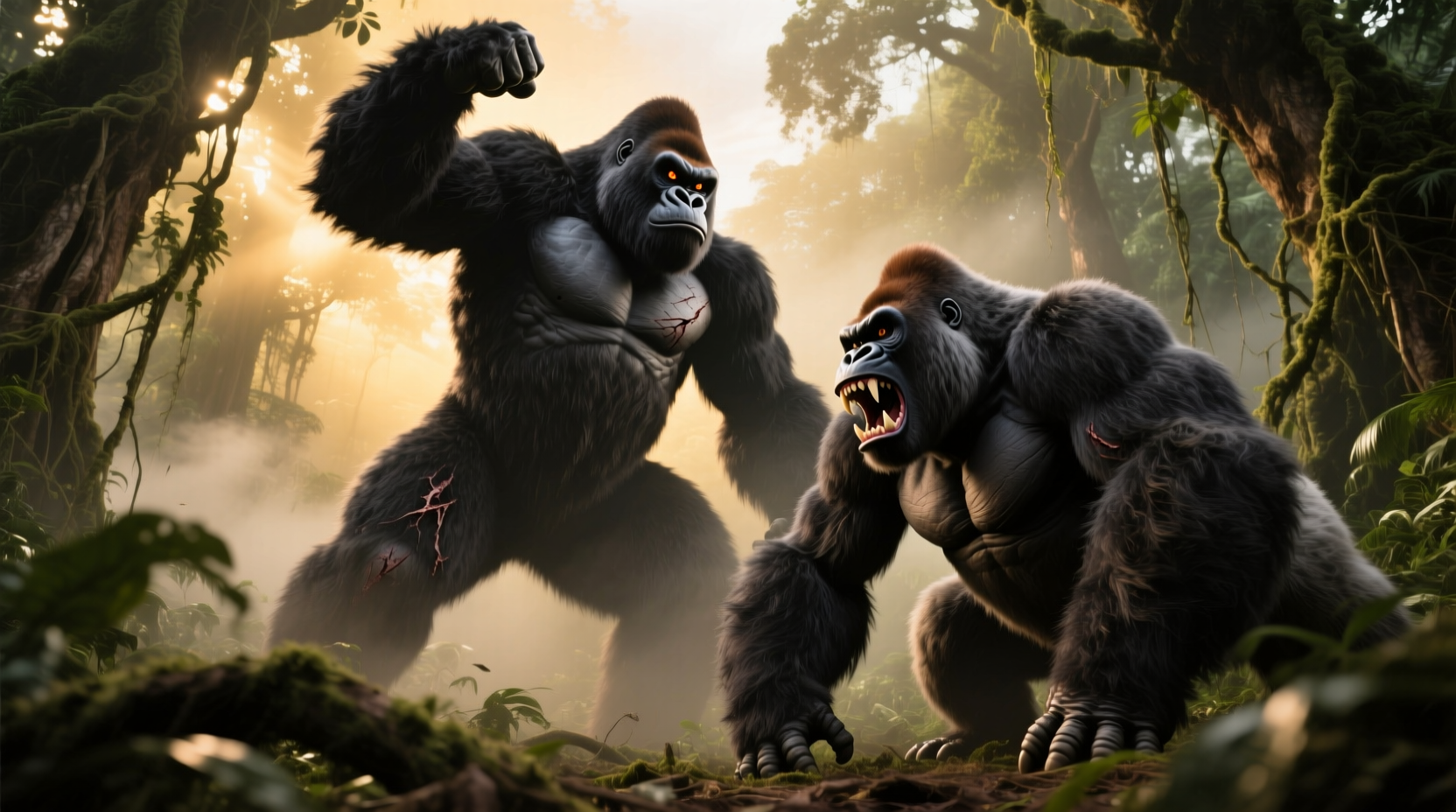
The most immediate difference between King Kong and a real gorilla is sheer size. In most modern portrayals—particularly Peter Jackson’s 2005 version—King Kong stands around 25 feet (7.6 meters) tall and weighs an estimated 8,000 pounds (3,600 kg). Compare that to a large male silverback gorilla, which reaches up to 5.5 feet (1.7 m) when standing upright and weighs between 300 and 485 pounds (136–220 kg).
This discrepancy isn’t just dramatic—it’s biologically impossible under Earth’s current gravity and skeletal constraints. Real animals are limited by the square-cube law: as an animal grows taller, its volume (and weight) increases faster than its cross-sectional muscle and bone area. A creature King Kong’s size would require impossibly dense bones and muscles to support its own mass, let alone move with agility.
Strength Comparison: Power Beyond Proportion
Gorillas are already incredibly strong. A silverback can lift up to 10 times its body weight—roughly 4,000 pounds—in short bursts. This strength comes from dense muscle fibers adapted for climbing and dominance displays. Their bite force exceeds 1,300 psi, stronger than a great white shark.
King Kong, scaled up proportionally, would possess vastly greater absolute strength. Even assuming conservative estimates, his lifting capacity could exceed hundreds of tons. He’d be able to uproot trees, throw boulders, and crush vehicles with ease. In terms of raw power, there’s no contest: King Kong wins by magnitude.
However, real-world strength doesn’t scale linearly. If a gorilla were magically enlarged to King Kong’s size without structural changes, it would collapse under its own weight. King Kong, as depicted, must have fictionalized biology—reinforced bones, hyper-efficient muscles, or unknown physiology—to function at all.
“Gigantism in mammals hits a ceiling around the size of elephants. Anything larger faces insurmountable biomechanical challenges.” — Dr. Lena Torres, Evolutionary Biologist, University of Oregon
Behavior and Fighting Style: Instinct vs. Intelligence
A real gorilla relies on intimidation, social hierarchy, and explosive bursts of aggression. Fights between silverbacks are rare but intense, involving chest-beating, charging, biting, and grappling. These confrontations are usually brief and end when one male submits. Gorillas avoid lethal combat—they’re built for display, not killing.
King Kong, in contrast, is portrayed as both emotionally complex and highly combative. He uses tools, strategizes in battle, and shows adaptability against predators like *Venatosaurus* or mechanical threats like biplanes. His fighting style combines brute force with tactical awareness—something no real gorilla exhibits.
In a direct confrontation, King Kong’s intelligence would give him a decisive edge. He could exploit terrain, use environmental objects as weapons, and anticipate attacks. A real gorilla, while fearless, operates primarily on instinct and would struggle against such calculated aggression.
Biological Realities: Why King Kong Couldn’t Exist
Even if we accept King Kong as a “what-if” scenario, several biological barriers make his existence implausible:
- Skeletal Structure: Mammalian bones cannot support multi-ton bipedal frames without collapsing.
- Respiratory System: Oxygen diffusion in lungs becomes inefficient at such scales.
- Thermoregulation: A body that large would overheat rapidly without specialized cooling mechanisms.
- Dietary Needs: King Kong would need to consume thousands of pounds of food daily—far beyond what any ecosystem could sustain.
These factors don’t just affect survivability—they impact combat performance. A real animal of Kong’s size would move slowly, tire quickly, and be vulnerable to overheating during prolonged exertion. In contrast, a healthy silverback gorilla can sustain high-intensity activity for short durations, making it far more agile and resilient in a close-quarters fight.
Head-to-Head Comparison Table
| Attribute | King Kong (Fictional) | Real Silverback Gorilla |
|---|---|---|
| Height (Standing) | 25 ft (7.6 m) | 5.5 ft (1.7 m) |
| Weight | ~8,000 lbs (3,600 kg) | 300–485 lbs (136–220 kg) |
| Strength (Lifting Capacity) | Estimated hundreds of tons | Up to 4,000 lbs (1,800 kg) |
| Bite Force | Fictional (~5,000+ psi?) | 1,300 psi |
| Intelligence & Strategy | High (tool use, problem-solving) | Moderate (social learning, no tool use) |
| Aggression Level | High (defensive, territorial) | Moderate (ritualized displays) |
| Biological Plausibility | None (violates scaling laws) | Full (real, observed species) |
Mini Case Study: The Skull Island Ecosystem
In the 2005 *King Kong* film, Kong lives on Skull Island—a fictional, isolated landmass teeming with prehistoric creatures. He battles *Vastatosaurus rex*, a genetically altered descendant of *T. rex*, and survives falls from great heights. This environment suggests extreme evolutionary pressures that might explain Kong’s size and resilience.
Yet even within this fictional context, Kong appears uniquely large compared to other primates. No other apes on the island approach his stature. This raises questions: Was Kong a genetic outlier? A result of mutation or isolation? While entertaining, such explanations remain speculative. In reality, no known evolutionary mechanism could produce a single primate so far beyond its peers without leaving fossil or genetic evidence.
If we imagine a hypothetical \"super-gorilla\" evolved under unique conditions, it still wouldn’t reach Kong’s proportions. Natural selection favors efficiency, not gigantism for its own sake. A creature that large would require an entire ecosystem dedicated to supporting it—something never observed in nature.
FAQ: Common Questions About King Kong vs. Real Gorilla
Could a real gorilla ever beat King Kong?
No. Even if King Kong were only twice the size of a normal gorilla, the sheer disparity in mass and strength would make victory impossible. At 25 feet tall, Kong is over four times taller and thousands of times heavier. The real gorilla wouldn’t survive the first impact.
Is King Kong based on a real animal?
King Kong was inspired by early 20th-century fascination with exotic animals and lost worlds. While gorillas were poorly understood in 1933 (when the original film debuted), Kong is a fictional creation blending ape traits with dinosaur-like ferocity and human-like emotion.
Are gorillas dangerous to humans?
Healthy wild gorillas rarely attack humans unless provoked or threatened. Most aggression occurs in captivity or during habitat encroachment. Despite their strength, gorillas are generally peaceful and family-oriented.
Conclusion: The Verdict on the Ultimate Showdown
Could King Kong beat a real gorilla? In a purely physical sense—yes, effortlessly. His size, strength, and intelligence render the outcome non-competitive. But the deeper question reveals something more interesting: King Kong isn’t just a big gorilla. He’s a mythic symbol—a blend of animal power and human tragedy.
The real gorilla, meanwhile, is a marvel of evolution. Strong, intelligent, and socially complex, it commands respect without needing to tower over cities. While King Kong captures our imagination, the true wonder lies in the living, breathing silverback thriving in the forests of Central Africa.




 浙公网安备
33010002000092号
浙公网安备
33010002000092号 浙B2-20120091-4
Comments
No comments yet. Why don't you start the discussion?