
As the holiday season approaches, homeowners across the country begin the annual ritual of decorating their homes with festive lights. For decades, traditional light strings have been the go-to choice—delicate strands of bulbs draped over eaves, wrapped around trees, and strung across railings. But in recent years, a new contender has surged in popularity: the laser Christmas projector. Marketed as a quick, dazzling alternative, these devices promise to cover entire facades with colorful patterns using just one plug-in unit. But when it comes to installation speed—which option truly wins?
This article dives deep into the practical differences between laser Christmas projectors and traditional light strings, focusing specifically on setup time, effort, scalability, and long-term usability. Whether you're a seasoned decorator or a first-time holiday enthusiast, understanding the real-world implications of each method can save you hours—and possibly your back.
Understanding the Basics: How Each System Works
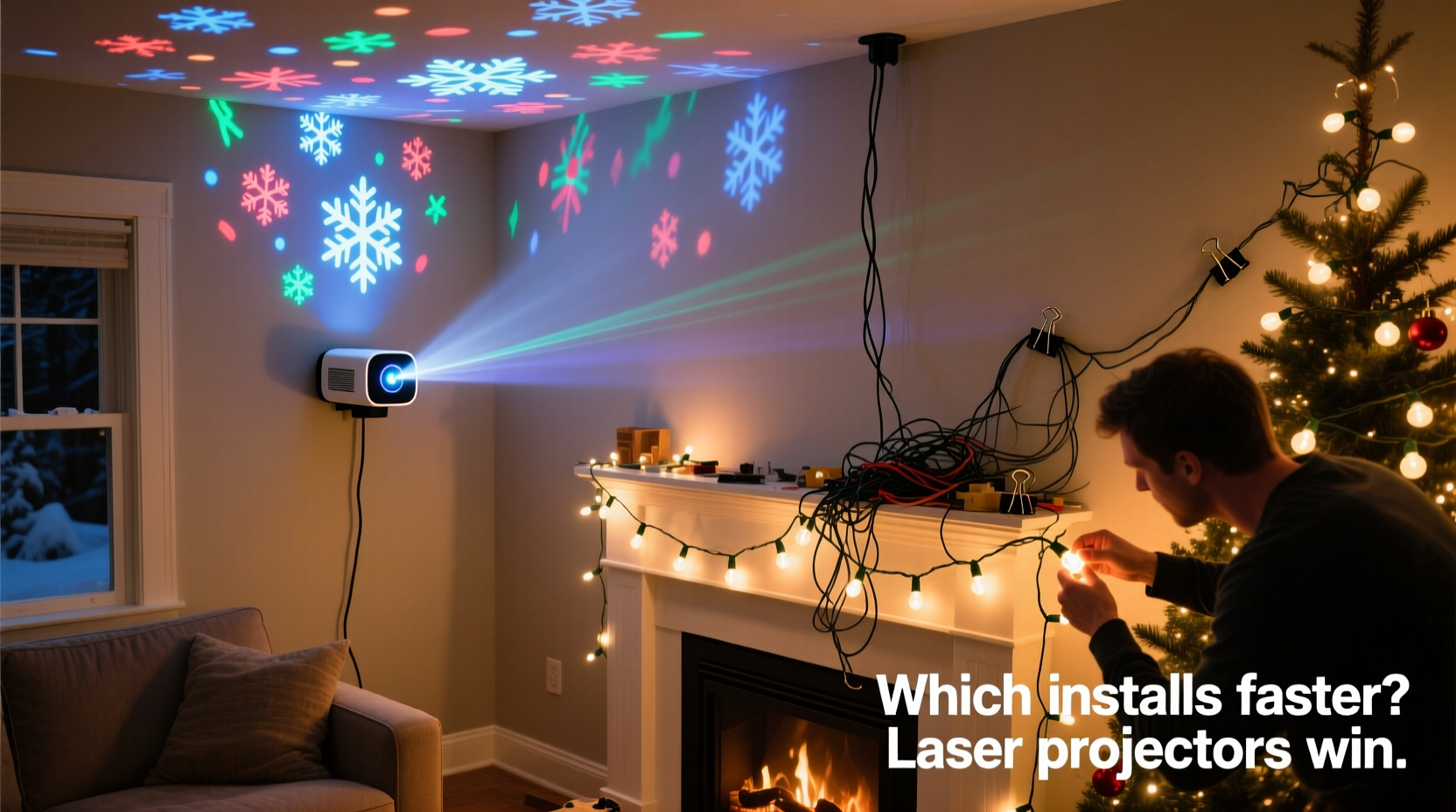
Before comparing installation speeds, it’s essential to understand how each lighting system functions.
Traditional light strings consist of connected LED or incandescent bulbs wired together in series. These strings vary in length (typically 25 to 100 feet) and are designed to be manually placed along architectural features. Installation involves untangling, testing, securing with clips or staples, connecting multiple strands, and ensuring even spacing and coverage. The process is tactile and often requires ladders, extension cords, and multiple people for larger homes.
Laser Christmas projectors, by contrast, use diode lasers and diffraction lenses to project hundreds of moving or static dots across surfaces. Most units operate on low-voltage power, require only a single outlet, and are mounted on stakes or attached to walls via adjustable brackets. Once positioned and plugged in, they illuminate large areas instantly—no weaving, no climbing, no complex wiring.
The fundamental difference lies in scale versus precision. Light strings offer granular control over placement but demand physical labor. Projectors trade fine detail for massive coverage and minimal setup.
Installation Time Breakdown: Real-World Scenarios
To evaluate which method installs faster, consider two common residential setups: a standard two-story home and a modest single-level ranch.
Scenario 1: Two-Story Home (Approx. 2,500 sq ft exterior)
Decorating a two-story home with traditional lights typically involves covering rooflines, windows, columns, and front landscaping. This usually requires:
- Unpacking and testing 6–10 light strings (150+ bulbs each)
- Using a ladder for at least 90 minutes
- Installing gutter clips or nail-in fasteners every 12–18 inches
- Running extension cords from multiple outlets
- Connecting and troubleshooting daisy-chained sets
- Adjusting spacing and fixing flickering sections
Total hands-on time: 3 to 4.5 hours, depending on experience and weather conditions.
In contrast, a dual-head laser projector setup might involve:
- Placing two ground-based projectors in front yard
- Adjusting angle and spread using built-in knobs
- Plugging into outdoor-rated outlets or power strips
- Testing pattern alignment
Total hands-on time: 15 to 30 minutes.
Scenario 2: Single-Level Ranch (Approx. 1,800 sq ft exterior)
For a smaller home, traditional string lights may take 1.5 to 2.5 hours to install, especially if covering porch railings, shrubs, and entryways. While less intensive than a two-story, it still involves repetitive clipping, cord management, and safety precautions.
A single laser projector can cover the same area in under 10 minutes. Some models include remote controls for on/off toggling and pattern rotation, eliminating the need to return to the unit once placed.
The disparity in setup time is not marginal—it's exponential. In both cases, laser projectors reduce installation duration by 85–95% compared to traditional methods.
Side-by-Side Comparison: Setup Factors Analyzed
| Factor | Traditional Light Strings | Laser Christmas Projectors |
|---|---|---|
| Setup Time | 1.5 – 4.5 hours | 10 – 30 minutes |
| Tools Required | Ladder, clips, staple gun, voltage tester, tape measure | None (or small stake/tripod) |
| Physical Effort | High (climbing, reaching, lifting) | Low (ground-level placement) |
| Number of Outlets Needed | 2–5 (depending on string count) | 1–2 |
| Learning Curve | Moderate (timing, spacing, electrical load) | Low (point and plug) |
| Storage & Unpacking | Time-consuming (tangling common) | Fast (compact units) |
| Weather Sensitivity | High (wet ladders, tripped GFCIs) | Low (most are IP44-rated) |
The data clearly favors laser projectors in terms of speed and simplicity. However, speed isn't the only consideration—durability, aesthetics, and neighborhood regulations also play roles.
Case Study: The Miller Family’s Holiday Upgrade
The Millers, a family of four in suburban Ohio, had decorated their colonial-style home with traditional lights every December for 12 years. Their routine was consistent: Thanksgiving weekend, dad climbed the ladder while mom managed cords and the kids handed up clips. Last year, after John Miller pulled a muscle during setup, they decided to try laser projectors.
They purchased a dual-green-and-red rotating laser system advertised for large homes. On a Saturday morning, they unboxed the unit, placed it in the front flower bed, adjusted the projection angle using the included leveling base, and plugged it in. Total time: 18 minutes. The entire house facade was covered in shimmering red and green dots, with animated snowflakes cycling through.
“I couldn’t believe it,” said Sarah Miller. “We used to spend half the day hanging lights, and now it’s done before breakfast. The kids love that we can turn it on with a remote.”
While neighbors initially questioned the “lack of tradition,” several asked where they could buy similar projectors after seeing the effect at night. The Millers reported saving over three hours in setup time—and avoided any risk of falls or electrical issues.
“Time is the most valuable resource during the holidays. Laser projectors aren’t replacing every decoration, but they’re replacing the most labor-intensive part.” — Mark Reynolds, Residential Lighting Designer, Holiday Illuminations Inc.
Step-by-Step Guide: Installing a Laser Christmas Projector in Under 20 Minutes
If you're considering making the switch, here’s how to do it efficiently:
- Choose Your Location: Find a flat surface 15–25 feet from your home’s main wall. Avoid slopes or soft soil.
- Clear the Area: Remove debris, toys, or plants that might block the beam or get damaged.
- Position the Projector: Place it on its stake or mounting base. Angle upward slightly to cover upper stories.
- Adjust the Spread: Use the focus dial (if available) to widen or narrow the dot field. Ensure coverage reaches gutters and windows.
- Plug In Safely: Use a grounded outdoor outlet and a surge-protected power strip. Never overload circuits.
- Test and Tweak: Turn on the unit and observe coverage. Minor adjustments may be needed for symmetry.
- Secure the Cord: Tape or stake down the power cord to prevent tripping hazards.
- Set a Timer: Program on/off times (many models include built-in timers or app control).
No special skills required. No tools beyond what’s included. And unlike tangled lights, there’s no frustration factor.
When Traditional Lights Still Make Sense
Despite their speed advantage, laser projectors aren’t universally superior. There are scenarios where traditional light strings remain the better choice:
- You value craftsmanship: Hand-placed lights convey effort and attention to detail.
- Local ordinances restrict projections: Some HOAs ban laser-type displays due to light pollution concerns.
- You’re decorating trees or enclosed porches: Projectors work best on flat, vertical surfaces—not dense foliage.
- You want multi-color variety per section: With strings, you can have blue on windows, white on railings, and multicolor on eaves.
- Power access is limited: If you lack outdoor outlets within range, running long extension cords for projectors may negate convenience.
Many decorators now adopt a hybrid approach—using projectors for large wall areas and traditional strings for accent zones like door frames or garages.
Frequently Asked Questions
Do laser Christmas projectors use more electricity than traditional lights?
No. Most laser projectors consume between 5–15 watts—comparable to a single string of 100 LED mini-lights. A full traditional display with multiple strands can use 100+ watts, making projectors more energy-efficient overall.
Can I leave a laser projector outside all winter?
Most models are rated for outdoor use (IP44 or higher), meaning they resist rain and snow. However, prolonged exposure to moisture and freezing temperatures can degrade seals over time. For longest lifespan, store them indoors during off-seasons and bring them out only during the holiday window.
Are laser projectors safe for neighbors and drivers?
Reputable models use Class II or Class IIIa lasers, which are eye-safe under normal use. However, avoid pointing them directly at sidewalks, roads, or adjacent homes. Always follow manufacturer guidelines for placement and beam direction.
Final Verdict: Speed Isn’t Everything—but It Matters
There’s no denying that laser Christmas projectors install significantly faster than traditional light strings. In head-to-head comparisons, they win by orders of magnitude in setup time, physical effort, and complexity. For busy families, older adults, or anyone short on time, this advantage is transformative.
But speed doesn’t equate to superiority in every context. Traditional lights offer unmatched texture, warmth, and customization. They’re tactile, nostalgic, and deeply embedded in holiday culture. For many, the act of hanging lights is part of the season’s joy.
The smartest approach may be strategic adoption: use laser projectors to handle the broad, time-consuming parts of your display—like covering large walls or driveways—and reserve traditional strings for personal touches. This hybrid model maximizes efficiency without sacrificing sentiment.
Technology doesn’t have to replace tradition—it can enhance it. By choosing the right tool for each part of your display, you gain more time to enjoy the holidays, share moments with loved ones, and simply savor the glow.




 浙公网安备
33010002000092号
浙公网安备
33010002000092号 浙B2-20120091-4
Comments
No comments yet. Why don't you start the discussion?