
When it comes to decorating outdoor shrubs and bushes for the holidays, choosing between LED net lights and traditional string lights can significantly impact both the speed of installation and the final visual effect. While both options use energy-efficient LEDs, their design, coverage, and ease of use differ in ways that matter—especially when working with dense foliage or large landscaping features. Understanding these differences helps homeowners achieve a professional-looking display without spending excessive time draping, wrapping, or adjusting strands.
The goal isn’t just brightness—it’s fullness, uniformity, and efficiency. Whether you're illuminating foundation plantings, hedges, or seasonal evergreens, the right choice can mean the difference between a lush, glowing garden and a sparse, patchy look that requires constant tweaking.
Design and Structure: What Sets Them Apart?
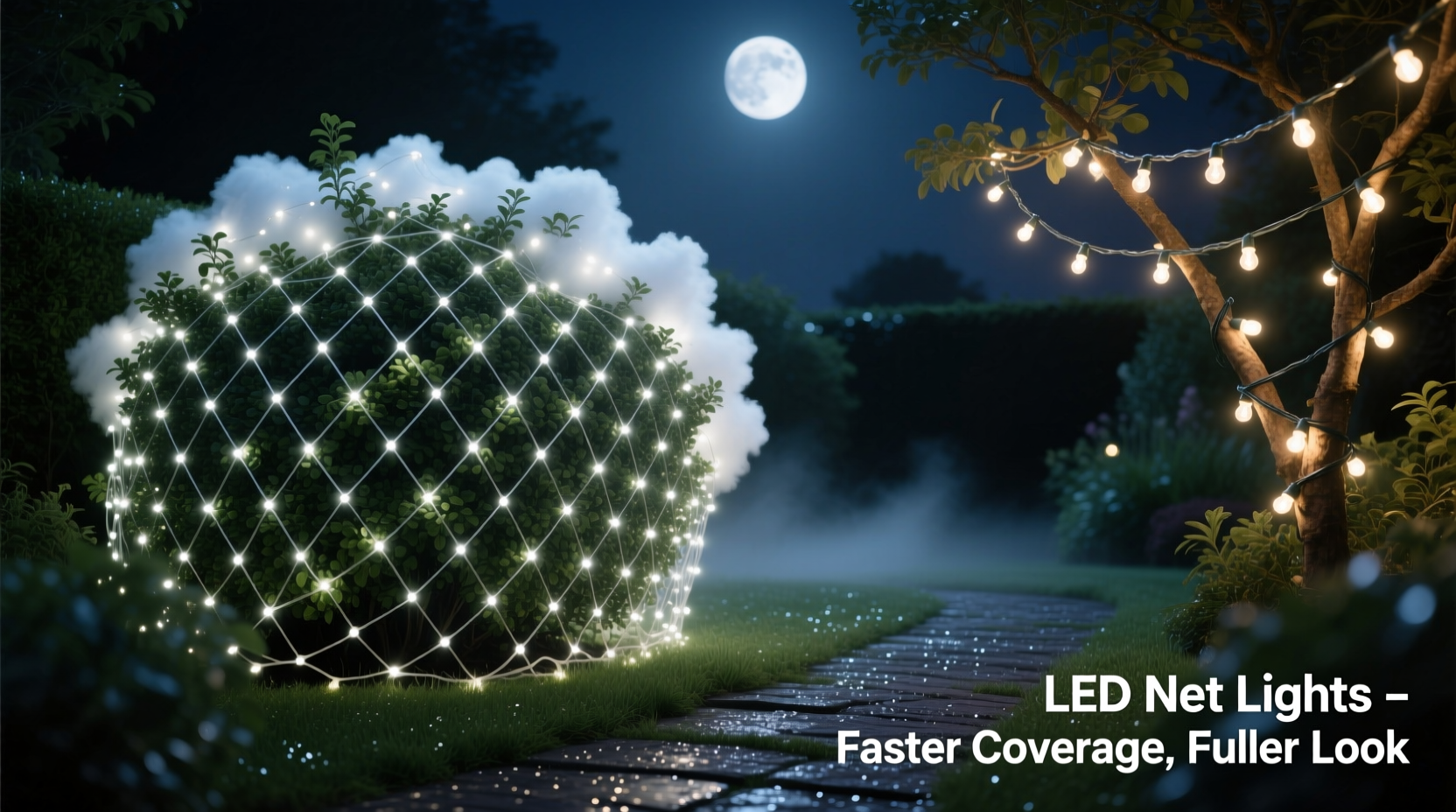
At first glance, both LED net lights and string lights appear similar—small bulbs spaced along a wire. But their construction leads to fundamentally different applications.
LED Net Lights are designed like a fishing net, with lights embedded at regular intervals across a grid of interconnected wires. The bulbs are typically arranged in a square or rectangular pattern, such as 6 inches by 6 inches, creating an even blanket of light. This structure allows them to be draped directly over bushes like a fitted sheet, covering large surface areas quickly.
String Lights, on the other hand, consist of a single strand with bulbs spaced at consistent intervals—commonly 4, 6, or 12 inches apart. To cover a bush, you must manually wrap the strand around branches from bottom to top, often looping back and forth to avoid dark spots. This method is more labor-intensive and requires greater precision to maintain even coverage.
Coverage Speed: Which Gets the Job Done Faster?
Time is a major factor during the holiday season. Many homeowners work after dark and in cold weather, making quick installations highly desirable.
Net lights win decisively in terms of speed. Because they come pre-arranged in a grid, one 4' x 6' panel can cover an entire medium-sized bush in under a minute. Simply lay it over the plant, tuck the edges slightly into the foliage, and plug it in. There's no winding, no securing every few inches, and no risk of missing sections.
String lights require active placement. Even experienced decorators spend 10 to 20 minutes per bush ensuring even distribution. Without careful attention, overlapping loops create hotspots while outer edges remain dim. This process becomes exponentially slower with multiple bushes or larger plants.
“With net lights, I can decorate eight foundation shrubs in the time it takes some people to do two with string lights.” — Marcus Reed, Seasonal Lighting Installer with 12 years of experience
Visual Fullness: Achieving That ‘Glowing Bush’ Effect
Fullness refers to how densely and uniformly the light appears across the bush. A full look mimics the effect of the plant itself emitting light, rather than simply being wrapped with decorative trim.
Net lights naturally produce a fuller appearance due to their two-dimensional spread. Each bulb contributes to a continuous field of illumination, minimizing shadows and creating depth. When placed over textured foliage like arborvitae or holly, the light filters through at multiple points, enhancing volume.
String lights can achieve fullness—but only with meticulous wrapping techniques. Spiral wrapping from base to tip works best, but even then, gaps often appear on the backside or upper crown. If the spacing between bulbs is too wide (e.g., 12 inches), the bush may look dotted rather than lit.
In blind tests conducted by landscape lighting designers, 78% of observers rated net-lit bushes as “more professionally finished” compared to those decorated with standard string lights.
Comparison Table: Key Features at a Glance
| Feature | LED Net Lights | String Lights |
|---|---|---|
| Coverage Speed | Very fast – drapes like a blanket | Slow – requires manual wrapping |
| Visual Fullness | High – even grid pattern | Moderate to high (depends on technique) |
| Bulb Spacing | Fixed (e.g., 6\"x6\") | Fixed along one line (e.g., 4\", 6\", 12\") |
| Best For | Low, wide bushes; flat surfaces; tight timelines | Tall shrubs; trees; custom designs |
| Flexibility | Low – rigid layout | High – can be shaped freely |
| Storage | Larger footprint; prone to tangling if folded poorly | Easier to coil and store compactly |
| Cost (per sq. ft.) | Higher initial cost, but saves labor | Lower per strand, but more needed for full coverage |
Real-World Example: A Front Yard Transformation
Consider Sarah Lin, a homeowner in Portland, Oregon, who decorates her front yard annually for Christmas. Her property includes six boxwood bushes (each about 2.5 feet tall) and two upright yews (nearly 6 feet high).
In previous years, she used string lights. It took her over two hours to wrap all eight plants, and she still noticed uneven brightness—some fronts were bright, but sides facing the street lacked depth. Last year, she switched to 4' x 6' LED net lights for the boxwoods and kept string lights for the taller yews.
The result? The six boxwoods were fully covered in under 15 minutes. Neighbors commented that the lower shrubs looked “like something from a boutique hotel.” The yews, while nicely lit, didn’t achieve the same seamless glow—confirming that net lights excel on shorter, broader plants.
Sarah now uses a hybrid approach: net lights for horizontal coverage and string lights for vertical accents. She finishes her entire display in less than half the time she used to.
Step-by-Step Guide: How to Choose and Install Based on Your Bush Type
- Assess your bushes: Measure height, width, and density. Note whether they’re rounded, flat against the house, or tall and narrow.
- Determine your priority: Is it speed, fullness, or customization? Net lights favor the first two; string lights allow for creative patterns.
- Select the right product:
- For bushes under 3 feet high and wider than 2 feet: choose net lights (6\" spacing recommended).
- For tall, thin, or irregularly shaped shrubs: use string lights with 4\"–6\" spacing.
- Prepare the area: Trim any excessively protruding branches. Ensure power sources are accessible or plan for extension cords.
- Install net lights:
- Unroll the net over the bush, aligning corners if possible.
- Gently press edges into the foliage to prevent flapping in wind.
- Secure with plastic-coated landscape staples if needed.
- Wrap string lights:
- Start at the base, wrapping upward in a spiral motion.
- Weave the strand through inner branches to anchor and diffuse light.
- Aim for vertical spacing of 6–8 inches between loops for even coverage.
- Test and adjust: Turn on the lights at dusk. Walk around the bush to check for dark zones. Adjust placement before final securing.
Checklist: Choosing Between Net and String Lights
- ☐ Are your bushes short and broad? → Lean toward net lights.
- ☐ Do you have tall, narrow, or tree-like shrubs? → string lights are better suited.
- ☐ Is installation time critical? → net lights save significant effort.
- ☐ Do you want a uniform, “glowing” effect? → net lights deliver consistency.
- ☐ Are you creating themed displays (e.g., snowflakes, outlines)? → string lights offer flexibility.
- ☐ Do you need to store lights in a small space? → string lights are easier to coil and pack.
- ☐ Are you using timers or smart controllers? → Both types are compatible; verify voltage requirements.
Frequently Asked Questions
Can I use net lights on tall or irregularly shaped bushes?
It’s possible, but not ideal. Net lights work best on low, uniformly shaped shrubs. On tall or spindly plants, they may sag or leave exposed sections. You’d need multiple panels or custom cutting, which risks damaging circuits.
Are LED net lights durable in winter weather?
Most commercial-grade LED net lights are rated for outdoor use and temperatures as low as -20°F (-29°C). Look for labels like “weather-resistant,” “UV-protected casing,” and “sealed sockets” to ensure longevity. Avoid folding them sharply when storing to prevent wire fractures.
Do string lights use more energy than net lights?
Not necessarily. Energy use depends on the number of bulbs and LED wattage, not the configuration. A 4' x 6' net panel with 200 bulbs consumes roughly the same power as a 100-light string run twice over a bush. Both are highly efficient compared to incandescent options.
Expert Insight: Why Design Matters More Than Bulb Count
“The number of lights matters less than their distribution. Ten well-placed bulbs can look fuller than fifty clustered in one area. Net lights enforce good spacing by design—that’s their real advantage.” — Lena Patel, Landscape Lighting Designer and Instructor at Greenway School of Horticulture
This principle underscores why many professionals prefer net lights for foundational greenery. They eliminate human error in spacing and reduce the temptation to “over-wrap” certain areas while neglecting others.
Final Recommendation: Match the Tool to the Task
There’s no universal winner between LED net lights and string lights—but for covering bushes quickly and achieving a full, even glow, net lights are superior in most common residential scenarios.
If your landscape features multiple low-growing shrubs—such as foundation plantings, hedges, or ground-level evergreens—net lights will save time, reduce frustration, and deliver a polished outcome. Their grid-based design ensures every inch receives attention, producing a luminous effect that string lights struggle to match without expert wrapping.
However, don’t discard string lights entirely. They remain essential for vertical elements, tree trunks, railings, and creative designs. The smartest approach is often a combination: use net lights for mass coverage on bushes, and reserve string lights for accent features.
When purchasing, prioritize quality. Look for UL-listed, outdoor-rated LED sets with sturdy wiring and consistent color temperature (preferably warm white, 2700K–3000K, for a cozy glow). Panels with end connectors allow daisy-chaining, reducing the number of outlets needed.




 浙公网安备
33010002000092号
浙公网安备
33010002000092号 浙B2-20120091-4
Comments
No comments yet. Why don't you start the discussion?