
The Galaxy S7 Edge was a flagship powerhouse in 2016—its curved display, water resistance, and excellent camera made it a fan favorite. Fast forward to 2017, and LG answered with the V30, a premium phablet emphasizing audio quality, OLED clarity, and refined design. But nearly seven years later, with both devices long out of production, is moving from the S7 Edge to the V30 still a meaningful upgrade? For users holding onto older Samsung flagships, this question isn’t just nostalgic—it’s practical.
While neither phone supports the latest apps or security updates fully, some users still rely on these devices for secondary use, travel, or as backup phones. Understanding the tangible differences helps determine whether the switch offers real benefits or merely swaps one aging device for another.
Design and Build: Refinement Meets Legacy
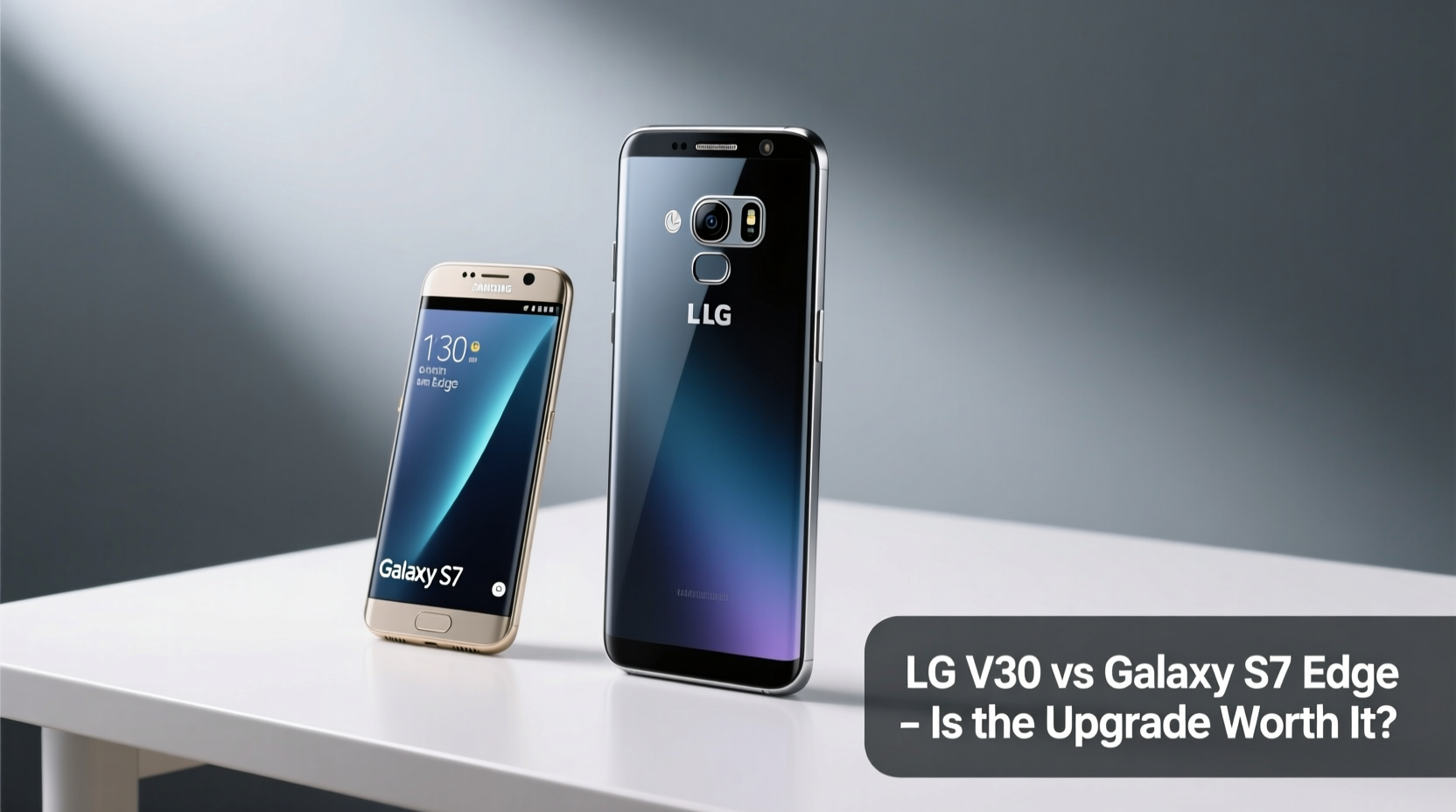
The Galaxy S7 Edge set a high bar for smartphone aesthetics. Its dual-curved AMOLED display, glass back, and aluminum frame gave it a luxurious feel. It was also one of the first mainstream phones with IP68 water and dust resistance, making it durable in everyday scenarios.
The LG V30 improved on that foundation with a sleeker profile. It featured a larger 6.0-inch OLED display but managed to be slightly thinner and lighter than the S7 Edge despite the size increase. LG used Gorilla Glass 5 on both front and back and maintained IP68 certification. However, its design leaned more toward minimalism—flat edges, fewer curves, and a rear-mounted fingerprint sensor that many found less convenient than the S7 Edge’s front placement.
Material-wise, both phones feel premium, but the V30’s glass back is more prone to smudges and scratches without a case. The S7 Edge, while similarly delicate, has proven over time to hold up well under daily wear when protected.
Display Quality: Clarity and Usability Evolution
The S7 Edge’s 5.5-inch Quad HD Super AMOLED display was groundbreaking at launch—vibrant colors, deep blacks, and excellent outdoor visibility. It remains sharp and functional today, though newer screen technologies have surpassed it.
The V30 introduced an FHD+ (1440 x 3120) P-OLED display with a taller 18:9 aspect ratio. While resolution dropped slightly from Quad HD to Full HD+, the pixel density remained high (~538 ppi), and the panel offered better brightness, improved HDR support, and reduced blue light emission thanks to LG’s Vision Care features.
In side-by-side viewing, the V30 delivers a more modern experience: less bezel, better scrolling efficiency due to the taller screen, and smoother media playback for widescreen content. For streaming video or reading long articles, the V30’s display is objectively superior—even years later.
Performance and Software Longevity
Under the hood, both phones launched with top-tier hardware. The S7 Edge used either the Exynos 8890 or Snapdragon 820, depending on region, paired with 4GB RAM. The V30 upgraded to the Snapdragon 835 with 4GB RAM—marginally faster CPU and GPU performance, better power efficiency, and improved thermal management.
In real-world use, the difference is subtle. Both handle basic tasks like web browsing, messaging, and music playback adequately today. However, app loading times, multitasking, and background app retention are noticeably smoother on the V30. This becomes evident when switching between social media, email, and navigation apps.
Software support tells a clearer story. Samsung provided three major Android updates for the S7 series (up to Android 9 Pie with limited security patches until 2020). LG supported the V30 up to Android 9 as well, but rolled out updates faster and included additional software features like Floating Bar multitasking and advanced audio tuning.
“Even small improvements in SoC efficiency can extend usable life by months in older devices.” — David Kim, Mobile Hardware Analyst at TechLongevity Labs
For users still relying on these phones, the V30’s slightly better optimization and cleaner UI (LG UX vs Samsung Experience) offer a more pleasant experience in 2024.
Camera Comparison: Different Philosophies, Similar Results
| Feature | Galaxy S7 Edge | LG V30 |
|---|---|---|
| Rear Camera | 12MP f/1.7, Dual Pixel AF | 16MP f/1.6 + 13MP f/2.4 (wide) |
| Front Camera | 5MP f/1.7 | 5MP f/1.9, 100-degree wide |
| Video Recording | 4K @ 30fps | 4K @ 30/60fps, Cine Log, HDR10 |
| Low Light | Excellent for its time | Slightly better dynamic range |
The S7 Edge’s camera was legendary in 2016. Its large 1.4µm pixels and f/1.7 aperture captured stunning low-light photos. Fast autofocus and natural color reproduction made it a go-to for casual photographers.
The V30 took a different approach: higher resolution (16MP) main sensor with an even wider f/1.6 aperture and a secondary wide-angle lens. While individual pixel size dropped to 1.0µm, LG compensated with advanced noise reduction and optical stabilization. The addition of manual controls, Pro mode, and HDR10 video recording gave creative users more flexibility.
In daylight, both produce pleasing results. In low light, the S7 Edge often looks warmer and more balanced, while the V30 captures more detail but can appear cooler or noisier if not tuned properly. For video enthusiasts, the V30 is clearly superior—60fps 4K and Cine Log profiles are unmatched in this class.
Battery and Charging: Efficiency Gains Matter
The S7 Edge packs a 3,600mAh battery—impressive for 2016—and supports fast charging and wireless charging. In regular use, it delivered a full day easily. The V30 uses a slightly smaller 3,300mAh cell but benefits from the more efficient Snapdragon 835 and OLED power savings. Real-world testing showed similar endurance: about 5–6 hours of screen-on time.
Where the V30 pulls ahead is in charging intelligence. It includes adaptive battery management and supports Qualcomm Quick Charge 3.0 more consistently. However, it lacks wireless charging—a notable downgrade for S7 Edge owners accustomed to convenience.
Real-World Example: Upgrading After Five Years
Consider Maria, a freelance photographer who held onto her S7 Edge as a backup phone until 2022. When it finally began lagging during file transfers and failed to support newer editing apps, she sourced a used V30. Her experience highlights the practical trade-offs.
She appreciated the V30’s taller screen for reviewing photos and using split-screen apps. The improved audio DAC made listening to client feedback clearer. However, she missed wireless charging and found the rear fingerprint sensor less reliable. Overall, she rated the upgrade “worth it” for productivity, but noted that both phones now struggle with Instagram and WhatsApp updates.
Upgrade Checklist: Is the Move Right for You?
- ✅ Need a taller, more modern display for media consumption?
- ✅ Want better video recording capabilities (4K/60fps, HDR)?
- ✅ Prioritize audio quality for calls or music?
- ✅ Can live without wireless charging?
- ✅ Using the phone primarily for light tasks or offline functions?
- ❌ Need strong app compatibility or long-term security updates?
If most of your answers are “yes” to the first five and “no” to the last, the V30 offers measurable improvements. Otherwise, consider stepping into current mid-range models instead.
Frequently Asked Questions
Can the LG V30 run modern apps smoothly?
Basic apps like Gmail, Chrome, and Spotify work, but performance degrades with heavier apps like TikTok or Google Maps with multiple layers. Expect occasional crashes or slow loading.
Is the V30’s wide-angle camera better than the S7 Edge’s zoom?
The V30 doesn’t have optical zoom, but its 135-degree wide-angle lens is excellent for landscapes and group shots. The S7 Edge relies on digital zoom, which reduces quality. For versatility, the V30 wins.
Which phone holds battery longer today?
It depends on usage. With degraded batteries, the S7 Edge often retains capacity better due to earlier calibration. But with healthy cells, the V30’s efficiency gives it a slight edge in mixed use.
Final Verdict: A Niche Upgrade with Diminishing Returns
Moving from the Galaxy S7 Edge to the LG V30 in 2024 isn’t about future-proofing—it’s about squeezing extra utility from aging hardware. The V30 offers tangible upgrades: a better display, improved cameras, enhanced audio, and slightly snappier performance. But it removes conveniences like wireless charging and has a less intuitive fingerprint layout.
For collectors, audiophiles, or users in emerging markets where older flagships remain common, the upgrade makes sense. For everyone else, the real answer lies beyond these two devices. Modern budget phones now outperform both in AI processing, connectivity, and software support.




 浙公网安备
33010002000092号
浙公网安备
33010002000092号 浙B2-20120091-4
Comments
No comments yet. Why don't you start the discussion?