
In the modern workspace—whether at a standing desk, in a home office, or across multiple devices—your keyboard is more than a tool. It’s the primary interface between your thoughts and their digital expression. Two standout models have carved niches among professionals seeking efficiency: the Logitech MX Keys and the Keychron K3. Both are wireless mechanical keyboards designed for productivity, but they serve different philosophies, workflows, and user preferences. Choosing between them isn’t just about brand loyalty; it’s about aligning hardware with how you work.
This detailed analysis breaks down every critical factor—from typing experience and connectivity to ergonomics and customization—to help you determine which keyboard delivers the most meaningful productivity gains for your daily routine.
Design and Build Quality
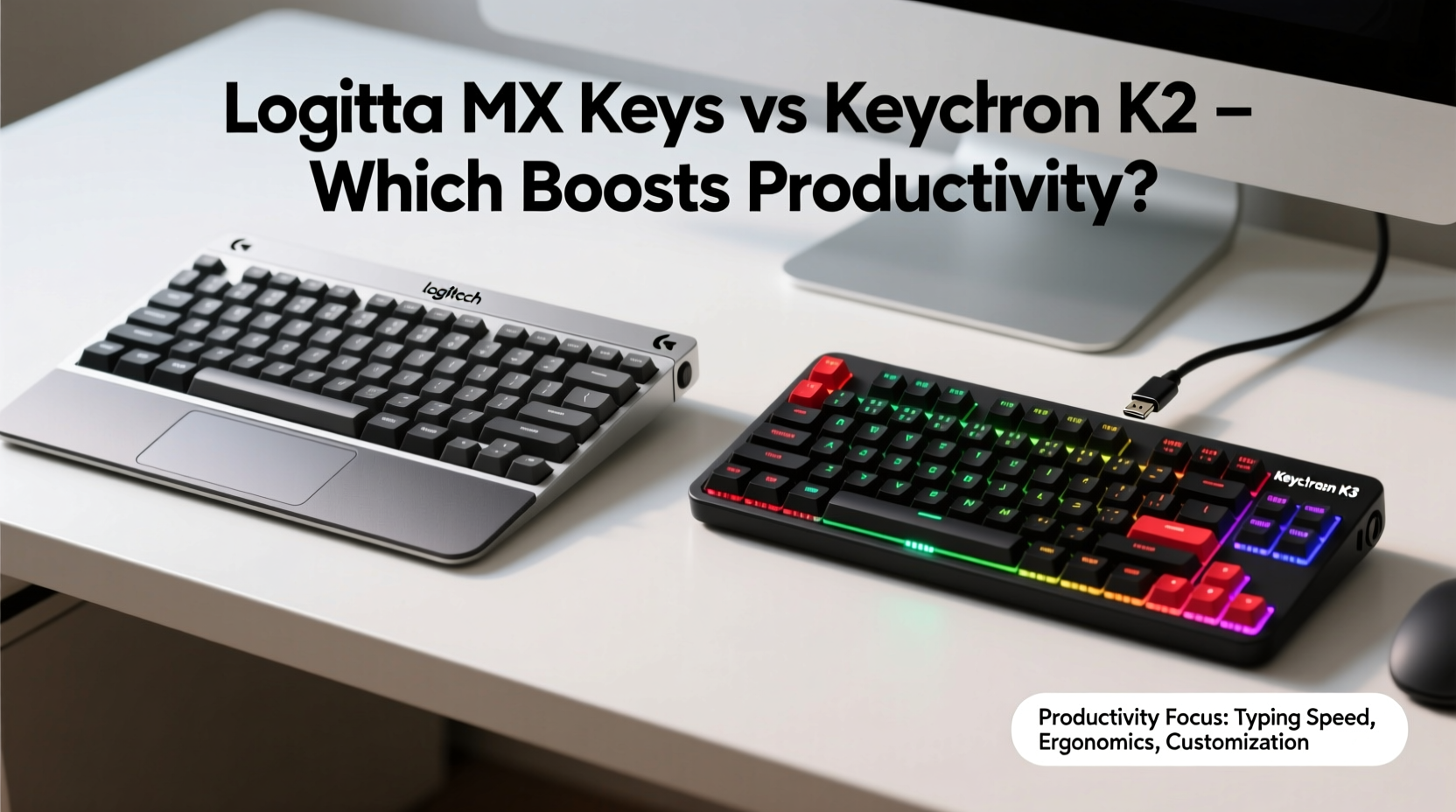
The first impression matters. A keyboard that feels solid and looks professional can elevate your workspace aesthetics while reinforcing confidence in its durability.
The Logitech MX Keys exudes premium minimalism. Its aluminum top case gives it a sleek, business-ready appearance suitable for corporate environments or minimalist desks. The low-profile design keeps it compact, and the rounded keycaps follow a concave shape optimized for finger glide. It weighs 960g, providing stability without being cumbersome.
In contrast, the Keychron K3 embraces a retro-inspired aesthetic with a thicker plastic body and slightly elevated key profile. While not as dense as the MX Keys, it still feels sturdy thanks to its ABS double-shot keycaps and integrated tilt legs. At 75% layout (compact 84 keys), it saves space but retains essential function keys—ideal for users who rely on F-keys regularly.
Both keyboards are spill-resistant and rated for long-term use, but the MX Keys benefits from IP rating certification (IP4X dust resistance and splash protection), giving it an edge in resilience against accidental spills—a common workplace hazard.
Typing Experience and Switch Options
Productivity begins with comfort. A keyboard that causes fatigue or lacks tactile feedback will slow you down over time, no matter how many features it offers.
The MX Keys uses scissor-switch mechanisms with pre-travel actuation of 1.5mm and total travel of 3mm. These are not traditional mechanical switches but rather high-end membrane-style keys engineered for quietness and consistency. The result is a soft, cushioned keystroke ideal for shared offices or late-night typing sessions. There’s no hot-swappability—the switches are fixed.
The Keychron K3, however, is a true mechanical keyboard. It comes with Gateron Red, Brown, or Blue switches—all hot-swappable via its plate-mounted PCB. This means you can change switch types without soldering, allowing customization based on preference:
- Gateron Red: Linear, light actuation (45g), smooth press—great for fast typists and gamers.
- Gateron Brown: Tactile bump at mid-press (55g)—a balanced choice for general productivity.
- Gateron Blue: Clicky and tactile (50g)—preferred by typists who like audible feedback.
“Mechanical keyboards reduce finger strain over extended typing sessions because of consistent actuation force.” — Dr. Lena Torres, Ergonomics Researcher at MIT Human Factors Lab
For writers, coders, or anyone spending hours at the keyboard, the ability to tailor switch feel makes the Keychron K3 inherently more adaptable. However, if you work in a quiet environment where clicky keys would disturb others, the quieter MX Keys may be the pragmatic pick.
Connectivity and Multi-Device Performance
In today’s hybrid workflow, switching between laptop, tablet, phone, and desktop is routine. Seamless multi-device support is no longer a luxury—it’s a necessity.
Both keyboards offer Bluetooth 5.1 and USB-C wired connectivity. But here's where Logitech shines: the MX Keys supports **Easy-Switch technology**, allowing pairing with up to three devices simultaneously. A simple toggle button lets you switch between them instantly. It also integrates with Logitech’s Flow software, enabling mouse and keyboard control across computers—even copying text on one machine and pasting on another.
The Keychron K3 also pairs with three devices via Bluetooth and remembers them reliably. However, switching requires either using function shortcuts (Fn + Q/W/E) or reconnecting manually through device settings. No companion software enhances cross-device functionality beyond basic input.
Additionally, the MX Keys includes a USB Unifying receiver option for ultra-stable connection, especially useful in high-interference environments like open-plan offices. The K3 relies solely on Bluetooth or wired mode.
| Feature | Logitech MX Keys | Keychron K3 |
|---|---|---|
| Switch Type | Scissor (Low-profile) | Mechanical (Gateron Red/Brown/Blue) |
| Hot-Swappable | No | Yes |
| Backlighting | White backlight with auto-sensing | RGB per-key lighting (customizable) |
| Battery Life | Up to 10 days (backlight on), 5 months (off) | Up to 72 hours (RGB on), ~3 weeks (off) |
| Multi-Device Pairs | 3 (with Easy-Switch buttons) | 3 (manual Fn switching) |
| Dedicated Function Row | No (requires Fn key) | Yes (full F1–F12 row) |
| Software Customization | Logitech Options+ (full remapping, macros) | VIA (open-source, limited support) |
Real-World Productivity: A Mini Case Study
Consider Sarah, a technical writer splitting her day between a Windows desktop (documentation), a MacBook Air (email and research), and an iPad Pro (editing on the couch). She values speed, accuracy, and seamless transitions.
She tested both keyboards over two weeks. With the MX Keys, she appreciated the instant device toggling and reliable Logitech Flow integration. Copying code snippets from her PC to her Mac felt effortless. The quiet keystrokes didn’t distract her partner during video calls. However, after several hours of writing, she noticed slight finger fatigue due to the lack of tactile feedback.
Switching to the Keychron K3 with Gateron Browns, she immediately felt more engaged with each keystroke. The tactile bump helped prevent typos, and the dedicated F-keys sped up her browser and IDE commands. But switching devices required pausing her flow to press Fn+W, and the RGB backlight drained the battery in just three days when left on.
In the end, Sarah chose the MX Keys—not because it typed better, but because its ecosystem reduced friction across her multi-device workflow. For her, productivity wasn't just about keystrokes per minute; it was about minimizing interruptions.
Customization and Software Ecosystem
A keyboard should adapt to you—not the other way around. This is where software becomes critical.
Logitech’s **Options+** app allows full key remapping, macro creation, and behavior customization (e.g., turning Caps Lock into Escape or Ctrl). You can set different profiles per connected device, so your shortcuts stay context-aware. The interface is polished and beginner-friendly.
Keychron supports **VIA (Variable Input Architecture)**, an open-source configuration tool that enables on-the-fly reprogramming without proprietary software. While powerful for enthusiasts, VIA has limitations: not all Keychron firmware versions support it out-of-the-box, and the UI is less intuitive than Logitech’s offering. Still, for tinkerers who want complete control, this is a major advantage.
If you frequently use specialized shortcuts (e.g., developers, designers, data analysts), the ability to create custom layers or macros can save hundreds of keystrokes per week. The MX Keys makes this accessible to all users; the K3 reserves it for those willing to dive into open-source tools.
Which One Boosts Productivity More?
The answer depends on your definition of “productivity.”
If your priority is **seamless integration across devices, quiet operation, and plug-and-play reliability**, the Logitech MX Keys is superior. Its intelligent backlight adjusts to ambient light, its anti-dust coating protects longevity, and its cross-computer Flow capability reduces repetitive tasks. It’s engineered for professionals who value polish over personalization.
But if you define productivity as **typing endurance, tactile precision, and long-term adaptability**, the Keychron K3 wins. Mechanical switches reduce finger strain, customizable layouts enhance efficiency, and hot-swap compatibility future-proofs your investment. It’s ideal for writers, coders, and keyboard enthusiasts who spend six-plus hours typing daily.
Frequently Asked Questions
Can I use the Keychron K3 with macOS effectively?
Yes. The Keychron K3 has a macOS mode (activated via Fn + Control) that swaps Command and Option keys, adds media controls, and enables brightness adjustment. However, some function keys require additional system-level remapping for full parity with Apple’s native keyboards.
Does the MX Keys work with Linux?
Yes, the MX Keys functions well with most Linux distributions via Bluetooth or Unifying receiver. Logitech Options+ software is not available for Linux, so advanced customization (like remapping) must be handled through third-party tools like Solaar or xbindkeys.
Is the Keychron K3 really louder than the MX Keys?
It depends on the switch. With Gateron Reds or Browns, the K3 is moderately loud but acceptable in quiet spaces. Gateron Blues produce a distinct click that may disturb nearby colleagues. The MX Keys, with its dampened scissor mechanism, remains significantly quieter across all scenarios.
Action Plan: Choosing Your Keyboard
- Evaluate your primary device setup: Do you use multiple operating systems? If yes, prioritize MX Keys for smoother transitions.
- Assess your typing volume: Over 20,000 keystrokes per day? Mechanical switches (K3) may improve accuracy and reduce fatigue.
- Test noise sensitivity: In shared spaces, choose MX Keys or equip the K3 with silent switches (e.g., Gateron Silent Reds).
- Decide on customization needs: Need macros or deep software integration? MX Keys offers better-supported tools.
- Consider long-term ownership: Want to upgrade switches later? The K3’s hot-swap PCB gives it lasting value.
Final Verdict
The Logitech MX Keys and Keychron K3 represent two philosophies of productivity. One prioritizes ecosystem harmony and executive refinement; the other champions mechanical authenticity and user empowerment.
The MX Keys excels in environments where silence, elegance, and smart features matter most. It’s the keyboard for executives, remote workers, and creatives juggling devices with minimal fuss.
The Keychron K3 appeals to hands-on professionals who type extensively and want full control over their tools. Its mechanical foundation, expandable firmware, and compact layout cater to those who see their keyboard as a long-term companion—not just an accessory.
Ultimately, boosting productivity isn’t about choosing the “best” keyboard overall—it’s about selecting the one that best aligns with your habits, environment, and goals. Test both if possible. Your fingers—and your output—will thank you.




 浙公网安备
33010002000092号
浙公网安备
33010002000092号 浙B2-20120091-4
Comments
No comments yet. Why don't you start the discussion?