
The Logitech MX Master series has long been a favorite among professionals who demand precision, comfort, and productivity from their peripherals. When Logitech released the MX Master 3S as the successor to the widely acclaimed MX Master 3, one headline feature stood out: the “90% quieter clicks.” While this sounds like a clear improvement—especially in shared offices or late-night work sessions—it raises a critical question: does reducing click noise come at the cost of user satisfaction? Is the quiet click feature actually annoying?
To answer that, we need to go beyond marketing claims and examine how these mice perform in real-world scenarios. This isn’t just about decibels; it’s about tactile feedback, muscle memory, and the subtle sensory cues that shape our interaction with tools we use daily.
Design and Build: Evolution, Not Revolution
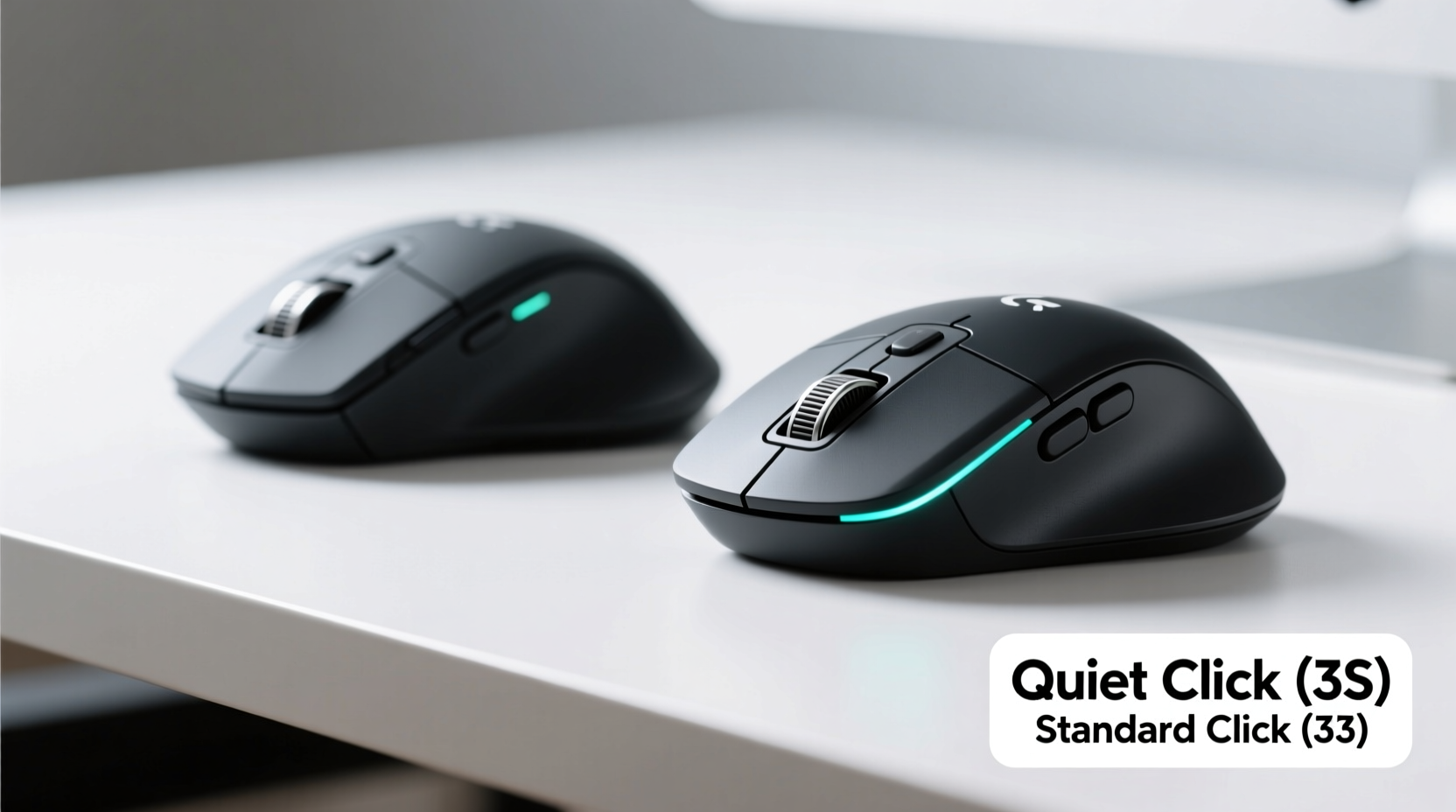
At first glance, the MX Master 3S and 3 are nearly identical. Both feature the same ergonomic silhouette designed for right-handed users, contoured thumb rest, and premium matte finish. They share the same 8K DPI sensor, MagSpeed scroll wheel, and multi-device Bluetooth connectivity. Even the weight—141 grams—is unchanged.
The differences lie beneath the surface. The 3S introduces Logitech’s new mechanical switch technology, specifically engineered to reduce actuation noise without sacrificing responsiveness. According to Logitech, each left-click is now 90% quieter than the MX Master 3, registering at approximately 57 dB compared to the original’s 68 dB. That’s roughly equivalent to lowering the volume of a normal conversation to the background hum of a library.
Tactile Feedback: The Heart of the Debate
Noise reduction in mechanical switches often involves altering the spring tension, internal dampening, or switch housing design. In the case of the MX Master 3S, Logitech redesigned the microswitches using what they call “silent switch technology,” which includes internal rubber dampeners and optimized spring mechanics.
Users accustomed to the crisp, sharp feedback of the MX Master 3 may find the 3S underwhelming at first. The click feels softer, slightly more muted—not mushy, but less defined. It lacks the satisfying “snap” that many typists and clickers associate with confirmation of input.
“Tactile feedback isn't just about touch—it's auditory and kinesthetic too. Removing the audible cue can make actions feel less certain, even if response time hasn't changed.” — Dr. Lena Park, Human-Computer Interaction Researcher, MIT Media Lab
This phenomenon is known as sensory substitution. When one sensory channel (sound) is diminished, the brain relies more heavily on others (touch, vision). For some, this shift is imperceptible. For others, especially those with repetitive workflows involving hundreds of clicks per hour, the absence of auditory feedback creates a sense of disconnection from the device.
Performance Comparison: Specs vs. Sensation
On paper, both mice are technically matched. But real-world performance reveals nuances that specs can’t capture.
| Feature | MX Master 3 | MX Master 3S |
|---|---|---|
| Click Noise Level | ~68 dB | ~57 dB (90% quieter) |
| Switch Type | Standard mechanical | Logitech Silent Switch |
| Tactile Feedback | Crisp, pronounced | Softer, subdued |
| DPI Range | Up to 8,000 | Up to 8,000 |
| Scroll Wheel | MagSpeed electromagnetic | MagSpeed electromagnetic |
| Battery Life | Up to 70 days | Up to 70 days |
| Connectivity | Bluetooth, USB Unifying | Bluetooth, USB Unifying |
| Price (MSRP) | $99.99 | $99.99 |
While the core functionality remains consistent, the subjective experience diverges significantly. The MX Master 3 delivers a confident, almost mechanical keyboard-like click—ideal for users who rely on sensory confirmation. The 3S prioritizes discretion, making it better suited for collaborative spaces, open offices, or hybrid home setups where noise pollution is a concern.
Real-World Use Case: Working in a Shared Apartment
Consider Alex, a freelance UX designer living in a two-bedroom apartment with a partner who works night shifts. During evening hours, Alex needs to edit wireframes, navigate Figma files, and communicate via Slack—all while minimizing disturbance.
With the MX Master 3, every left-click produced a noticeable tap, especially on a glass desk. Over several hours, the cumulative effect was disruptive enough that his partner began wearing earplugs. After switching to the 3S, the ambient noise dropped noticeably. His workflow remained uninterrupted, but his partner reported being able to concentrate better during late-night study sessions.
However, Alex noticed a trade-off: he occasionally double-clicked icons, thinking the first click hadn’t registered. It took nearly a week to recalibrate his clicking pressure and rhythm. Once adapted, the transition smoothed out—but the initial adjustment period highlighted how deeply ingrained auditory feedback is in digital interaction.
User Adaptability: Can You Get Used to It?
Adaptation plays a major role in whether the quiet click becomes an asset or an annoyance. Most users report acclimating within 3–5 days of regular use. However, individual sensitivity varies.
- Fast adapters: Users who prioritize silence or already use low-noise keyboards tend to embrace the 3S quickly.
- Slow adapters: Those with strong muscle memory from years of using louder switches may struggle initially.
- Non-adapters: A small segment reports persistent dissatisfaction, describing the 3S as “lifeless” or “unresponsive,” despite no actual latency difference.
The key factor isn’t technical performance—it’s psychological expectation. We expect a click to sound a certain way because that’s what decades of mouse design have conditioned us to accept as “working correctly.” When that expectation is violated—even subtly—we perceive a flaw, even if none exists.
Step-by-Step: How to Evaluate the Quiet Click for Yourself
If you're considering upgrading or choosing between models, follow this practical evaluation process:
- Identify your environment: Do you work in quiet spaces, shared offices, or late at night? High noise sensitivity favors the 3S.
- Test side-by-side: If possible, use both mice for a full work session. Pay attention to subconscious reactions—do you miss clicks? Feel uncertain?
- Adjust your surface: Hard surfaces amplify sound. Try using a padded mousepad to see if it reduces the 3’s noise to acceptable levels.
- Monitor fatigue: Over extended use, does the lack of feedback cause you to press harder, leading to finger strain?
- Check return policy: Buy from a retailer with a 30-day return window. Give yourself two weeks of consistent use before deciding.
Frequently Asked Questions
Does the MX Master 3S have any lag due to quieter switches?
No. The 3S maintains the same 8,000 DPI sensor and 1ms report rate as the 3. There is no measurable input lag introduced by the silent switches. The change is purely in sound and tactile feel, not performance.
Can I replace the switches on the MX Master 3S myself?
Technically, yes—but it’s not recommended. The MX Master series uses proprietary switches soldered onto the PCB. Replacing them requires advanced soldering skills and risks voiding the warranty. Logitech does not offer user-replaceable switch kits.
Is the right-click also quieter on the 3S?
Yes. The quieting technology applies to both left and right buttons. However, most user feedback focuses on the left-click, as it’s used far more frequently in daily tasks.
Final Verdict: Annoying or Advantageous?
Calling the quiet click feature “annoying” oversimplifies a nuanced reality. For many users—especially those in noise-sensitive environments—it’s a meaningful improvement. For others, particularly those who value tactile certainty and auditory feedback, it can feel like a step backward.
The truth is, the MX Master 3S isn’t objectively better or worse than the 3. It’s different. It represents a shift in design philosophy: from performance-first to coexistence-first. It’s optimized not just for speed and accuracy, but for harmony within shared spaces.
If you’ve never considered how much noise your mouse makes, you might not notice the difference. But if you’ve ever apologized for clicking too loudly in a meeting or hesitated to open a spreadsheet at midnight, the 3S could be the mouse you didn’t know you needed.
Conclusion: Choose Based on Your Workflow, Not Just Specs
When deciding between the Logitech MX Master 3 and 3S, look beyond the spec sheet. Ask yourself: What kind of environment do I work in? How important is discretion? Do I rely on sound and feel to confirm my actions?
The quiet click isn’t a flaw. It’s a design choice—one that prioritizes peace over punch. Whether that trade-off annoys or appeals to you depends entirely on your personal and professional context.
If you’re still unsure, try before you buy. Borrow one, visit a store, or take advantage of a return policy. Because in the end, the best mouse isn’t the quietest or the loudest—it’s the one that disappears into your workflow, letting you focus on what really matters: the work itself.




 浙公网安备
33010002000092号
浙公网安备
33010002000092号 浙B2-20120091-4
Comments
No comments yet. Why don't you start the discussion?