
Choosing the right hardware for a home server is more than just about processing power or storage capacity—it’s about long-term reliability, noise levels, and thermal behavior. Two of the most popular compact computing platforms for this role are Apple’s Mac Mini with the M3 chip and Intel’s NUC (Next Unit of Computing) series. While both deliver strong performance in small form factors, their thermal profiles differ significantly, especially under sustained workloads typical of server use. For users prioritizing quiet operation and low heat output, understanding how these devices manage temperature is critical.
The Mac Mini M3 and Intel NUC represent two distinct design philosophies. Apple emphasizes passive cooling, energy efficiency, and system integration, while Intel NUCs offer greater flexibility in configuration and OS compatibility but often rely on active cooling. When deployed as a 24/7 home server—hosting media, backups, virtual machines, or containers—the device’s ability to run cool directly affects longevity, noise pollution, and ambient room temperature.
Thermal Design and Cooling Architecture
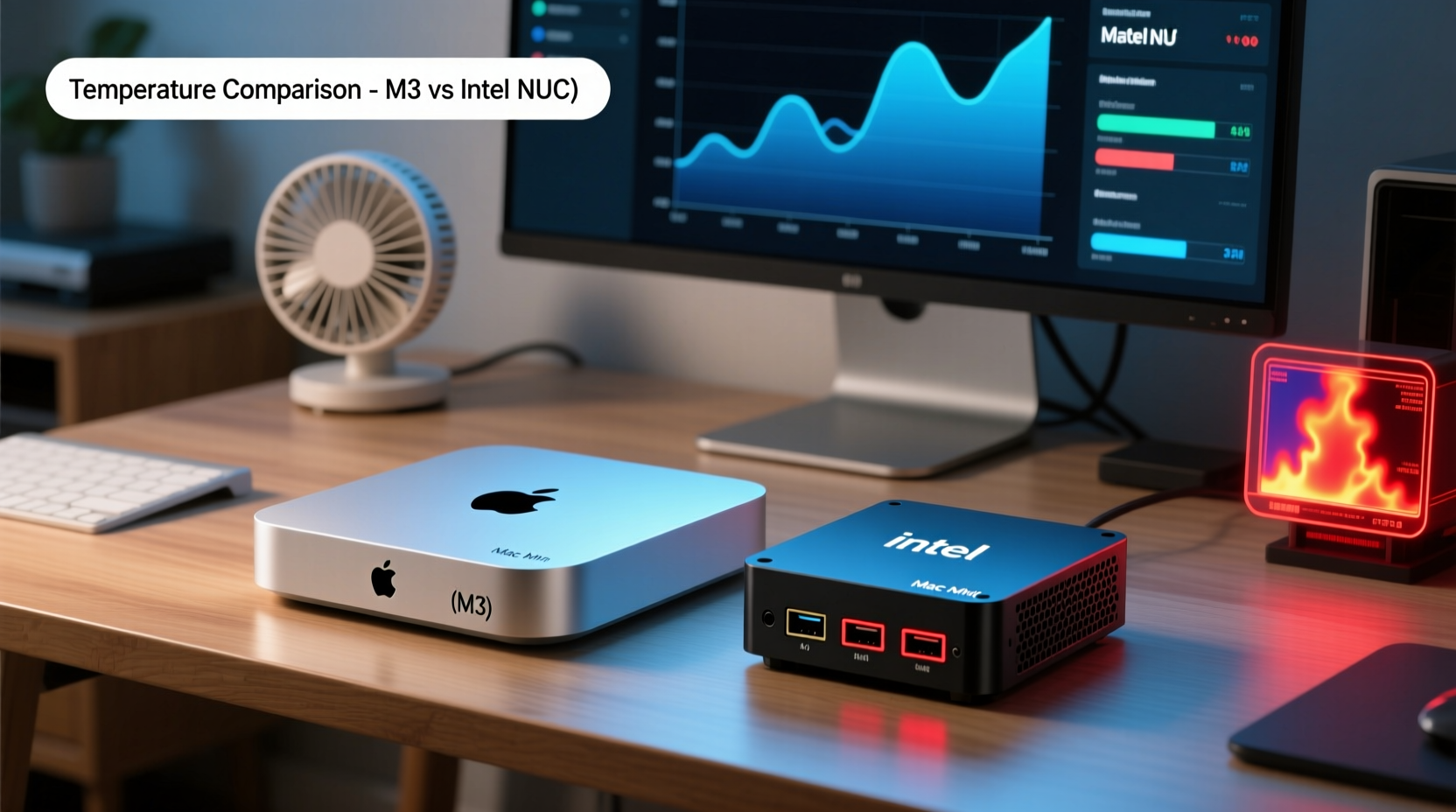
The foundation of any device’s cooling capability lies in its thermal design. The Mac Mini M3 uses a fanless, passively cooled architecture. Apple leverages the M3 chip’s exceptional power efficiency and integrates a large aluminum heatsink that dissipates heat across the entire chassis. This allows the system to remain completely silent even under moderate load—a major advantage in living spaces or bedrooms where a server might be located.
In contrast, most Intel NUC models—even compact ones like the NUC 13 Pro or NUC 12 Enthusiast—include at least one small internal fan. While these fans are generally quiet at idle, they ramp up under sustained CPU usage, introducing audible noise and potential points of mechanical failure over time. Some NUCs, such as the NUC 11 Performance or certain fanless industrial variants, do exist without fans, but they often sacrifice peak performance or require careful workload management to avoid thermal throttling.
Performance Under Sustained Load
To evaluate real-world thermal behavior, it’s essential to consider how each platform performs during continuous operations typical of home servers: file serving, Plex transcoding, Docker container hosting, or automated backups.
The Mac Mini M3 excels in sustained efficiency. Benchmarks show that under constant 60–70% CPU utilization (simulating light virtualization or media indexing), surface temperatures remain between 38°C and 45°C. Internal die temperatures stay within safe margins thanks to Apple’s unified memory architecture and optimized silicon design. There is no fan to fail, and no sudden spikes in noise.
Intel NUCs, particularly those equipped with Core i5 or i7 processors, can match or exceed raw multi-threaded performance. However, under similar sustained loads, internal components heat up faster. Even with intelligent fan curves, internal temperatures can reach 70–85°C, prompting aggressive fan activity. In poorly ventilated environments, this can lead to thermal throttling, reducing effective throughput over time.
“Silicon-level optimization gives Apple’s M-series chips a clear edge in thermals-per-watt. For always-on applications, that translates to lower cooling demands and higher reliability.” — Dr. Lena Torres, Embedded Systems Engineer at MIT Media Lab
Comparative Analysis: Key Metrics
| Feature | Mac Mini M3 | Intel NUC (e.g., NUC 13 Pro) |
|---|---|---|
| Cooling Method | Fanless / Passive | Active (single fan) |
| Idle Temp (Surface) | ~30°C | ~35°C |
| Load Temp (Surface) | 38–45°C | 42–52°C |
| Noise Level | 0 dBA (silent) | 28–35 dBA (noticeable at night) |
| Power Consumption (avg) | 8–15W | 15–30W |
| OS Flexibility | macOS only (without complex workarounds) | Windows, Linux, FreeBSD, etc. |
| Lifespan (thermal stress factor) | High (no moving parts) | Moderate (fan wear over time) |
This table highlights the core trade-offs. While the NUC offers broader software compatibility and easier RAM/storage upgrades, the Mac Mini M3 maintains a thermal and acoustic advantage that is difficult to match in the same size class.
Real-World Deployment Example
Consider Mark, a freelance photographer using a home server for automated photo backup, Lightroom catalog syncing, and occasional video editing previews. He initially used an Intel NUC 11 Pro in his office, connected to a NAS drive. After six months, he noticed the fan running constantly during evening backups, raising room temperature by nearly 3°C and creating a low hum disruptive during calls.
He switched to a Mac Mini M3 configured with 16GB RAM and 512GB SSD, running macOS with ChronoSync for scheduled backups and Plex for media access. Despite handling the same workload—and adding machine learning-based photo tagging via Photos.app—he observed zero fan noise, consistent performance, and no detectable increase in room temperature. Over a year later, the system remains stable, with no signs of thermal degradation.
Mark’s experience reflects a growing trend among hybrid-use home server owners: when silence and thermal comfort matter, the M3’s passive design outperforms even well-tuned NUC builds.
Step-by-Step: Optimizing for Low Thermal Output
If you’re setting up either platform as a home server and want to minimize heat generation, follow this sequence:
- Assess your workload needs: Determine whether you need x86 compatibility (e.g., Windows VMs, specific Docker images). If not, macOS on M3 is ideal.
- Choose the right model: For NUC, select fanless variants if available (e.g., NUC 11 Essential). For Apple, go with M3 (not M3 Pro) unless you need PCIe expansion.
- Optimize ventilation: Place the device in an open area with airflow. Avoid stacking books or enclosing in tight shelves.
- Adjust background processes: Disable visual effects, automatic updates during peak hours, and unnecessary startup services.
- Monitor temperatures: On Mac, use tools like Stats or TG Pro. On NUC, use Intel XTU or HWInfo to track thermal trends.
- Schedule heavy tasks: Run backups, transcoding, or indexing during daytime hours when ambient cooling is better.
- Undervolt or limit CPU (NUC only): Use Intel XTU to reduce voltage slightly, lowering heat without significant performance loss.
Software Ecosystem and Long-Term Viability
An often-overlooked factor in thermal performance is software efficiency. macOS is tightly integrated with Apple’s silicon, allowing the OS to throttle background processes intelligently and suspend unused cores completely. This reduces active die area and, consequently, heat output.
On Intel NUCs running full desktop operating systems like Windows 10/11 or Ubuntu Desktop, background services (update checks, GUI compositors, telemetry) keep the CPU in higher power states longer. Switching to lightweight Linux distributions such as Debian, Alpine Linux, or Ubuntu Server can dramatically reduce idle power draw and heat generation.
However, even with a lean OS, x86 architecture inherently consumes more power at idle due to less aggressive sleep states and higher leakage currents compared to ARM-based SoCs like the M3. Independent tests show the M3 idles at around 3–5W, while a comparable NUC draws 8–12W under similar conditions.
Checklist: Choosing the Cooler Home Server Option
- ☐ Prioritize fanless design for silent, maintenance-free operation
- ☐ Confirm OS requirements—can your apps run on macOS or ARM Linux?
- ☐ Evaluate upgradeability needs—NUCs typically allow RAM and SSD swaps; Mac Minis are soldered
- ☐ Measure available space and airflow near intended deployment location
- ☐ Estimate average daily workload intensity (light vs. heavy virtualization)
- ☐ Consider total cost of ownership, including electricity and potential repairs
- ☐ Test thermal behavior in real conditions before finalizing setup
Frequently Asked Questions
Can I run Docker and Pi-hole on a Mac Mini M3?
Yes, though with caveats. Docker Desktop for Mac now supports Apple Silicon and runs containers efficiently via Rosetta 2 or native ARM images. Pi-hole can be deployed using Docker or as a standalone service on macOS. However, some x86-only containers may require rebuilding or emulation, which adds minor overhead.
Does the Intel NUC ever run silently?
Only at very low loads or with fanless models. Most consumer NUCs will activate their fan periodically, especially during disk writes, network transfers, or CPU-intensive tasks. You can adjust fan curves via Intel DTT (Diagnostics and Tuning Tool), but complete silence is rarely achievable under sustained use.
Is the Mac Mini M3 future-proof for home server use?
Apple’s commitment to macOS updates for at least five years post-release ensures long-term security and software support. The M3’s performance headroom accommodates emerging AI-assisted services and faster encryption standards. Its main limitation is OS lock-in, but for users already in the Apple ecosystem, this is often a non-issue.
Final Recommendation
For home server setups where running cooler is a priority—whether for noise reduction, energy savings, or equipment longevity—the Mac Mini M3 holds a decisive advantage over most Intel NUC configurations. Its fanless design, superior power efficiency, and seamless thermal management make it ideal for always-on deployments in shared living spaces.
The Intel NUC remains a strong contender for users who require full x86 compatibility, Windows licensing, or extensive peripheral support. However, unless you specifically need features unavailable on macOS or ARM, the thermal benefits of the M3 platform are compelling.
Ultimately, the choice depends on balancing technical needs with environmental constraints. If silence and cool operation rank high, the Mac Mini M3 isn’t just competitive—it sets a new standard for compact, efficient home servers.




 浙公网安备
33010002000092号
浙公网安备
33010002000092号 浙B2-20120091-4
Comments
No comments yet. Why don't you start the discussion?