
If your MacBook displays the wrong time or incorrect date, it can disrupt calendar alerts, email timestamps, video calls, and even file synchronization. While a minor issue at first glance, persistent clock inaccuracies often point to deeper system or network settings that need attention. Fortunately, macOS includes robust tools to automatically manage time — when properly configured. This guide walks through proven methods to diagnose and fix time and date issues on any MacBook, from simple resets to advanced NTP server adjustments.
Understanding How macOS Manages Time
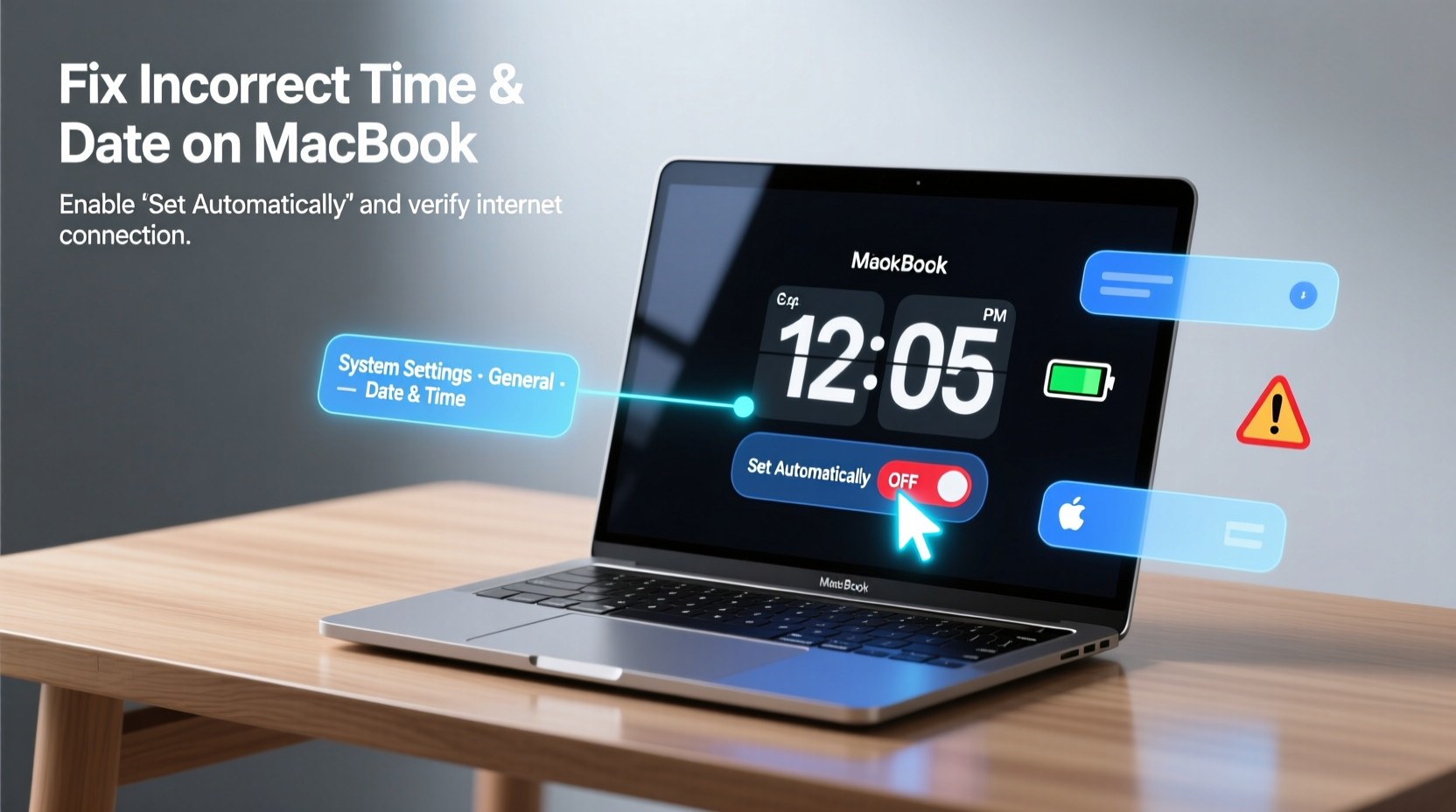
Modern MacBooks rely on Network Time Protocol (NTP) to synchronize their internal clocks with atomic time servers across the internet. When functioning correctly, your Mac updates its time automatically, adjusting for daylight saving changes and time zones without user input. However, several factors can interfere: poor internet connectivity, misconfigured settings, third-party software conflicts, or outdated system files.
Apple maintains its own NTP server (time.apple.com) as the default for all macOS devices. If this service is unreachable or rejected due to firewall rules, your Mac may fall back to an inaccurate local clock or fail to update entirely.
“Accurate system time is critical not only for user experience but also for security protocols like SSL certificate validation.” — Dr. Lin Zhao, Systems Engineer at Apple Support Network
Step-by-Step Guide to Fixing Your MacBook’s Clock
Follow this logical sequence to identify and resolve time discrepancies. Begin with basic checks before progressing to advanced solutions.
- Check Internet Connection: Ensure your MacBook has stable Wi-Fi or Ethernet access. Time synchronization requires online connectivity.
- Verify Time Zone Settings: Click the Apple menu > System Settings > General > Date & Time. Confirm “Set time zone automatically using current location” is enabled, or manually select your correct city.
- Enable Automatic Time Sync: In the same panel, ensure “Set date and time automatically” is turned on and set to
time.apple.com. - Restart the Time Service: Open Terminal and run:
sudo ntpdate -u time.apple.com
This forces an immediate sync with Apple’s server. - Reset System Management Controller (SMC): On Intel-based Macs, resetting the SMC can restore low-level hardware functions, including clock management. For Apple Silicon Macs, a full shutdown and restart typically suffices.
Common Causes and Solutions Table
| Issue | Possible Cause | Solution |
|---|---|---|
| Clock drifts forward/backward slowly | NTP disabled or unreachable | Re-enable automatic time sync; test connection to time.apple.com |
| Time jumps by hours | Incorrect time zone detection | Disable auto-location, set time zone manually |
| Date stuck in past/future | System clock battery failure (rare on modern Macs) | Reset PRAM/NVRAM; contact Apple Support if persistent |
| Changes revert after reboot | Permissions issue or conflicting app | Boot into Safe Mode; check for background apps modifying system time |
| No option to change settings | Parental controls or MDM policy enforced | Check Screen Time restrictions or consult administrator |
Mini Case Study: Remote Worker Facing Calendar Chaos
Sophie, a freelance project manager based in Lisbon but working with teams in Toronto and Sydney, began missing Zoom meetings despite calendar reminders. Her MacBook consistently showed meetings two hours late. Initial troubleshooting revealed her “Set time zone automatically” was off, likely disabled during travel. Even after re-enabling it, the time remained incorrect.
Further inspection showed her DNS provider was blocking external NTP requests. By switching to a public DNS (Google's 8.8.8.8), she restored access to time.apple.com. A manual sync via Terminal corrected the offset instantly. Since then, Sophie performs a monthly check of her Date & Time settings, especially after international travel.
Troubleshooting Checklist
- ✅ Confirm Wi-Fi or Ethernet is connected
- ✅ Open System Settings > General > Date & Time
- ✅ Enable “Set date and time automatically”
- ✅ Verify server is set to
time.apple.com - ✅ Toggle automatic time off and on to force refresh
- ✅ Manually trigger sync using Terminal command
- ✅ Restart your Mac and verify persistence
- ✅ Check for configuration profiles under System Settings > Privacy & Security > Profiles
Advanced Fixes for Persistent Issues
When standard fixes fail, deeper intervention may be necessary. These steps are safe but require careful execution.
Reset PRAM/NVRAM (Intel Macs)
Shut down your Mac. Turn it on and immediately press and hold Option + Command + P + R for about 20 seconds. Release after the second startup chime or Apple logo appears. This resets firmware settings, including time-related parameters.
Use Alternative NTP Servers
If time.apple.com fails repeatedly, switch to a trusted public server like pool.ntp.org or regional options such as uk.pool.ntp.org. Enter the address directly in the Date & Time settings field.
Check for Software Conflicts
Some applications — particularly virtualization tools (e.g., VMware, Parallels), development environments, or time-tracking software — may override system time. Boot into Safe Mode (hold Shift during startup) to disable third-party extensions. If time sync works in Safe Mode, isolate the culprit app through process of elimination.
Frequently Asked Questions
Why does my MacBook keep changing the time incorrectly?
This usually happens when “Set time zone automatically” relies on imprecise location data or when NTP synchronization fails due to network blocks. It can also occur if multiple devices sync calendars with mismatched time zones.
Can a dead battery affect my MacBook’s clock?
Unlike traditional PCs, most modern MacBooks (especially Apple Silicon models) maintain time via low-power coprocessors even when powered off. There is no user-replaceable CMOS battery. However, prolonged complete discharge (below 0%) might cause temporary clock loss until the next sync.
Is it safe to manually set the date and time?
While possible, manually setting time disables automatic daylight saving updates and risks desynchronization with online services. Only disable automatic settings temporarily for testing. Always re-enable them afterward.
Conclusion: Maintain Accuracy with Proactive Habits
A correctly functioning system clock is more than a convenience — it's foundational to productivity, communication, and digital security. Most MacBook time issues stem from easily correctable settings rather than hardware faults. By verifying automatic sync, ensuring network access, and understanding how macOS interacts with global time servers, you can eliminate timing errors for good.




 浙公网安备
33010002000092号
浙公网安备
33010002000092号 浙B2-20120091-4
Comments
No comments yet. Why don't you start the discussion?