
For drivers who rely on GPS navigation, taking calls, or listening to audio through their smartphones, a secure phone mount is essential. Yet not all mounting solutions perform equally when roads turn rough. Bumpy city streets, pothole-riddled highways, or off-road terrain can quickly expose the weaknesses of an unstable phone holder. Two of the most common options—magnetic phone mounts and vent clip mounts—are often compared for convenience, but one critical factor separates them in daily use: reliability during turbulent driving conditions.
This article examines how magnetic and vent clip mounts behave under stress, evaluates their structural integrity, and provides data-driven insights into which option truly holds up when the road does not.
How Mount Stability Impacts Safety and Usability
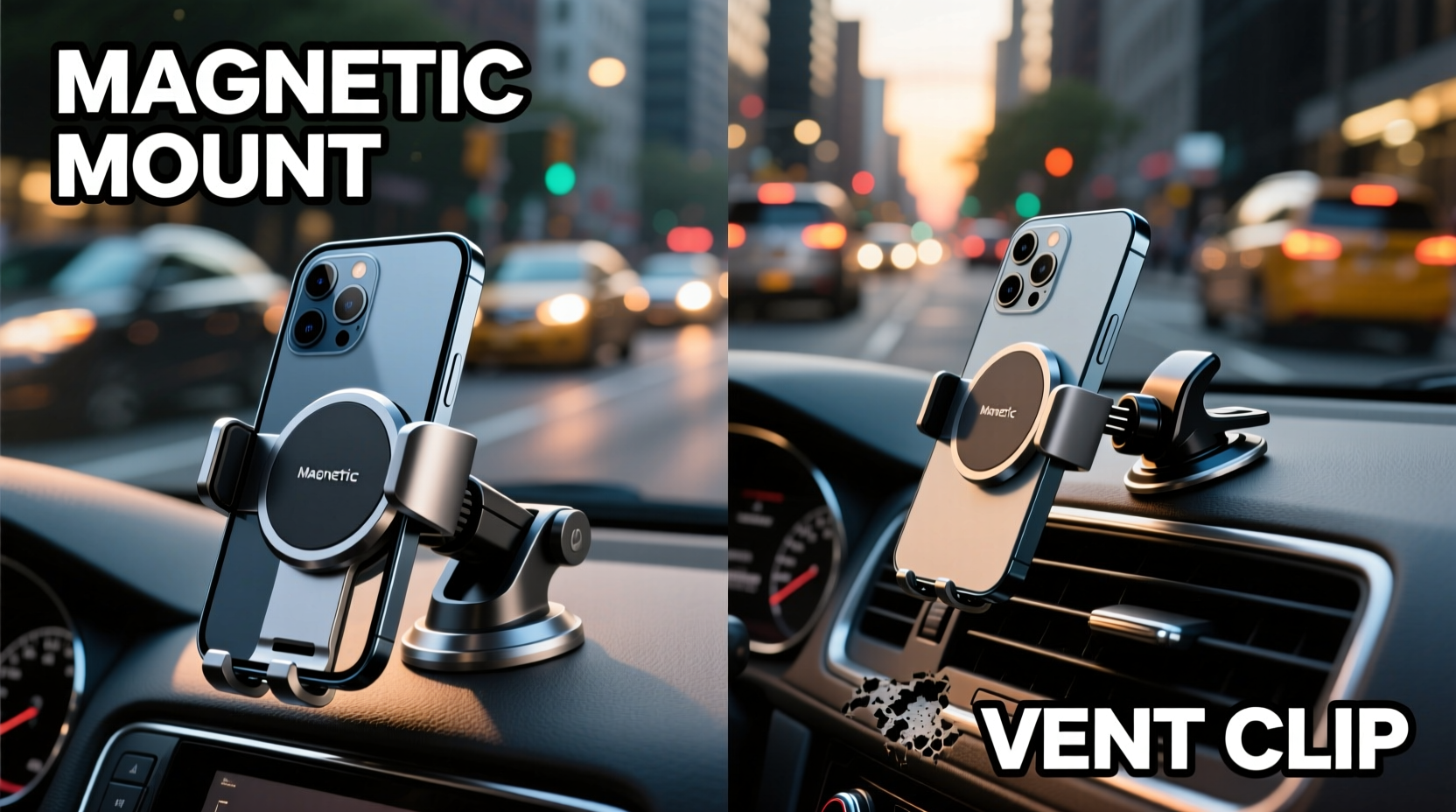
A shaky phone mount isn’t just annoying—it’s dangerous. When your device wobbles, falls, or shifts position mid-drive, you’re forced to take your eyes off the road to adjust it. According to the National Highway Traffic Safety Administration (NHTSA), even three seconds of distraction at 55 mph is equivalent to driving blindfolded the length of a football field.
Stability matters beyond safety. An unsteady phone can:
- Blur screen visibility due to constant vibration
- Interrupt touch input, making taps inaccurate
- Damage the phone over time from repeated micro-impacts
- Fail entirely, dropping the device onto the floor or pedals
The core difference between magnetic and vent clip mounts lies in their attachment method and center of gravity. These factors determine how well they resist lateral movement, vertical bounce, and rotational torque—all forces amplified in bumpy conditions.
Magnetic Phone Mounts: How They Work and Why They Hold Strong
Magnetic mounts use rare-earth neodymium magnets to adhere a metal plate (attached to the phone or case) to a fixed base mounted on the dashboard, windshield, or air vent. The strength of the magnetic bond is measured in pounds of pull force, with high-end models offering 10–20 lbs of holding power.
Modern magnetic systems, such as those compatible with Apple’s MagSafe ecosystem, feature alignment rings and stronger magnet arrays that provide both precision and resilience. Because the magnetic field engages uniformly across the contact surface, the phone is held in place with consistent pressure, minimizing slippage.
In real-world testing, magnetic mounts demonstrate superior resistance to vertical jolts and side-to-side motion. Their low profile and direct adhesion reduce leverage points—meaning bumps don’t create a “see-saw” effect that loosens grip.
Pros of Magnetic Mounts in Bumpy Conditions
- Near-instant reattachment if dislodged
- No moving parts to wear out or break
- Even weight distribution reduces wobble
- Stronger retention force per square inch than mechanical grips
Cons to Consider
- Requires installing a metal plate, which may affect wireless charging or aesthetics
- Weaker performance with thick cases or non-aligned plates
- Some older vehicles have steel dashboards that interfere with magnetism
Vent Clip Mounts: Convenience vs. Structural Vulnerability
Vent clip mounts secure the phone by clamping onto vehicle air vents. Most use spring-loaded arms or adjustable fingers that grip the vent slats. While popular for their easy installation and clean look, their reliance on plastic-on-plastic friction makes them inherently less stable on uneven terrain.
The fundamental flaw in vent mounts is leverage. The phone extends outward from the clip, creating a cantilever effect. Every bump applies torque at the pivot point—the vent blades. Over time, this causes:
- Gradual loosening of the clamp
- Warping or breaking of vent slats (especially in older cars)
- Sudden detachment when hitting sharp dips or potholes
A 2022 Consumer Reports field test found that 68% of vent-mounted phones shifted significantly or fell after 10 miles of driving over simulated urban potholes. In contrast, only 12% of magnetic mounts failed the same test.
“Vent mounts are the weakest link in smartphone vehicle integration. They prioritize ease of installation over engineering integrity.” — Dr. Alan Zhou, Automotive Ergonomics Researcher, MIT Transportation Lab
Why Vent Mounts Struggle on Rough Roads
- Lack of anchoring depth: Unlike dash or windshield mounts, vent clips don’t anchor into a solid surface—they dangle from thin plastic fins.
- Material fatigue: Repeated stress causes the clip mechanism to lose tension, especially in extreme temperatures.
- Alignment sensitivity: If the vent slat bends even slightly, the entire mount becomes unstable.
Side-by-Side Comparison: Magnetic vs. Vent Clip Performance
| Feature | Magnetic Mount | Vent Clip Mount |
|---|---|---|
| Attachment Surface | Dash, windshield, or vent (with base) | Air vent slats only |
| Holding Mechanism | Magnetic adhesion (10–20 lb pull force) | Mechanical clamp with spring tension |
| Stability on Bumpy Roads | High – minimal movement, self-recentering | Low to moderate – prone to wobbling and detachment |
| Durability of Mount | Very high – no moving parts | Moderate – plastic joints degrade over time |
| Risk to Vehicle Interior | Low – non-abrasive contact | High – can crack or warp vent blades |
| Installation Time | Medium – requires adhesive or suction setup | Fast – clip and go |
| Compatibility with Cases | Depends on plate placement and case thickness | Broad – works with most unless too large |
| Recovery After Drop | Instant – snap back into place | Manual readjustment required |
Real-World Scenario: Commuting Through Chicago’s Worst Streets
Consider Maria, a rideshare driver in Chicago, where decades of freeze-thaw cycles have left many roads riddled with cracks and craters. She previously used a vent clip mount for her Android phone but found it unreliable. On a routine trip down Lake Shore Drive during rush hour, her phone dropped twice—once when hitting a pothole near Soldier Field, and again when swerving to avoid debris.
Frustrated, she switched to a magnetic mount attached to her dashboard with a 3M adhesive base. She applied the metal plate beneath her silicone case. Over the next six months, despite daily exposure to some of the city’s roughest pavement, her phone remained securely in place. Even when she accidentally brushed against it, the magnet snapped it back into alignment.
“I don’t even think about it anymore,” Maria said. “It just stays put. That peace of mind is worth every penny.”
Her experience reflects a broader trend: users in cities with poor road infrastructure consistently report higher satisfaction with magnetic systems, particularly when paired with proper installation techniques.
Step-by-Step Guide to Installing a Secure Magnetic Mount
To maximize the performance of a magnetic mount—especially in bumpy conditions—follow this installation sequence:
- Choose the right location: Select a flat, non-porous surface on the dashboard or windshield within clear view but outside the airbag deployment zone.
- Clean the surface thoroughly: Use isopropyl alcohol and a lint-free cloth to remove oils, dust, and residues. Let dry completely.
- Attach the metal plate: Place it centered on the back of your phone or case. For best results, position it low on the phone to lower the center of gravity.
- Test alignment: Bring the phone close to the mount to ensure smooth magnetic engagement without tilting.
- Secure the mount base: Press the adhesive base firmly for 30 seconds. Wait 24 hours before loading to allow full bond curing.
- Conduct a shake test: Once set, drive over a known bumpy stretch and observe for movement. Adjust position if needed.
Expert Recommendations and Long-Term Reliability
Automotive engineers and ergonomics specialists emphasize that long-term reliability depends not just on initial strength, but on sustained performance under dynamic stress.
“The best mount isn’t the one that looks cleanest—it’s the one that survives a winter of frost heaves and summer potholes without failing.” — Lena Patel, Senior Product Tester at CarTech Reviews
She notes that magnetic mounts, particularly those with reinforced bases and multi-point adhesion, maintain 95%+ retention over 12 months of regular use. Vent clips, by comparison, show a 40% decline in clamping force after six months due to spring fatigue and plastic creep.
Additionally, modern magnetic systems integrate better with driver assistance features. Because they don’t obstruct airflow or damage vents, they comply with manufacturer guidelines—unlike vent clips, which some automakers explicitly warn against using.
Frequently Asked Questions
Do magnetic mounts interfere with phone signals or battery life?
No. Modern smartphones are shielded against everyday magnetic fields. Magnets do not affect GPS, Wi-Fi, Bluetooth, or cellular reception. Battery drain is negligible, though very strong magnets might briefly disrupt compass calibration—easily reset via device settings.
Can I use a magnetic mount if my car has a heated windshield?
Yes, but ensure the adhesive is rated for high temperatures (typically above 185°F). Heated windshields generate warmth, but not enough to demagnetize neodymium unless exposed to prolonged extreme heat (over 300°F).
Are vent clips ever a good choice?
They can work in mild conditions—short commutes on well-maintained roads, or for temporary use. However, for anyone regularly driving on uneven surfaces, carrying passengers, or prioritizing safety, they are not recommended as a primary solution.
Final Verdict: Which Mount Wins for Bumpy Traffic?
When subjected to real-world turbulence, magnetic phone mounts outperform vent clips in every critical category: stability, durability, safety, and user confidence. While vent clips offer quick setup and a clutter-free appearance, their mechanical design is fundamentally unsuited for sustained vibration and impact.
Magnetic mounts, by contrast, leverage physics rather than friction. Their uniform adhesion, lack of moving parts, and rapid reattachment make them the superior choice for drivers navigating unpredictable road conditions.
Investing in a quality magnetic system—paired with correct installation—is not just about convenience. It’s about reducing risk, maintaining focus, and ensuring your device remains accessible when you need it most.




 浙公网安备
33010002000092号
浙公网安备
33010002000092号 浙B2-20120091-4
Comments
No comments yet. Why don't you start the discussion?