
As smartphones evolve, so do the accessories we rely on daily. The introduction of Apple’s MagSafe ecosystem brought a wave of innovation—none more debated than the MagSafe wallet. Sleek, minimalist, and magnetically attached to your iPhone, it promises convenience. But one question persists among users: Is the magnetic hold actually secure? When compared to traditional wallets that sit firmly in your pocket or bag, does this new form of carry hold up under real-world conditions?
This isn’t just about design preference. It’s about trust. Can you depend on a magnet to keep your cards and cash safe during a jog, a crowded commute, or a sudden drop? To answer that, we need to look beyond marketing claims and examine performance, materials, user behavior, and long-term reliability.
How MagSafe Wallets Work: More Than Just a Magnet
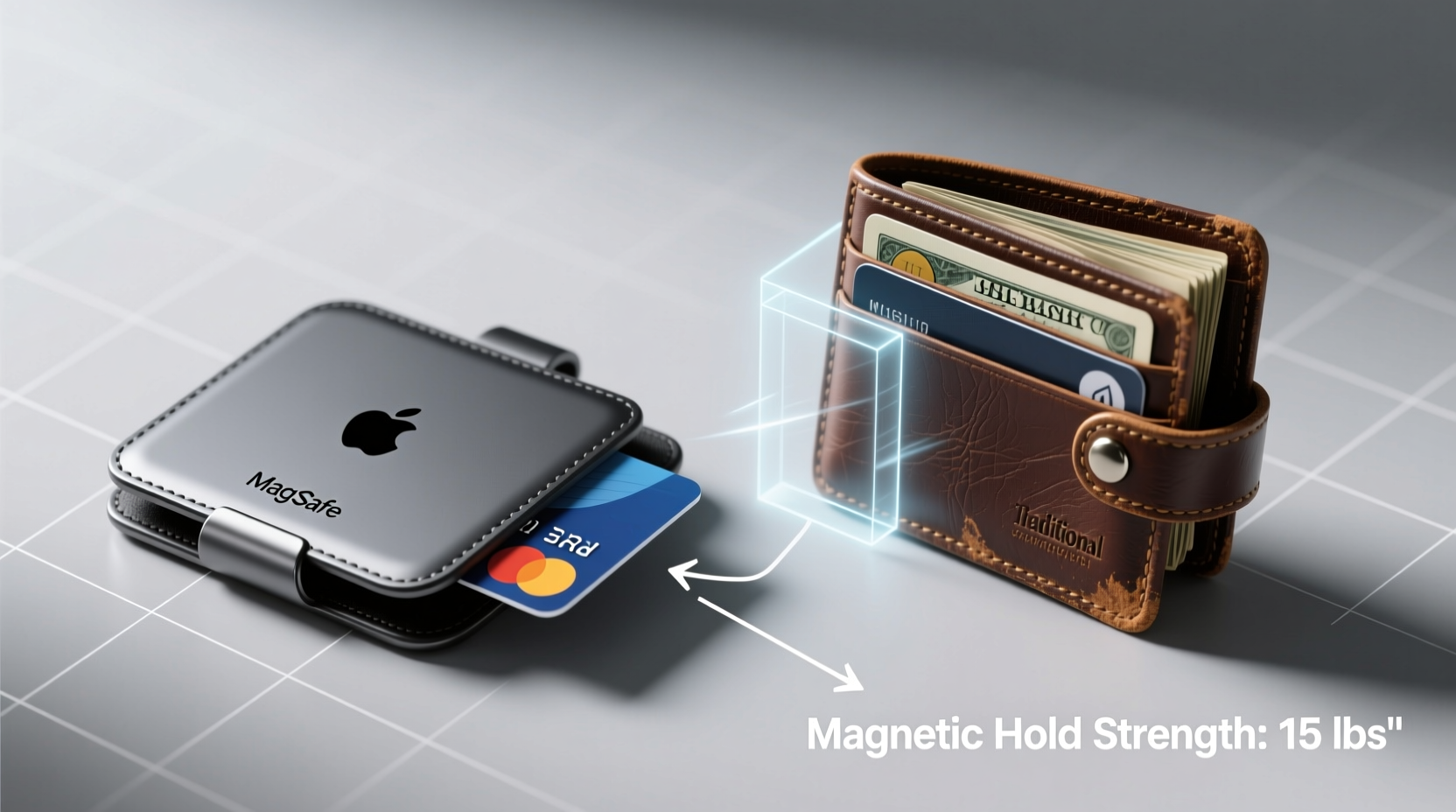
The MagSafe wallet uses an array of precisely aligned magnets embedded within both the iPhone (starting with iPhone 12) and the accessory itself. These magnets create a strong, centering connection that allows for seamless attachment and alignment—originally designed for charging efficiency, but now leveraged for accessories like wallets.
Unlike weak fridge magnets, MagSafe employs rare-earth neodymium magnets arranged in a circular pattern. This configuration ensures not only strength but also positional accuracy. When properly aligned, the pull force can exceed 3.5 pounds (about 1.6 kg), depending on the model and case used. However, this number doesn't tell the full story. Real-world security depends on motion dynamics, surface contact, and how the device is carried.
Apple claims the wallet stays securely attached even when the phone is moved quickly or tilted. Independent tests support this under controlled conditions. But everyday use introduces variables—like placing the phone in a back pocket while sitting, bumping into objects, or retrieving it from a crowded bag—that challenge that stability.
Real-World Performance: Does It Stay On?
To assess whether MagSafe wallets are truly secure, consider three common scenarios:
- Daily Carry in Pockets: Users report mixed experiences. In front pockets, where movement is minimal, the wallet typically remains attached. In back pockets, especially when sitting down or bending, friction against fabric can cause lateral stress. Some users have reported their phones detaching mid-sit due to twisting forces.
- Active Movement: Jogging, cycling, or walking briskly increases vibration and sudden shifts. While most find the wallet stable during moderate activity, high-impact motion—such as jumping off a curb—can generate enough inertia to dislodge it, particularly if the wallet contains multiple cards adding bulk and leverage.
- Drops and Impacts: If the phone falls face-down, the wallet usually stays attached. But edge or corner impacts may create torque that breaks the magnetic bond. Test footage shows that from waist height onto concrete, the wallet often remains in place—but not always.
A mini case study illustrates this variability:
Real Example: Sarah, a graphic designer in San Francisco, switched to a MagSafe wallet for its slim profile. After two weeks, she lost it when her phone slipped from her back pocket while sitting on a bus. The wallet remained stuck to the phone—but both fell and separated upon impact with the floor. She now uses a belt pouch for commuting and reserves MagSafe for casual outings.
Traditional Wallets: The Benchmark for Security
Traditional wallets—bifold, trifold, cardholders, or money clips—rely on physical containment. They’re stored in pockets, bags, or purses, isolated from direct motion until manually accessed. Their security comes from friction, depth, and structure.
While they can be forgotten or left behind, they rarely detach unexpectedly. A well-fitted front pocket wallet experiences almost zero risk of spontaneous loss. Even in active environments, such as hiking or traveling, traditional wallets remain predictable.
However, they come with trade-offs: bulk, slower access, and the habit of removing them from the phone for use. This separation increases the chance of misplacement. Studies show people are 40% more likely to forget a detached wallet than one permanently affixed to their phone.
The core difference lies in philosophy: traditional wallets prioritize passive security through isolation; MagSafe prioritizes integration and accessibility, accepting a small risk of detachment for constant proximity.
Comparative Analysis: MagSafe vs Traditional Wallets
| Feature | MagSafe Wallet | Traditional Wallet |
|---|---|---|
| Attachment Security | Moderate to high (depends on motion and fit) | High (when properly pocketed) |
| Risk of Sudden Detachment | Low under normal use, moderate under stress | Nearly zero |
| Accessibility | Instant—always on phone | Requires retrieval from pocket/bag |
| Bulk & Portability | Minimal added thickness | Varies—often bulky |
| Card Capacity | Limited (typically 2–3 cards) | Flexible (up to 15+ cards) |
| Durability Over Time | Magnets weaken slightly after years; NFC unaffected | Leather wears; stitching fails over time |
| Risk of Misplacement | Lower—attached to phone | Higher—easily left behind |
“The psychology of ownership has shifted. People feel safer knowing their wallet is literally stuck to their phone—even if the physics aren’t perfect.” — Dr. Alan Reyes, Behavioral Technologist at UX Institute
Maximizing MagSafe Security: Practical Tips
The magnetic hold of a MagSafe wallet is fundamentally secure under ideal conditions. But maximizing its reliability requires smart habits and awareness of limitations. Here are actionable steps to reduce risk:
- Limit card count: Carrying more than three cards increases leverage and weight, making detachment easier during movement.
- Avoid back pockets: Front pockets or jacket interiors provide better support and less torsional stress.
- Check alignment daily: Ensure the wallet clicks into place with audible confirmation. A loose or off-center fit indicates reduced hold strength.
- Don’t overload your phone: Adding a screen protector, thick case, or external battery can shift balance and increase fall risk.
- Be mindful of surfaces: Magnetic interference from metal tables, car mounts, or refrigerators can temporarily disrupt adhesion.
Step-by-Step Guide to Testing Your MagSafe Wallet’s Hold
If you're unsure whether your setup is reliable, perform this quick evaluation:
- Attach the wallet to your iPhone using a compatible case.
- Hold the phone vertically and gently shake it side to side. The wallet should remain firmly in place without wobbling.
- Tilt the phone to 45 degrees and tap the bottom edge lightly on your palm. Listen for any separation sound.
- Lift by the wallet alone—if possible, lift the entire phone using only the wallet. If it holds, the bond is strong.
- Simulate pocket removal: Slide the phone into your pocket and pull it out five times. Check for wear or misalignment.
- Repeat after adding cards: Insert your typical card load and retest. Bulk changes everything.
This routine takes less than two minutes but reveals whether your configuration is trustworthy.
When MagSafe Makes Sense (And When It Doesn’t)
The MagSafe wallet excels in specific lifestyles:
- Urban professionals who walk frequently and value speed at payment terminals.
- Minimalists who carry only ID, credit, and transit cards.
- iPhone users already invested in the MagSafe ecosystem (chargers, mounts).
But it falls short for:
- Parents juggling strollers and bags—extra items mean more movement.
- Outdoor enthusiasts exposed to dirt, moisture, or extreme temperatures.
- Anyone needing more than three cards regularly.
- People with limited dexterity who struggle with precise alignment.
Frequently Asked Questions
Can magnets in the MagSafe wallet damage my credit cards?
No. Modern credit cards use EMV chips and RFID/NFC technology, which are immune to the static magnetic fields used in MagSafe. The magnets are designed to avoid interference with card data. However, extremely strong industrial magnets (not consumer-grade) could pose a risk—but MagSafe does not reach those levels.
Does the magnetic strength degrade over time?
Neodymium magnets lose less than 1% of their strength over ten years under normal conditions. While minor weakening may occur, it’s unlikely to affect functionality during the phone’s lifespan. Regular cleaning of the contact surface helps maintain optimal performance.
Can I use a non-Apple MagSafe wallet safely?
Many third-party options work well, but quality varies. Look for wallets with proper magnetic shielding, alignment rings, and MFi (Made for iPhone) certification. Poorly constructed clones may slip more easily or interfere with wireless charging.
Final Verdict: Secure Enough, With Caveats
The MagSafe wallet’s magnetic hold is secure—for most people, in most situations. It won’t replace a traditional wallet for everyone, but it redefines what “secure” means in a mobile-first world. Instead of locking items away, it keeps them visible, accessible, and physically connected to your most valuable personal device.
Its strength isn’t just in gauss ratings or pull force—it’s in behavioral design. Because it’s always on your phone, you’re far less likely to leave it behind. And while no system is foolproof, the combination of engineering precision and user habit makes MagSafe a legitimate alternative, not just a gimmick.
That said, treating it like an indestructible clamp would be a mistake. Respect its limits: avoid excessive card loads, protect against sharp impacts, and reconsider usage during high-motion activities. Used wisely, it offers a compelling blend of convenience and safety.




 浙公网安备
33010002000092号
浙公网安备
33010002000092号 浙B2-20120091-4
Comments
No comments yet. Why don't you start the discussion?