
In an era where automatic transmissions dominate showrooms and driving schools, the manual gearbox feels increasingly like a relic from another time. Yet for many drivers, the act of shifting gears with your hand and coordinating clutch and throttle remains one of the most engaging parts of driving. While convenience has tipped the balance heavily toward automatics, the question persists: is learning to drive a stick shift still worth it?
The answer isn’t as simple as “yes” or “no.” It depends on your lifestyle, driving goals, geographic location, and personal preferences. This article breaks down the practical, economic, and experiential differences between manual and automatic transmissions, offering a realistic perspective on whether mastering the clutch pedal today is a smart investment.
Why Manual Transmissions Are Becoming Rare
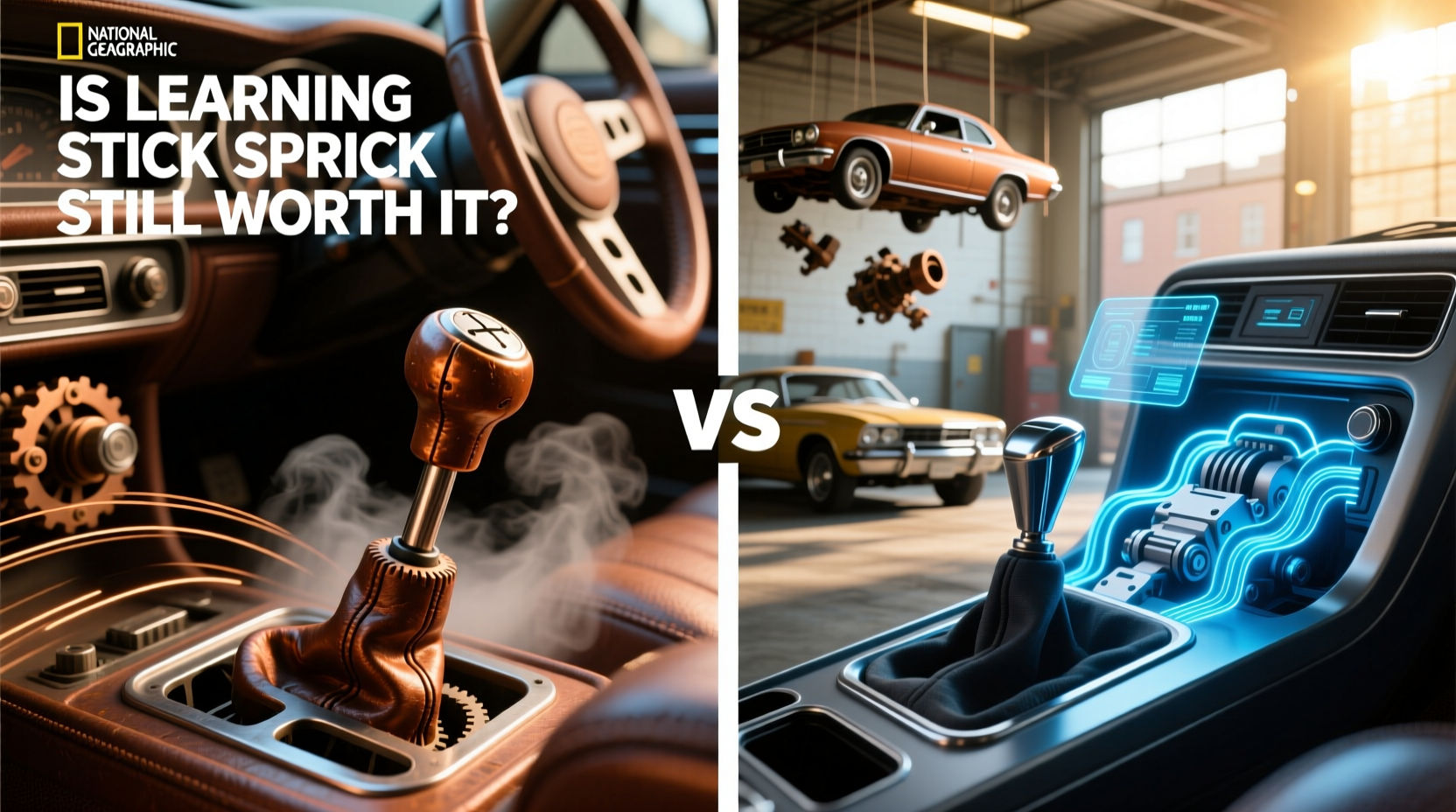
Over the past two decades, automatic transmissions have evolved dramatically. Modern dual-clutch and continuously variable transmissions (CVTs) now match — and often surpass — manuals in terms of fuel efficiency, performance, and driver comfort. As a result, automakers are phasing out manual options across most vehicle segments.
In the U.S., only about 1% of new cars sold in 2023 came with a manual transmission. Even performance models, once bastions of three-pedal setups, now offer paddle shifters and lightning-fast automated gearboxes. The decline is even steeper in urban markets, where stop-and-go traffic makes clutch work exhausting.
Still, manuals haven’t vanished entirely. Enthusiast-focused models like the Mazda MX-5 Miata, Subaru WRX, and certain Jeep Wrangler trims continue to offer stick shifts. In Europe and developing countries, manual cars remain more common due to cost and fuel economy advantages.
Manual vs Automatic: A Practical Comparison
To understand whether learning stick is worthwhile, it helps to compare key aspects of both transmission types. The following table outlines critical differences across several categories:
| Factor | Manual Transmission | Automatic Transmission |
|---|---|---|
| Initial Cost | Typically $1,000–$2,000 cheaper | Higher base price |
| Fuel Efficiency | Slightly better in older models; comparable in modern versions | Now matches or exceeds manuals thanks to advanced programming |
| Maintenance & Repairs | Clutch replacements needed every 50,000–100,000 miles; lower long-term complexity | Transmission fluid changes required; potential for expensive internal repairs |
| Driving Engagement | High – requires coordination and attention | Low to moderate – mostly hands-off operation |
| Traffic Handling | Painful in heavy congestion | Effortless with creep function and no clutch |
| Resale Value & Availability | Limited selection; may appeal to niche buyers | Wider market; easier to sell |
| Learning Curve | Steeper – requires practice and patience | Gentle – intuitive for most learners |
This comparison shows that while manuals offer cost savings and engagement, they come with trade-offs in convenience and availability. For daily commuters in cities, the automatic clearly wins. But for those who value control and mechanical connection, the manual retains unique appeal.
When Learning Stick Shift Makes Sense
Despite their declining presence, there are still compelling reasons to learn how to drive a manual transmission.
- Travel flexibility: In countries like Portugal, Greece, or Thailand, rental cars with manual gearboxes are far more common and significantly cheaper than automatics. Knowing how to drive stick opens up affordable travel options.
- Used car access: Many high-value used vehicles—especially sports cars and trucks—were only offered with manuals. Being limited to automatics shrinks your buying pool.
- Emergency adaptability: If you’re stranded and the only available vehicle has a manual, knowing how to drive it could get you home—or help someone else.
- Driving skill development: Mastering a manual improves overall car control, spatial awareness, and mechanical understanding. These skills transfer to better handling in all vehicles.
- Job requirements: Some careers—overseas aid work, overlanding guides, or vintage vehicle restoration—require manual proficiency.
“Drivers who know how to handle a manual transmission tend to be more attentive, smoother operators—even when driving automatics.” — Daniel Reeves, Professional Driving Instructor and Motorsport Coach
A Real-World Example: Sarah’s Road Trip Dilemma
Sarah planned a two-week road trip through rural Spain. She reserved a compact car online without checking the transmission type. When she arrived at the rental desk, the agent explained that only manual vehicles were available at that location—and her reservation was non-refundable.
Having learned stick shift in college but rarely using it, Sarah hesitated. After a brief refresher tutorial from the agent, she took off. The first hour was rough—stalling on hills, jerky starts—but by day two, muscle memory returned. By the end of the trip, she found herself enjoying the rhythm of shifting, especially on mountain passes. More importantly, she saved nearly €200 compared to the automatic upgrade fee.
Her experience underscores a broader truth: manual driving ability isn’t just about owning a stick-shift car. It’s about freedom—the freedom to adapt, explore, and avoid last-minute surprises abroad.
How to Learn Stick Shift: A Step-by-Step Guide
If you’ve decided to learn, follow this structured approach to build confidence efficiently and safely.
- Find the Right Vehicle: Borrow or rent a manual car with a light clutch and forgiving engine. Older Civics, Focuses, or Golfs are ideal. Avoid diesels or trucks for initial learning.
- Practice in a Safe Area: Choose a flat, empty parking lot. Turn off distractions and focus solely on coordination.
- Master the Bite Point: Press the clutch, start the engine, shift into first, and slowly release the clutch until the car begins to move. That’s the bite point. Hold it briefly to move forward smoothly.
- Start Moving: Combine gentle accelerator input with slow clutch release. Practice starting from a stop 20–30 times until it becomes natural.
- Learn Upshifting: At around 2,500 RPM, press the clutch fully, release the gas, shift to second, then re-engage the clutch smoothly. Repeat through the gears.
- Practice Downshifting: Brake first, then clutch, shift down, and match revs slightly if possible. Not essential at first, but useful later for engine braking.
- Try Hills: On a gentle incline, use the handbrake to prevent rollback. Release the brake as you find the bite point and accelerate.
- Drive in Light Traffic: Once comfortable, take short routes with minimal stops. Gradually increase complexity.
- Refine Smoothness: Aim for seamless shifts, minimal jerking, and no stalling. Record feedback from passengers or mirrors.
- Test Different Conditions: Drive on highways, in rain, and uphill to build full competence.
Common Myths About Manual Transmissions
Several misconceptions persist about stick shifts, often discouraging learners unnecessarily.
- Myth: Manuals are always more fuel-efficient.
Reality: Modern automatics with 8+ speeds and adaptive logic often beat manuals in real-world MPG. - Myth: Manual cars are cheaper to insure.
Reality: Insurers focus more on driver age, record, and vehicle type than transmission. No significant discount exists. - Myth: You’ll ruin the clutch within a year.
Reality: With proper technique, clutches last 75,000+ miles. Aggressive riding of the clutch pedal causes premature wear—not the transmission type itself. - Myth: Manual cars are faster.
Reality: High-performance automatics shift faster than humans. Supercars like the Ferrari 488 or Porsche 911 Turbo use automated gearboxes for optimal acceleration.
Frequently Asked Questions
Can I switch from automatic to manual later in life?
Absolutely. Age isn’t a barrier. Many adults in their 30s, 40s, and beyond successfully learn stick shift. The key is patience and consistent practice. Start with short sessions to build muscle memory without frustration.
Are manual cars harder to sell?
In mainstream markets, yes. Most buyers prefer automatics, so your resale pool will be smaller. However, among enthusiasts, well-maintained manual cars often command premium prices, especially in performance or collector segments.
Do electric cars have manual transmissions?
No. Electric vehicles use single-speed gearboxes because electric motors deliver instant torque across a wide RPM range. There’s no need for multiple gears. Some simulators attempt to recreate shift feel, but these are novelty features without mechanical function.
Final Checklist: Is Learning Stick Shift Right for You?
Before committing time and effort, ask yourself the following:
- ✅ Do you plan to travel internationally, especially in Europe or developing regions?
- If yes, manual knowledge is highly beneficial.
- ✅ Are you interested in classic, performance, or off-road vehicles?
- Many of these come primarily or exclusively with manual options.
- ✅ Do you enjoy hands-on, skill-based activities?
- Driving stick offers tactile satisfaction similar to playing an instrument.
- ❌ Will you mainly commute in dense urban traffic?
- Stick driving can become tedious and tiring in stop-and-go conditions.
- ❌ Are you extremely time-constrained or anxious about learning curves?
- Automatics are easier and faster to master.
Conclusion: Mastery Over Convenience
Learning to drive a manual transmission isn’t about necessity anymore—it’s about capability. In a world designed for ease, choosing to master something difficult carries its own quiet reward. It’s not just about operating a car; it’s about understanding how it works, responding to its feedback, and feeling truly connected to the machine.
While automatics dominate for good reason, knowing how to drive a stick shift remains a valuable, empowering skill. It opens doors—literally and figuratively—to vehicles, experiences, and countries that might otherwise be off-limits. And should the rare breakdown, overseas rental hiccup, or vintage dream car opportunity arise, you’ll be ready.
You don’t need to drive manual every day to benefit from knowing how. Just like swimming, CPR, or speaking a second language, it’s a competency that pays dividends when it matters most.




 浙公网安备
33010002000092号
浙公网安备
33010002000092号 浙B2-20120091-4
Comments
No comments yet. Why don't you start the discussion?