
Speed reading is often misunderstood as simply moving the eyes faster across a page. But true speed reading isn’t about sacrificing understanding for velocity—it’s about optimizing how your brain processes written information. Without focus and comprehension, rapid eye movement is just skimming. The most effective readers don’t just read fast; they absorb, retain, and apply what they’ve read. This article explores scientifically supported techniques that enhance both speed and depth of understanding, allowing you to process text efficiently without losing meaning.
Understanding the Focus-Comprehension Gap
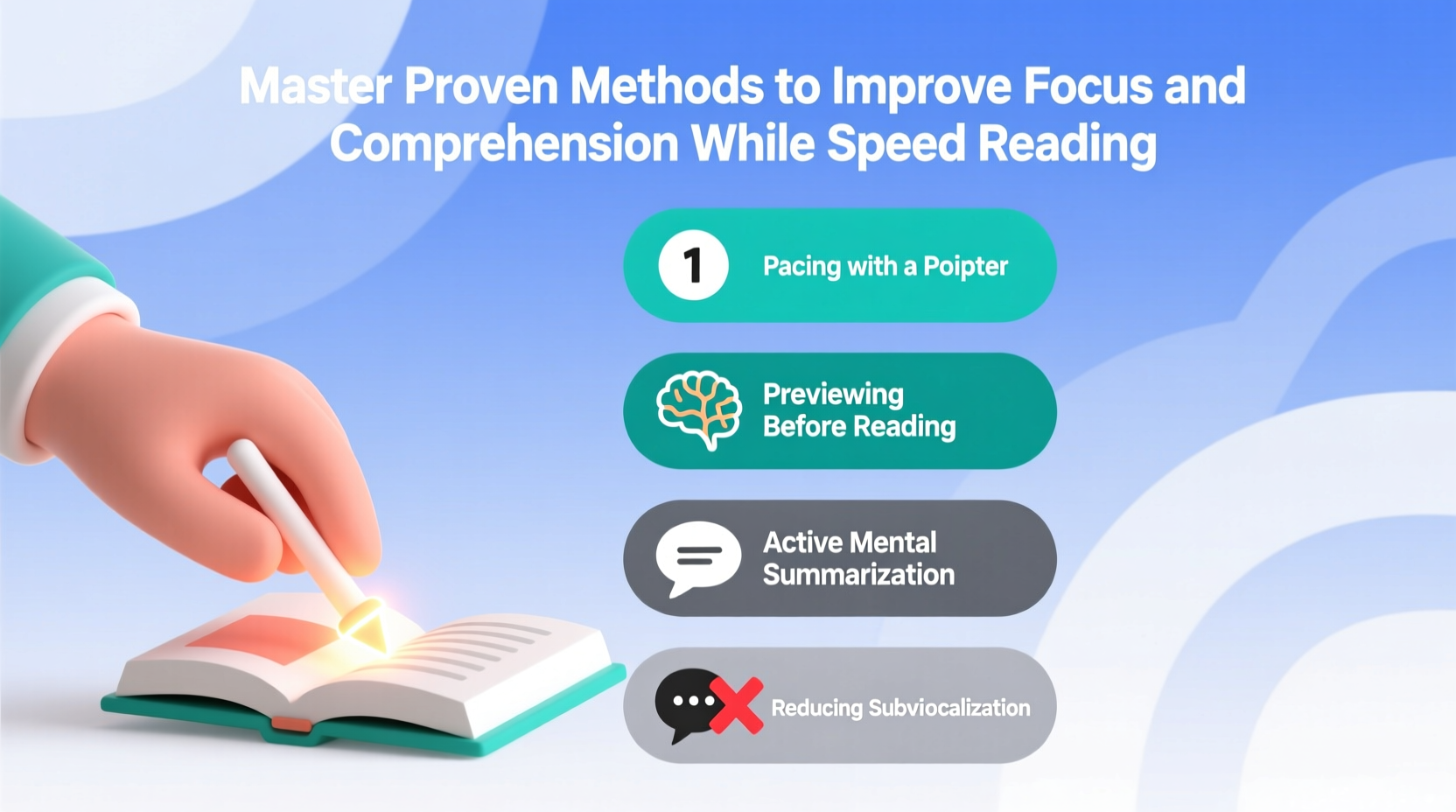
Many people who attempt speed reading report declining comprehension. This happens because traditional reading habits—such as subvocalization (mentally \"saying\" each word) or regression (rereading lines)—slow processing but create a false sense of security. When these are removed too quickly, the brain struggles to keep up, leading to mental fatigue and poor retention.
The key is not to eliminate these behaviors overnight but to retrain cognitive patterns gradually. Focus and comprehension rely on working memory, attention control, and contextual integration—all of which can be strengthened with deliberate practice.
“Reading fast means nothing if you remember nothing. True speed comes from efficient cognition, not just visual tracking.” — Dr. Anne Jones, Cognitive Psychologist, University of Cambridge
Step-by-Step Guide to Building Speed with Comprehension
Improving reading performance requires a structured approach. Follow this six-phase timeline over 4–6 weeks to build lasting skills:
- Week 1: Baseline Assessment – Measure your current reading speed (words per minute) and comprehension (via self-quizzing). Use timed passages and note recall accuracy.
- Week 2: Eliminate Subvocalization – Practice reading phrases instead of individual words. Use a finger or pen to guide your eyes smoothly across lines, reducing inner speech.
- Week 3: Expand Peripheral Vision – Train your eyes to capture more words per fixation using chunking exercises. Read in groups of 3–5 words at a glance.
- Week 4: Reduce Regression – Use a pacing tool (like a pointer) to prevent backtracking. Trust your initial pass and use summaries to reinforce retention.
- Week 5: Apply Active Reading Techniques – Integrate questioning, predicting, and summarizing into your reading. Ask: “What’s the main idea?” before finishing a section.
- Week 6: Test and Refine – Reassess speed and comprehension. Adjust pacing based on material complexity—technical texts require slower processing than narratives.
Effective Techniques to Boost Focus and Retention
Speed is meaningless without substance. These methods strengthen both concentration and memory during reading:
- Pre-reading Scanning: Skim headings, subheadings, and first/last sentences of paragraphs to build a mental framework. This primes your brain for incoming information.
- The 2-Minute Summary Rule: After reading a section, pause and write a two-sentence summary. This forces synthesis and reveals gaps in understanding.
- Pacing with a Visual Guide: Use a pen, finger, or cursor to pull your eyes forward at a steady rate. This prevents erratic eye movements and maintains rhythm.
- Chunking: Train yourself to see word groups instead of single words. For example, read “The quick brown fox” as one unit rather than four separate words.
- Mindful Reading Sessions: Limit sessions to 25 minutes with 5-minute breaks (Pomodoro method). Short bursts maintain high focus and reduce mental drift.
Do’s and Don’ts of Speed Reading Practice
| Do | Don’t |
|---|---|
| Use a pointer to maintain pace and reduce regression | Rely solely on apps that flash words rapidly (Rapid Serial Visual Presentation), which can impair deep processing |
| Adjust speed based on text difficulty—slow down for dense material | Push speed at the expense of understanding |
| Practice daily for 15–20 minutes with focused intent | Practice for hours without feedback or reflection |
| Test comprehension after each session with recall questions | Assume faster = better without measuring outcomes |
| Read aloud occasionally to reinforce phonological awareness | Subvocalize every word silently—this limits maximum speed |
Mini Case Study: From Struggling Student to Academic Reader
Sophia, a graduate student in public policy, struggled to keep up with her weekly reading load—often spending 10+ hours on academic papers with poor retention. She began applying structured speed reading techniques: first assessing her baseline (180 wpm with 60% recall), then introducing chunking and guided pacing. Over five weeks, she increased her speed to 380 wpm while improving comprehension to 85%, measured through self-administered quizzes. Her secret? Consistent short practice sessions and active summarization. Instead of rereading, she used margin notes to track key arguments and questions. This shift didn’t just save time—it improved her class participation and paper writing.
Checklist: Daily Speed Reading Practice Routine
Integrate these actions into your routine to build sustainable progress:
- ✅ Warm up with 3 minutes of paced reading using a finger or pen
- ✅ Choose one technique to focus on each week (e.g., chunking, reduced subvocalization)
- ✅ Read for 15–20 minutes with full attention—no multitasking
- ✅ Pause every 5 minutes to summarize the last section in your own words
- ✅ End with a 3-question self-test (main idea, supporting points, personal takeaway)
- ✅ Track progress weekly: log wpm and comprehension score
Frequently Asked Questions
Can anyone learn to speed read effectively?
Yes—while natural aptitude varies, most adults can double their reading speed with consistent training. Success depends more on technique and discipline than innate ability. However, peak speeds (1000+ wpm) with high comprehension are rare and typically limited to experienced readers with strong working memory.
Does speed reading work for technical or academic texts?
With adjustments, yes. Technical material requires deeper processing, so aim for moderate speed increases (e.g., 25–50%) while prioritizing comprehension. Use pre-reading, annotation, and post-reading review to ensure mastery. Speed reading here is less about velocity and more about eliminating inefficiencies like unnecessary rereading.
How long does it take to see results?
Most people notice improved pacing and focus within 1–2 weeks. Significant gains in both speed and comprehension typically emerge after 4–6 weeks of daily practice. Long-term retention and application depend on continued use and adaptation to different text types.
Conclusion: Read Smarter, Not Just Faster
Mastering speed reading isn’t about becoming a human scanner—it’s about becoming a more efficient thinker. By combining visual pacing, cognitive strategies, and active engagement, you can process information faster while deepening understanding. The methods outlined here are not quick fixes but durable skills that compound over time. Whether you're a student, professional, or lifelong learner, the ability to absorb written content with clarity and speed is one of the most valuable assets you can develop.




 浙公网安备
33010002000092号
浙公网安备
33010002000092号 浙B2-20120091-4
Comments
No comments yet. Why don't you start the discussion?