
As winter descends across Europe and beyond, Christmas markets begin to sparkle in town squares, drawing visitors with the scent of mulled wine, handcrafted ornaments, and the unmistakable glow of thousands of tiny lights. One striking feature unites nearly every market: the extensive use of string lights rather than conventional overhead lighting. From Nuremberg to Strasbourg, Prague to Copenhagen, delicate strands crisscross wooden stalls, drape over canopies, and wind through trees. But why choose these seemingly fragile strings over practical, high-output ceiling or pole-mounted lamps? The answer lies not just in aesthetics but in a confluence of tradition, emotional resonance, logistical flexibility, and cultural identity.
The Emotional Power of Light in Winter
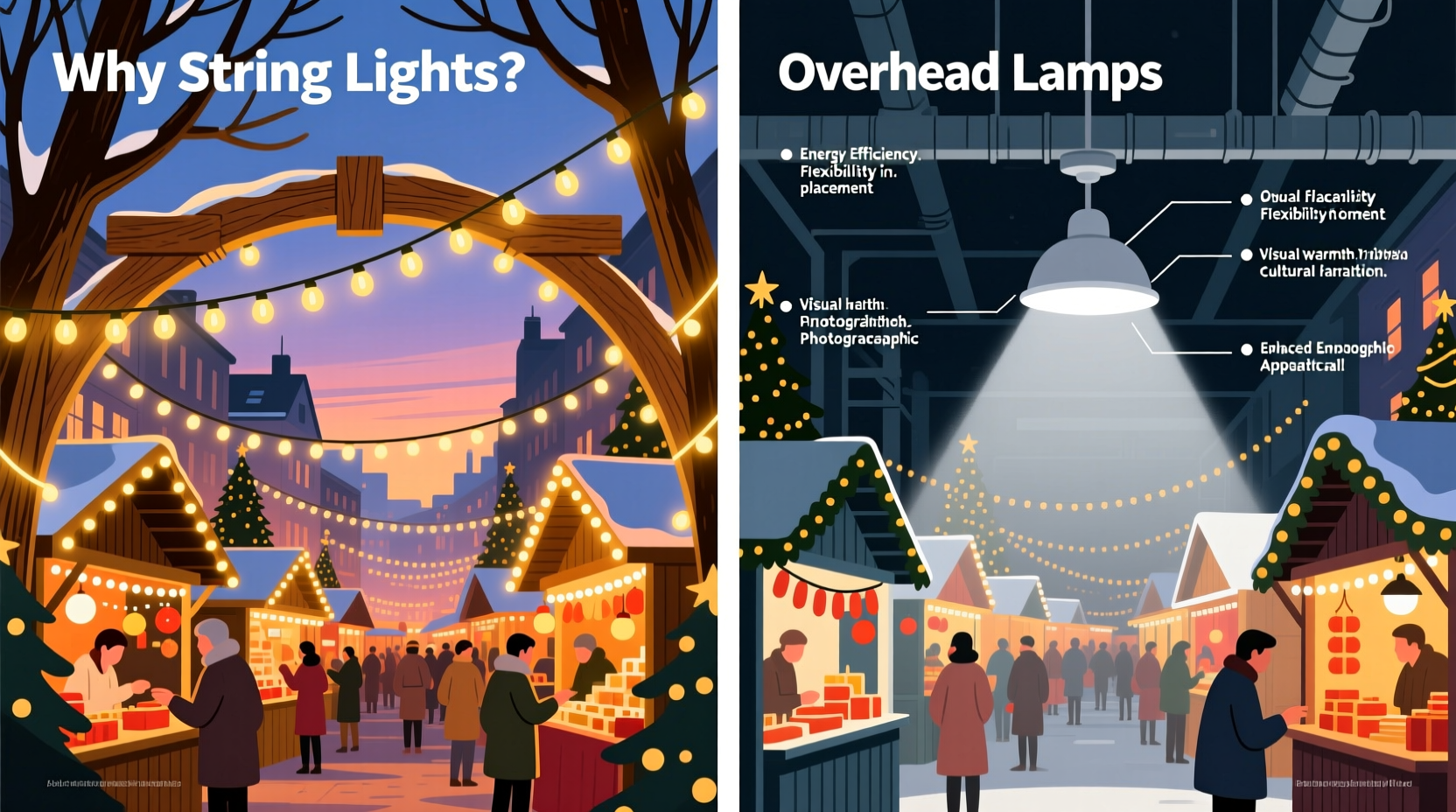
Winter solstice celebrations have long relied on light as both a literal and symbolic force. Before electric illumination, candles and oil lamps were used to combat the psychological weight of short days and long nights. This instinct remains embedded in modern holiday traditions. String lights, with their warm, flickering glow, mimic the softness of candlelight more effectively than harsh overhead fixtures. They create a sense of intimacy and wonder that aligns with the nostalgic tone of Christmas markets.
Unlike uniform ceiling-mounted floodlights—which evenly illuminate but often feel clinical—string lights produce dynamic shadows and highlights. Their irregular spacing and gentle sway in the breeze add movement and life to static spaces. Visitors don’t just see the market; they *feel* it. The warmth of 2700K–3000K LED bulbs, commonly used in modern strings, closely replicates incandescent warmth, reinforcing a cozy atmosphere known in German as gemütlichkeit.
“Light is not just functional at Christmas markets—it’s emotional architecture. String lights shape memory as much as space.” — Dr. Lena Hoffmann, Cultural Historian, University of Vienna
Design Flexibility and Architectural Harmony
Christmas markets are temporary installations, often erected in historic city centers with cobblestone streets, medieval buildings, and limited electrical infrastructure. Overhead lamps would require permanent mounting, trenching for cables, and structural reinforcement—costly and often prohibited in heritage zones. String lights, by contrast, offer unmatched versatility.
They can be strung between temporary poles, attached to stall roofs, draped along railings, or woven into trees without permanent modifications. This adaptability allows organizers to tailor lighting to the unique contours of each location. A narrow alleyway might be transformed with zig-zagging lines overhead, while a central plaza could feature concentric rings of light above the main stage.
Beyond logistics, string lights enhance architectural storytelling. When hung vertically along timber-framed facades or wrapped around clock towers, they accentuate historical details rather than obscuring them. Overhead lamps, especially those with bulky housings, tend to dominate sightlines and flatten depth.
Safety and Practical Advantages
Despite their delicate appearance, modern string lights are engineered for durability and safety. Most contemporary markets use low-voltage (12V or 24V) LED strings encased in weather-resistant materials. These generate minimal heat, reducing fire risk near wooden structures and flammable decorations like wreaths or paper crafts.
In contrast, traditional overhead halogen or metal-halide lamps can become hot enough to ignite nearby materials if improperly installed or shielded. They also draw more power, increasing load on temporary generators or grid connections. String lights consume up to 80% less energy than equivalent incandescent overhead systems, making them both eco-friendlier and cost-effective for month-long seasonal operations.
Maintenance is another key factor. If one bulb fails in a string, the rest typically remain lit (especially with shunted-base LEDs), whereas a single faulty overhead fixture can leave large areas dark. Replacement is simpler too—individual sections of string lights can be swapped without dismantling entire circuits.
Comparison: String Lights vs. Overhead Lamps
| Feature | String Lights | Overhead Lamps |
|---|---|---|
| Installation Speed | Fast, modular setup | Slow, requires mounting hardware |
| Energy Efficiency | High (LED versions) | Low to moderate |
| Heat Output | Very low | High (fire hazard near wood) |
| Aesthetic Integration | Blends with decor | Industrial appearance |
| Flexibility | High (adaptable to any layout) | Low (fixed positions) |
| Maintenance Access | Easy section replacement | Requires lifts or scaffolding |
Cultural Tradition and Brand Identity
String lights are not merely a lighting solution—they are part of the brand identity of Christmas markets. For centuries, small-scale vendors illuminated their wares with candles. In the early 20th century, electric miniature bulbs began replacing flames, but the visual language remained: clusters of small, bright points suspended in darkness.
This continuity matters. Tourists don’t just visit markets for gifts—they come for authenticity. Replacing string lights with industrial-grade overhead lamps would disrupt the immersive experience. It would feel more like a parking lot than a festive village. The charm lies in the handmade, temporary, almost magical quality of the environment.
Moreover, string lights are deeply embedded in regional traditions. In Germany, the concept of Lichterglanz—the shimmer of many small lights—is associated with hope and renewal during Advent. Austrian villages often use hand-wired light displays passed down through generations. These customs reinforce community pride and attract cultural tourism.
“We tested overhead spotlights in Salzburg’s Residenzplatz one year. Attendance dropped 18%. People said it ‘felt wrong.’ We went back to strings the next season.” — Markus Riedl, Market Coordinator, Salzburg Tourism Board
Mini Case Study: The Transformation of Birmingham’s Frankfurt Market
Birmingham, UK, hosts one of the largest German-themed Christmas markets outside Germany. In 2015, organizers experimented with adding overhead canopy lighting to improve visibility during heavy rain. While functionally effective, visitor feedback was overwhelmingly negative. Surveys showed that 73% of attendees felt the space “lost its magic” and “looked like a shopping center.”
By 2016, the team reverted to full string-light coverage, increasing density by 40% and using dimmable LEDs to maintain brightness without sacrificing ambiance. Foot traffic rose by 12% that year, and social media sentiment improved significantly, with frequent mentions of “twinkling lights” and “fairytale atmosphere.”
The lesson was clear: functionality must serve emotion, not override it. String lights weren’t just decorative—they were essential to the market’s perceived authenticity.
Step-by-Step: How Organizers Plan String Lighting Layouts
Professional market designers follow a structured approach when deploying string lights. Here’s how it’s done:
- Assess Site Topography: Map walkways, stall placements, height restrictions, and power access points.
- Determine Light Density: Use 10–15 watts per linear meter for ambient effect; higher density for focal zones like entrances.
- Choose Suspension Method: Decide between tension cables, temporary poles, or attachment to existing structures.
- Select Bulb Type: Opt for warm-white, G40 or T12 LED bulbs with E26/E27 bases for durability and color consistency.
- Plan Circuit Load: Group strings into 80% of breaker capacity to prevent overloads; use GFCI protection near ground level.
- Install in Phases: Begin with perimeter lighting, then move inward, testing voltage drop across long runs.
- Conduct Night Walkthrough: Adjust spacing or angles based on real-world visibility and shadow patterns.
Checklist: Best Practices for Christmas Market Lighting
- Use only IP65-rated or higher weatherproof string lights
- Ensure all wiring is grounded and inspected by a licensed electrician
- Space strands no more than 3 feet apart for even coverage
- Avoid running cables across walkways; elevate or bury in protective conduit
- Include backup strands for quick replacement
- Program dimming schedules to reduce energy use after midnight
- Coordinate with local authorities on light pollution regulations
Frequently Asked Questions
Can string lights withstand snow and freezing temperatures?
Yes, modern LED string lights rated for outdoor use (IP65 or higher) are designed to operate in temperatures as low as -20°C (-4°F). However, ice buildup can strain wires—regular inspection is recommended.
Why not use fairy lights inside lanterns instead?
While lanterns are used in some areas, they limit coverage and require more labor to install. String lights provide broader illumination and allow light to interact dynamically with moving air and falling snow.
Are there sustainability concerns with so many lights?
Historically, yes—but today’s markets predominantly use energy-efficient LEDs. A typical 100-bulb string consumes only 5–7 watts. Many cities now power markets via renewable microgrids or offset emissions through green programs.
Conclusion: More Than Just Illumination
Christmas markets use string lights not because they’re easier to find or cheaper to buy, but because they fulfill a deeper purpose. They transform ordinary spaces into realms of wonder, connecting modern audiences with centuries-old traditions of light, warmth, and community. Overhead lamps may offer brighter, more uniform lighting, but they lack the soulful flicker, the human scale, and the storytelling power of a thousand tiny bulbs glowing against the winter dark.
The choice of string lights is ultimately a commitment to atmosphere over efficiency, emotion over utility. It reflects an understanding that holiday experiences are remembered not by how well they were lit, but by how warmly they made us feel.




 浙公网安备
33010002000092号
浙公网安备
33010002000092号 浙B2-20120091-4
Comments
No comments yet. Why don't you start the discussion?