
Understanding the metric system is essential in today’s globalized world, especially when working with tools, crafting, engineering, or even cooking. At the heart of this system lies the centimeter—a unit so common it often goes unnoticed, yet so critical that misreading it can lead to costly errors. Whether you're measuring fabric for a sewing project, checking dimensions for furniture, or assisting a child with homework, knowing how to read centimeters accurately builds confidence and precision.
The centimeter (cm) is one-hundredth of a meter, making it ideal for measuring medium-sized objects—larger than millimeters but smaller than meters. Unlike imperial units such as inches and feet, which rely on fractions, the metric system uses decimals, simplifying calculations and reducing room for error. This guide will walk you through how to read a metric ruler, avoid common mistakes, apply your knowledge in real life, and develop a reliable habit of accurate measurement.
How to Read a Metric Ruler
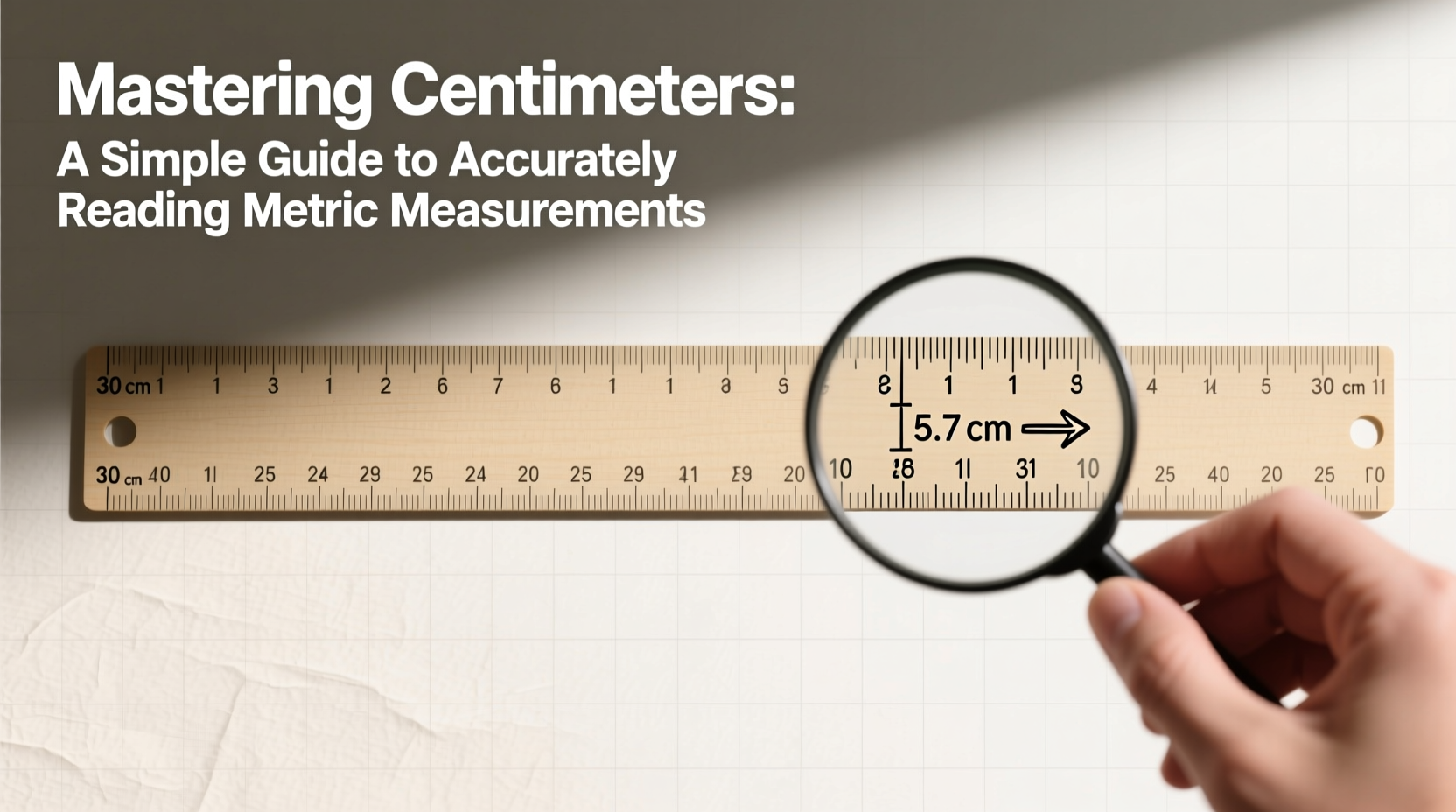
A standard metric ruler is marked in centimeters and millimeters. The longer lines with numbers represent centimeters, while the shorter lines between them are millimeters. Each centimeter is divided into 10 millimeters, allowing for precise readings down to 1 mm (0.1 cm).
To read a measurement:
- Align the object’s edge with the zero mark on the ruler.
- Identify the nearest centimeter line before the end of the object.
- Count the number of millimeter marks beyond that centimeter to get the decimal value.
- Add the two values together. For example, if an object ends at the seventh millimeter after the 4 cm mark, its length is 4.7 cm.
Common Measurement Mistakes and How to Avoid Them
Even experienced users make small errors when measuring. These often stem from poor technique or misunderstanding the scale. Recognizing these pitfalls is the first step toward consistent accuracy.
- Starting from the edge instead of zero: Some rulers have a small gap before the zero mark. If you start measuring from the physical end, your reading will be off.
- Miscounting millimeters: It's easy to count only five lines and assume it’s half a centimeter, but remember—there are ten millimeters per centimeter.
- Rounding too early: Premature rounding leads to cumulative errors, especially in multi-step projects.
- Using a worn or bent ruler: Over time, plastic rulers can warp or chip, compromising accuracy.
| Mistake | Why It Happens | How to Fix It |
|---|---|---|
| Parallax error | Viewing the ruler from the side | Position eyes directly over the measurement line |
| Incorrect starting point | Assuming the ruler’s edge is zero | Always locate the actual “0” mark |
| Confusing cm with mm | Not recognizing scale hierarchy | Remember: numbered lines = cm, unnumbered = mm |
Step-by-Step Guide to Measuring with Precision
Follow this sequence every time you need an accurate centimeter reading:
- Choose the right tool: Use a rigid metal ruler for straight edges or a flexible tape measure for curves.
- Inspect the tool: Check for damage, warping, or faded markings. <3> Align properly: Place the object flush against the ruler’s zero mark. Use a square edge if possible.
- Read the centimeters: Find the last full centimeter before the object ends.
- Count the millimeters: Count each small line past the centimeter. Each equals 0.1 cm.
- Record the total: Combine both values (e.g., 8 cm + 3 mm = 8.3 cm).
- Double-check: Repeat the measurement once more to confirm consistency.
Real-World Application: A Tailoring Scenario
Sophia, a home seamstress, was creating custom pillow covers for her living room. She measured the existing pillows using a fabric tape measure but neglected to ensure the tape was taut. Her initial reading was 45 cm, so she cut her fabric accordingly. After sewing, the covers were too loose.
Upon re-measuring with proper tension and eye alignment, she found the true dimension was 43.5 cm. The 1.5 cm difference came from sagging tape and parallax error. By applying correct technique—pulling the tape snugly and reading perpendicularly—she achieved a perfect fit on the second attempt.
This example shows how small inaccuracies compound in practical applications. In tailoring, woodworking, or model building, even half a centimeter can alter the final outcome.
Expert Insight: Why Precision Matters
“Accuracy in measurement isn’t about perfection—it’s about consistency. A measurement repeated three times should yield the same result each time. That reliability is what turns a novice into a skilled practitioner.” — Dr. Lena Petrov, Industrial Design Instructor at Berlin Technical Academy
Conversion and Estimation Tips
While mastering centimeters, it helps to understand how they relate to other units:
- 1 cm = 10 mm
- 100 cm = 1 meter
- 1 inch ≈ 2.54 cm (so 2.5 cm is a close approximation)
For quick estimation without a ruler:
- The width of an adult pinky finger is roughly 1 cm.
- A standard credit card is 8.6 cm wide and 5.4 cm tall.
- The diameter of a AAA battery is about 1 cm.
These mental benchmarks help verify measurements when tools aren’t available.
Checklist: Ensuring Accurate Centimeter Readings
Use this checklist before every important measurement:
- ☐ I am using a clean, undamaged measuring tool.
- ☐ I have located the true zero point, not just the edge.
- ☐ The object is aligned straight and flush with the ruler.
- ☐ I am viewing the scale from directly above.
- ☐ I have counted both full centimeters and additional millimeters.
- ☐ I have recorded the measurement in decimal form (e.g., 6.8 cm, not “six and eight-tenths”).
- ☐ I have repeated the measurement to confirm it.
Frequently Asked Questions
Can I use a metric ruler to measure curved surfaces?
Yes, but a rigid ruler won’t conform to curves. Use a flexible measuring tape instead. For small curves, approximate by following the contour closely and noting where the curve intersects each centimeter mark.
What does the smallest line on a metric ruler represent?
The smallest lines typically represent 1 millimeter (0.1 cm). On some precision rulers, they may indicate half-millimeter increments (0.05 cm), so always check the scale density.
Is there a difference between a centimeter and a cubic centimeter?
Yes. A centimeter (cm) measures length in one dimension. A cubic centimeter (cm³) measures volume—specifically, the space inside a cube that is 1 cm wide, 1 cm long, and 1 cm high. One cubic centimeter holds exactly 1 milliliter of liquid.
Conclusion: Build Confidence Through Practice
Mastering centimeters isn’t about memorizing facts—it’s about developing a mindset of attention and care. Every time you pick up a ruler, you’re practicing a fundamental skill used in science, design, medicine, and daily life. With the right tools, techniques, and habits, anyone can read metric measurements accurately and confidently.
Start small: measure everyday objects like books, phones, or kitchen utensils. Record your findings, compare them with known dimensions, and refine your method. Over time, reading centimeters will become second nature—just like telling time or typing on a keyboard.




 浙公网安备
33010002000092号
浙公网安备
33010002000092号 浙B2-20120091-4
Comments
No comments yet. Why don't you start the discussion?