
Time governs nearly every aspect of modern life—from catching the morning train to meeting work deadlines. Yet surprisingly, many adults struggle with interpreting analog clocks or making quick mental calculations about elapsed time. Whether you're relearning the basics, teaching a child, or simply refining your time perception, mastering clock reading is a foundational skill that enhances punctuality, planning, and self-reliance.
This guide breaks down the mechanics of reading both analog and digital clocks, introduces practical techniques for rapid comprehension, and provides real-world strategies to internalize time patterns. No jargon, no fluff—just clear, actionable knowledge that sticks.
Understanding the Basics: Analog vs. Digital Clocks
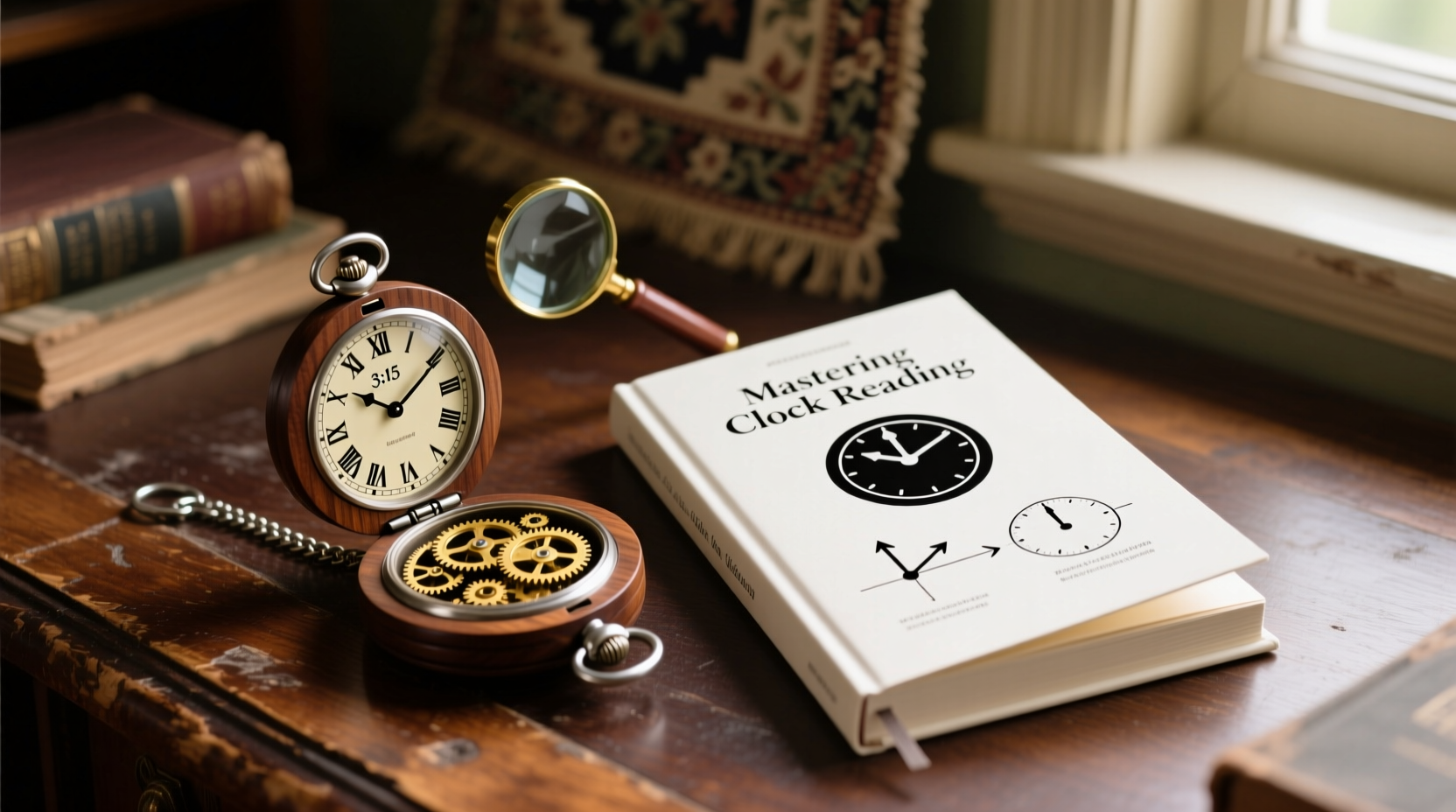
Analog and digital clocks display the same information in fundamentally different ways. Recognizing their distinctions—and knowing how to interpret each—is the first step toward fluency in time reading.
An analog clock uses rotating hands around a circular face marked with numbers 1 through 12. The shorter hand indicates the hour, while the longer hand shows minutes. Some models include a thin second hand that ticks every second. In contrast, digital clocks present time numerically, typically in formats like HH:MM or HH:MM:SS, often with an AM/PM or 24-hour indicator.
While digital displays offer instant readability, analog clocks provide spatial intuition about time progression. For example, seeing the minute hand halfway between 6 and 7 instantly conveys “about 33 minutes past,” reinforcing time as a continuous flow rather than discrete digits.
The Anatomy of an Analog Clock: Breaking Down the Hands
To read an analog clock accurately, you must understand what each hand represents and how they interact.
- Hour Hand (Short): Points to the current hour but moves gradually as minutes pass. At 2:30, it sits midway between 2 and 3.
- Minute Hand (Long): Each number on the clock represents five minutes. Multiply the number by five to get total minutes past the hour.
- Second Hand (Thin, Fast-Moving): Not always necessary for basic time-telling but useful for precision tasks.
For example, if the minute hand points at 4, it’s 20 minutes past the hour (4 × 5 = 20). If the hour hand is slightly past 7 and the minute hand is on 8, the time is approximately 7:40.
| Minute Hand Position | Minutes Past Hour |
|---|---|
| 1 | 5 |
| 3 | 15 |
| 6 | 30 |
| 9 | 45 |
| 12 | 0 (or 60) |
Step-by-Step Guide to Reading Time Quickly
Becoming fast and accurate at reading clocks doesn’t require memorization—it requires pattern recognition. Follow this sequence to build speed and confidence.
- Identify the hour hand’s position. Is it pointing directly at a number or between two? That tells you whether the hour has just started or is nearly over.
- Locate the minute hand. Count in fives based on the number it’s approaching. Use reference points: 3 = 15, 6 = 30, 9 = 45.
- Adjust for exactness. If the minute hand is between numbers, estimate additional minutes. Between 1 and 2? Add 1–4 minutes to 5.
- Determine AM or PM. Context matters. A clock showing 9:15 could be morning or night—use your environment to decide.
- Convert to digital format mentally. Saying “It’s ten minutes past two” becomes “2:10” in your mind, bridging analog and digital fluency.
“Time literacy is more than telling hours and minutes—it's about developing a spatial relationship with time.” — Dr. Alan Pierce, Cognitive Psychologist specializing in temporal perception
Common Mistakes and How to Avoid Them
Even experienced readers misread clocks under pressure. Here are frequent errors and how to correct them.
- Confusing the hands: The hour hand is shorter, but when it overlaps the minute hand near noon or midnight, it can be tricky. Focus on thickness and movement speed—the minute hand moves faster.
- Misreading half-past times: At 4:30, the hour hand should be halfway between 4 and 5. If you see it still near 4, you might think it’s 4:00.
- Forgetting AM/PM: Especially on digital clocks, skipping this distinction can lead to missed appointments. Train yourself to say the full time aloud: “six forty-five PM.”
| Do | Don't |
|---|---|
| Use landmarks: 12 = 0/60 min, 3 = 15 min, 6 = 30 min | Count each minute individually from 1 to 60 |
| Estimate positions between numbers | Assume the hand is exactly on a number unless it clearly is |
| Say the time out loud to reinforce memory | Rely solely on silent reading without verbal confirmation |
Real-Life Application: A Day in the Life of Timely Awareness
Sophie, a high school teacher, used to rely entirely on her smartphone for time checks. She noticed she was frequently late returning from lunch or missing the last few minutes of class discussions. After realizing she hadn’t truly looked at a wall clock in years, she decided to retrain herself.
She began by glancing at the classroom analog clock every time she transitioned between activities. At first, she’d pause and calculate: “Minute hand on 4—that’s 20 minutes. Hour hand just past 10… so 10:20.” Within a week, she could glance and know the time instantly. By month’s end, she was ending lessons on time, giving students better closure, and feeling more in control of her schedule.
Her experience underscores a key truth: clock reading isn’t just about knowing what time it is—it’s about reclaiming agency over your day.
Building Speed Through Practice: A Daily Checklist
Like any skill, proficiency comes with deliberate practice. Use this checklist daily for one week to build automaticity.
- ☑ Look at an analog clock three times today and state the time aloud.
- ☑ Estimate the time before checking your phone—then verify accuracy.
- ☑ Convert analog readings into 24-hour format (e.g., 3:45 PM → 15:45).
- ☑ Set small challenges: “When the minute hand reaches 7, I’ll stand up.”
- ☑ Teach someone else how to read the clock—explaining reinforces learning.
Frequently Asked Questions
Why is it important to learn analog clock reading when digital clocks are everywhere?
Analog clocks develop time intuition. They help visualize durations, estimate elapsed time, and support cognitive development in children. Many schools, public spaces, and formal environments still use analog displays, making fluency essential for independence.
How do I teach a child to tell time effectively?
Start with whole hours (“The short hand is on 3, so it’s 3 o’clock”), then progress to half-hours and quarter-hours using visual cues like “quarter past” or “half past.” Use a learning clock with movable hands, and tie time to daily routines: “We eat lunch at 12:15—look where the hands are!”
What’s the fastest way to read a clock without counting?
Memorize key positions: 3 = 15, 6 = 30, 9 = 45. These act as anchors. Then, interpolate between them. With repetition, your brain will recognize patterns like “hand near 10” as “~50 minutes” without calculation.
Conclusion: Take Control of Your Time
Mastering clock reading is more than a nostalgic throwback—it’s a practical tool for sharper focus, better scheduling, and deeper awareness of how you spend your most finite resource. Whether you’re navigating a busy day, helping a child learn, or simply want to reduce dependency on devices, this skill pays quiet dividends.




 浙公网安备
33010002000092号
浙公网安备
33010002000092号 浙B2-20120091-4
Comments
No comments yet. Why don't you start the discussion?