
Complex numbers are foundational in advanced mathematics, engineering, and physics. Yet many learners struggle not with the concept of imaginary numbers, but with the consistent and correct placement of the imaginary unit \\( i \\). Misplacing \\( i \\) can lead to incorrect results, confusion in algebraic manipulation, and errors in applied fields like signal processing or quantum mechanics. This guide clarifies where \\( i \\) belongs in various mathematical contexts, offering practical rules, common pitfalls, and structured examples to ensure precision.
Understanding the Imaginary Unit \\( i \\)
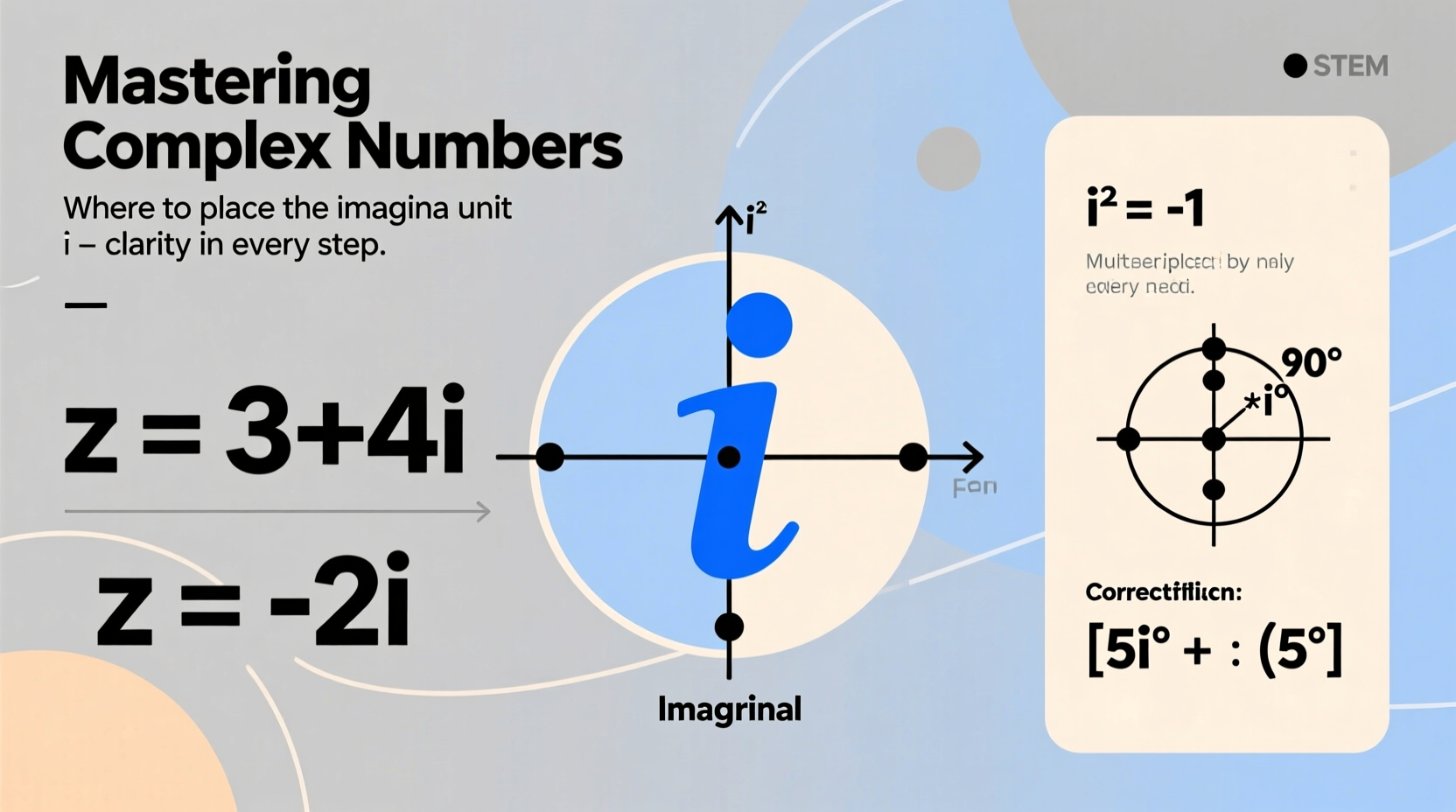
The imaginary unit \\( i \\) is defined as \\( i = \\sqrt{-1} \\). It allows us to extend the real number system to include solutions to equations like \\( x^2 + 1 = 0 \\), which have no real roots. A complex number takes the form \\( a + bi \\), where \\( a \\) and \\( b \\) are real numbers—\\( a \\) being the real part and \\( b \\) the coefficient of the imaginary part.
The placement of \\( i \\) is not arbitrary. It must always be associated with its coefficient and positioned such that it clearly modifies only the intended term. For example, \\( 3 + 4i \\) is correct; writing \\( 3 + i4 \\) may be mathematically equivalent but violates standard convention and reduces readability.
“Precision in notation is the first step toward mastery in complex analysis.” — Dr. Lena Torres, Applied Mathematician
Standard Conventions for Placing \\( i \\)
In both academic and professional settings, consistency in writing complex numbers ensures clarity and prevents misinterpretation. The following conventions are widely accepted across textbooks and research papers:
- Write the imaginary unit after its numerical coefficient: \\( 5i \\), not \\( i5 \\).
- In binomial form, write the real part first: \\( a + bi \\), never \\( bi + a \\) unless reordering serves a specific purpose.
- When multiplying, keep \\( i \\) adjacent to its factor: \\( (2 + 3i)(1 - i) \\), not \\( (2 + i3)(1 - i) \\).
- In fractions, maintain standard order: \\( \\frac{3 + 2i}{4} \\), not \\( \\frac{3 + i2}{4} \\).
Common Errors and How to Avoid Them
Misplacing \\( i \\) often stems from haste or unfamiliarity with algebraic structure. Below are frequent mistakes and their corrections:
| Error | Correction | Reason |
|---|---|---|
| \\( i7 + 2 \\) | \\( 2 + 7i \\) | Real part should come first; \\( i \\) follows coefficient. |
| \\( 4i3 \\) | \\( 12i \\) | Implied multiplication without operator causes confusion. |
| \\( \\sqrt{-5} = i\\sqrt{5} \\) | \\( \\sqrt{-5} = i\\sqrt{5} \\) ✅ | This is correct—\\( i \\) precedes the radical since it's factored out. |
| \\( e^{i\\pi/2} = i \\) | \\( e^{i\\pi/2} = i \\) ✅ | In exponentials, \\( i \\) is placed before the angle as per Euler’s formula. |
Note that while \\( i\\sqrt{5} \\) is acceptable (and standard) when extracting imaginary components from radicals, placing \\( i \\) before coefficients in additive expressions disrupts readability and is discouraged.
Step-by-Step Guide: Correctly Formatting Complex Expressions
Follow this sequence when writing or simplifying complex expressions to ensure proper placement of \\( i \\):
- Simplify all radicals involving negative numbers. Replace \\( \\sqrt{-a} \\) with \\( i\\sqrt{a} \\), where \\( a > 0 \\).
- Perform arithmetic operations (addition, multiplication) using distributive properties, keeping \\( i \\) attached to its coefficient.
- Combine like terms: group real parts and imaginary parts separately.
- Write the final result in standard form: \\( a + bi \\), with \\( a, b \\in \\mathbb{R} \\).
- Verify order: real part first, then \\( + \\), then coefficient times \\( i \\).
For example, simplify \\( (2 + \\sqrt{-9}) + (5 - 2i) \\):
- Replace \\( \\sqrt{-9} \\) with \\( 3i \\) → expression becomes \\( (2 + 3i) + (5 - 2i) \\).
- Group real: \\( 2 + 5 = 7 \\); imaginary: \\( 3i - 2i = i \\).
- Final answer: \\( 7 + i \\).
Real Example: Solving a Quadratic with Complex Roots
Consider the equation \\( x^2 - 4x + 13 = 0 \\). Using the quadratic formula:
\\[ x = \\frac{4 \\pm \\sqrt{(-4)^2 - 4(1)(13)}}{2} = \\frac{4 \\pm \\sqrt{16 - 52}}{2} = \\frac{4 \\pm \\sqrt{-36}}{2} \\]Now, \\( \\sqrt{-36} = 6i \\), so:
\\[ x = \\frac{4 \\pm 6i}{2} = 2 \\pm 3i \\]The solutions are \\( 2 + 3i \\) and \\( 2 - 3i \\)—both written in standard form. Writing them as \\( 3i + 2 \\) would not be wrong algebraically, but it breaks convention and could confuse readers expecting canonical form.
Expert Insight: Why Notation Matters Beyond Math Class
In electrical engineering, complex numbers represent impedance in AC circuits, where \\( Z = R + jX \\) (note: engineers often use \\( j \\) instead of \\( i \\) to avoid confusion with current). Consistent placement ensures accurate circuit modeling.
“In high-frequency design, a misplaced imaginary unit can simulate a capacitor as an inductor. Precision in notation prevents costly design flaws.” — Raj Patel, Senior RF Engineer
Similarly, in quantum mechanics, wave functions are complex-valued. The Schrödinger equation uses \\( i\\hbar \\frac{\\partial}{\\partial t} \\psi = \\hat{H}\\psi \\), where \\( i \\) appears at the front of the time derivative term. Its position is not decorative—it defines the phase evolution of the system.
Frequently Asked Questions
Can I write \\( i \\) before the coefficient in some cases?
Yes—but sparingly. In expressions like \\( i\\sqrt{3} \\) or \\( ie^{x} \\), placing \\( i \\) first is standard because there’s no real component competing for position. However, in binomial form, always use \\( a + bi \\).
Is \\( 0 + 1i \\) the same as just \\( i \\)?
Yes. While \\( i \\) is sufficient, writing \\( 0 + 1i \\) can be useful for pedagogical clarity or algorithmic consistency (e.g., in programming complex number classes).
Why do some textbooks use \\( j \\) instead of \\( i \\)?
Engineering disciplines use \\( j \\) to denote the imaginary unit because \\( i \\) traditionally represents electric current. The meaning is identical; only the symbol changes.
Checklist: Ensuring Proper Use of \\( i \\)
- ✅ Always write \\( i \\) after its coefficient in additive expressions (e.g., \\( 3 + 4i \\)).
- ✅ Use \\( i \\) before radicals when factoring negatives (e.g., \\( i\\sqrt{7} \\)).
- ✅ Maintain standard form \\( a + bi \\) in final answers.
- ✅ Double-check placement after simplification or distribution.
- ✅ Be aware of context—use \\( j \\) if working in electrical engineering.
Conclusion: Clarity Through Consistency
Mastering complex numbers isn’t just about understanding abstract concepts—it’s about expressing them clearly and correctly. The placement of \\( i \\) may seem minor, but it reflects deeper attention to mathematical rigor. Whether you're solving equations, analyzing signals, or studying quantum states, consistent notation builds confidence in your work and ensures others can follow your reasoning.




 浙公网安备
33010002000092号
浙公网安备
33010002000092号 浙B2-20120091-4
Comments
No comments yet. Why don't you start the discussion?