
Completing the square is a powerful algebraic technique used to solve quadratic equations, rewrite them in vertex form, and analyze their graphs. While many students rely solely on the quadratic formula, mastering this method offers deeper insight into the structure of quadratics and strengthens problem-solving skills. Unlike rote memorization, completing the square reveals the geometric reasoning behind parabolas and enables precise control over transformations.
This guide walks through the complete process—from basic principles to advanced applications—using clear explanations, real examples, and structured steps. Whether you're preparing for exams or deepening your mathematical understanding, this skill will serve as a cornerstone in algebra and precalculus.
Understanding the Purpose of Completing the Square
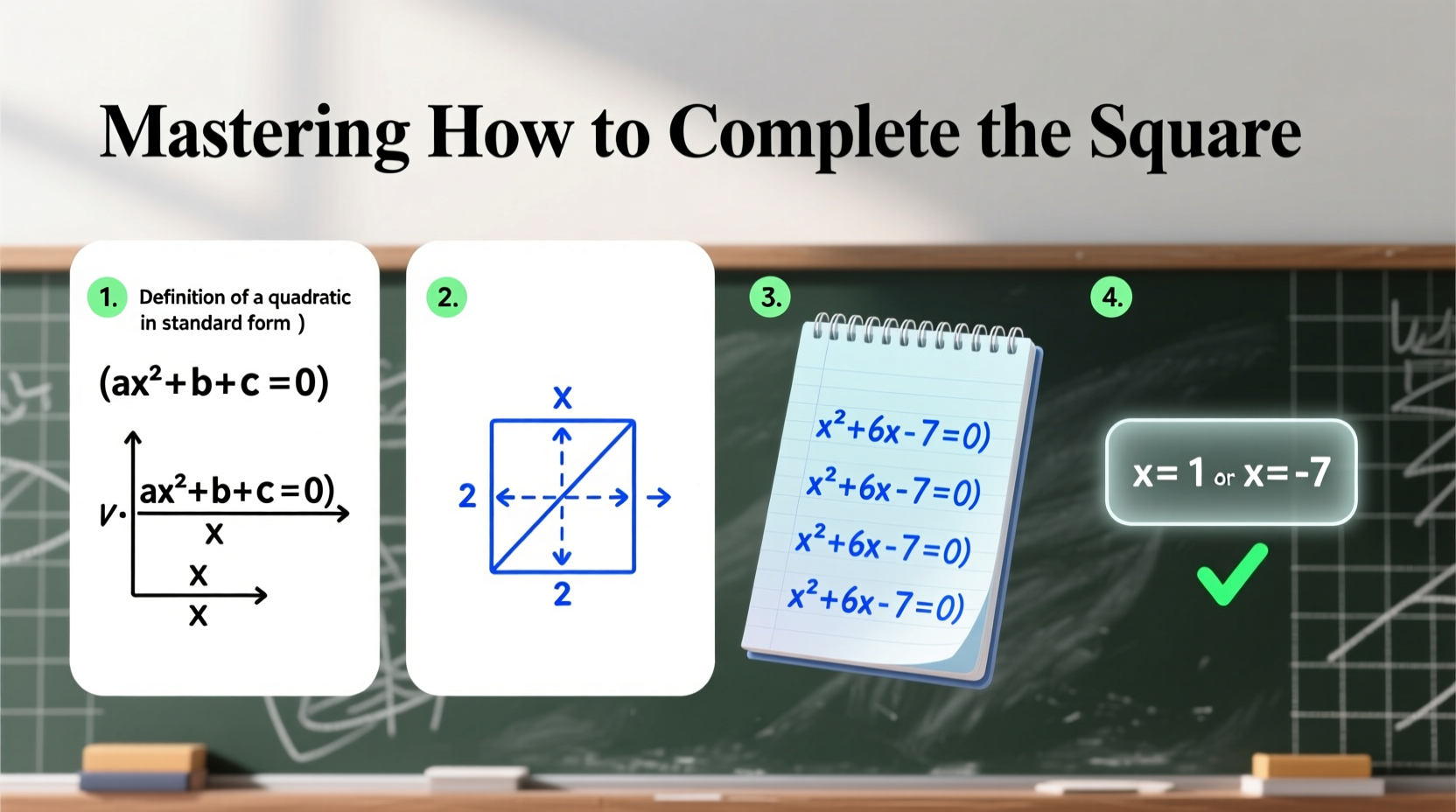
A quadratic equation takes the standard form \\( ax^2 + bx + c = 0 \\). While factoring and the quadratic formula are common solving methods, completing the square transforms the equation into a perfect square trinomial, allowing direct extraction of roots. More importantly, it converts the equation into vertex form:
\\( y = a(x - h)^2 + k \\)
This form immediately reveals the vertex \\((h, k)\\) of the parabola, making it invaluable for graphing and optimization problems.
“Completing the square isn’t just a solving tool—it’s a bridge between algebra and geometry.” — Dr. Alan Reyes, Mathematics Educator
The core idea relies on the identity:
\\( (x + d)^2 = x^2 + 2dx + d^2 \\)
By adjusting a quadratic expression to match this pattern, we can express it as a squared binomial plus a constant.
Step-by-Step Guide to Completing the Square
Follow this logical sequence to complete the square for any quadratic equation where \\( a = 1 \\). We’ll expand to cases where \\( a \ eq 1 \\) afterward.
- Ensure the coefficient of \\( x^2 \\) is 1. If not, factor out the leading coefficient from the first two terms.
- Move the constant term to the other side of the equation. This isolates the variable terms.
- Take half of the coefficient of \\( x \\), square it, and add it to both sides. This creates a perfect square trinomial on the left.
- Factor the left-hand side into a squared binomial.
- Solve by taking the square root of both sides and isolating \\( x \\).
Example 1: Basic Case (\\( a = 1 \\))
Solve: \\( x^2 + 6x - 7 = 0 \\)
Step 1: Move constant to the right:
\\( x^2 + 6x = 7 \\)
Step 2: Half of 6 is 3; square it: \\( 3^2 = 9 \\)
Add 9 to both sides:
\\( x^2 + 6x + 9 = 7 + 9 \\)
\\( x^2 + 6x + 9 = 16 \\)
Step 3: Factor left side:
\\( (x + 3)^2 = 16 \\)
Step 4: Take square root:
\\( x + 3 = \\pm 4 \\)
Step 5: Solve for \\( x \\):
\\( x = -3 + 4 = 1 \\) or \\( x = -3 - 4 = -7 \\)
Solutions: \\( x = 1 \\) and \\( x = -7 \\)
Example 2: When \\( a \ eq 1 \\)
Solve: \\( 2x^2 + 8x - 10 = 0 \\)
Step 1: Divide entire equation by 2:
\\( x^2 + 4x - 5 = 0 \\)
Step 2: Move constant:
\\( x^2 + 4x = 5 \\)
Step 3: Half of 4 is 2; square: \\( 2^2 = 4 \\)
Add to both sides:
\\( x^2 + 4x + 4 = 5 + 4 \\)
\\( (x + 2)^2 = 9 \\)
Step 4: Take square root:
\\( x + 2 = \\pm 3 \\)
Step 5: Solve:
\\( x = 1 \\) or \\( x = -5 \\)
Converting to Vertex Form
Completing the square is essential when rewriting quadratics in vertex form without using formulas.
Given: \\( f(x) = x^2 - 10x + 18 \\)
Group terms: \\( (x^2 - 10x) + 18 \\)
Half of -10 is -5; square: 25
Add and subtract 25 inside the expression:
\\( (x^2 - 10x + 25) + 18 - 25 \\)
\\( = (x - 5)^2 - 7 \\)
Vertex form: \\( f(x) = (x - 5)^2 - 7 \\)
Vertex: \\( (5, -7) \\)
This shows the parabola opens upward, has a minimum at \\( (5, -7) \\), and is symmetric about \\( x = 5 \\).
Practical Applications and Real-World Example
Consider a small business owner modeling daily profit with the function:
\\( P(x) = -2x^2 + 40x - 150 \\)
where \\( x \\) is the number of units sold, and \\( P(x) \\) is profit in dollars. To find the maximum profit and optimal sales volume, convert to vertex form.
Factor out -2 from first two terms:
\\( P(x) = -2(x^2 - 20x) - 150 \\)
Complete the square inside parentheses:
Half of -20 is -10; square: 100
Add and subtract 100:
\\( P(x) = -2(x^2 - 20x + 100 - 100) - 150 \\)
\\( = -2[(x - 10)^2 - 100] - 150 \\)
\\( = -2(x - 10)^2 + 200 - 150 \\)
\\( = -2(x - 10)^2 + 50 \\)
The vertex is at \\( (10, 50) \\), meaning maximum profit of $50 occurs when 10 units are sold.
“In business modeling, completing the square turns abstract equations into actionable insights.” — Maria Lin, Applied Math Consultant
Common Mistakes and Best Practices
Even experienced students make avoidable errors. The following table highlights frequent pitfalls and how to prevent them.
| Mistake | Why It's Wrong | How to Fix |
|---|---|---|
| Forgetting to halve the x-coefficient before squaring | Leads to incorrect constant addition | Always compute \\( (b/2)^2 \\), not \\( b^2 \\) |
| Not balancing both sides when adding a number | Breaks equation equality | Add the same value to both sides |
| Incorrectly factoring non-monic quadratics | Results in wrong binomial | Factor out 'a' first, then complete inside parentheses |
| Ignoring signs when taking square roots | Loses one solution | Always use \\( \\pm \\) after square rooting |
Checklist: Mastering Completion of the Square
- ✅ Confirm the coefficient of \\( x^2 \\) is 1 (or factor it out if not)
- ✅ Isolate variable terms on one side
- ✅ Compute \\( (b/2)^2 \\) accurately
- ✅ Add the result to both sides of the equation
- ✅ Factor the trinomial into \\( (x + d)^2 \\)
- ✅ Use \\( \\pm \\) when taking square roots
- ✅ Verify solutions by substitution
- ✅ For vertex form, simplify constants carefully
Frequently Asked Questions
Can I complete the square for any quadratic equation?
Yes, all quadratic equations can be solved by completing the square. It works regardless of whether the roots are real or complex. However, if the discriminant is negative, the result will involve imaginary numbers.
Is completing the square faster than using the quadratic formula?
It depends. For simple equations with integer coefficients, completing the square can be quick and insightful. However, the quadratic formula is more efficient for complex coefficients. That said, deriving the quadratic formula itself requires completing the square—so understanding the method deepens overall comprehension.
Why do we need vertex form?
Vertex form allows immediate identification of the parabola’s turning point and direction of opening. This is crucial in physics (projectile motion), economics (profit maximization), and engineering (signal optimization), where knowing the peak or trough of a curve is essential.
Final Thoughts and Call to Action
Completing the square is more than a procedural trick—it’s a window into the symmetry and behavior of quadratic functions. With consistent practice, what once seemed mechanical becomes intuitive. You begin to see patterns, anticipate outcomes, and manipulate expressions with confidence.
Start by applying the method to simple equations, then progress to real-world models. Challenge yourself to convert every quadratic you encounter into vertex form. Share your discoveries with peers or mentors. Teaching the process reinforces mastery.




 浙公网安备
33010002000092号
浙公网安备
33010002000092号 浙B2-20120091-4
Comments
No comments yet. Why don't you start the discussion?