
Drawing a clock may seem simple at first glance, but capturing the precision of its hands requires more than just sketching lines. The hour, minute, and second hands must reflect correct proportions, alignment, and angular relationships to appear realistic and functional. For artists, illustrators, or hobbyists beginning their journey into technical drawing, mastering clock hands offers valuable lessons in symmetry, measurement, and visual accuracy. This guide breaks down the process into manageable steps, equipping you with the skills to draw clock hands that are both aesthetically pleasing and technically sound.
Understanding Clock Hand Proportions
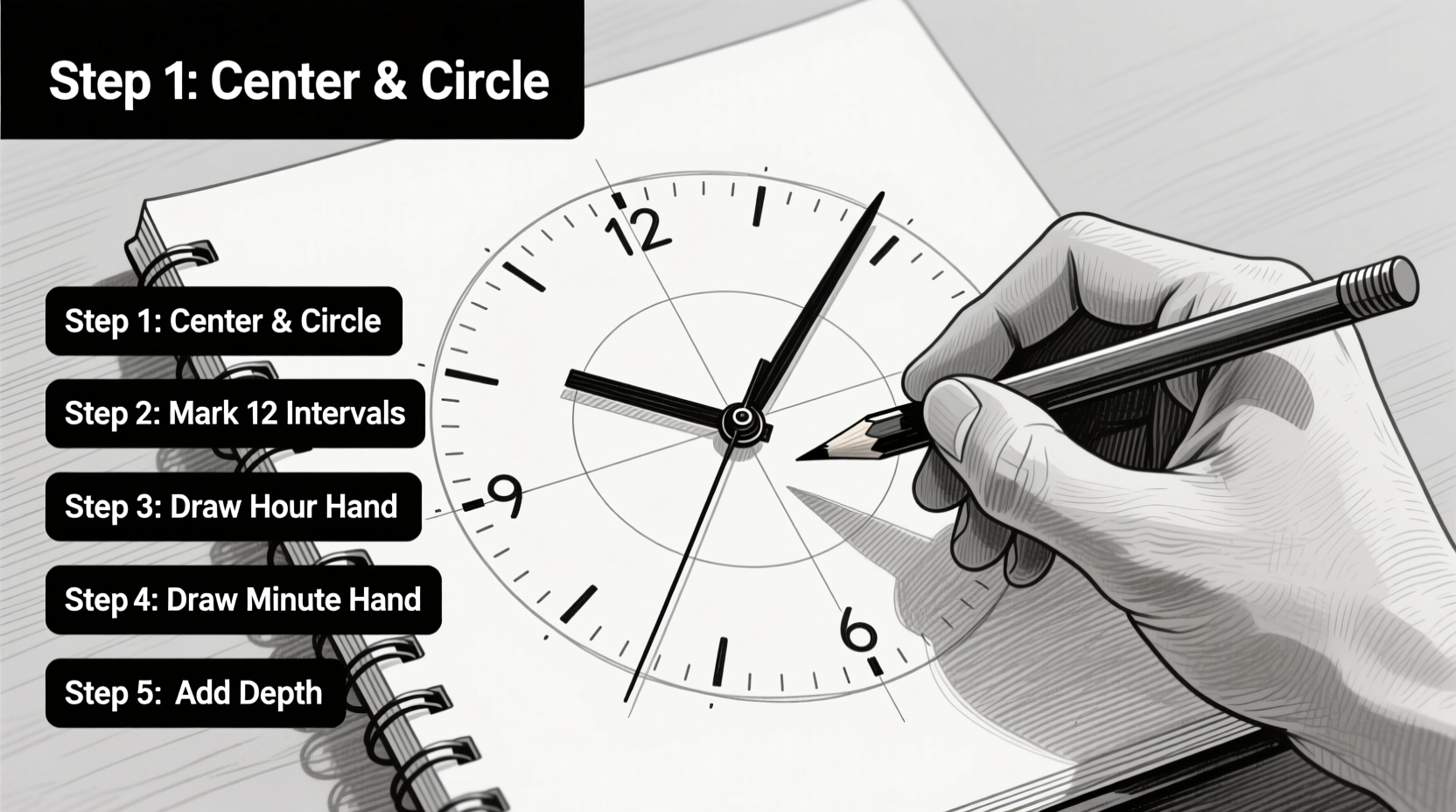
Clock faces follow consistent design principles across most analog timepieces. Recognizing the proportional relationship between the three hands—hour, minute, and second—is essential before putting pencil to paper.
The hour hand is typically the shortest and thickest, designed to point clearly at the hour markers. The minute hand is longer and slightly thinner, extending closer to the edge of the dial. The second hand is usually the longest, thinnest, and often colored red or distinctively styled to differentiate its motion.
As a general rule:
- Hour hand: Reaches about 50–60% of the distance from center to edge.
- Minute hand: Extends to 85–90% of the radius.
- Second hand: Often reaches the very edge or slightly beyond, emphasizing motion.
Step-by-Step Guide to Drawing Clock Hands
Follow this structured approach to ensure your clock hands are balanced, aligned, and accurate in appearance.
- Draw the clock face: Begin with a perfect circle using a compass or circular template. Mark the 12, 3, 6, and 9 positions lightly with a ruler.
- Find the center: Use intersecting diagonals (from corner to corner if using a square guide) to locate the exact center point where all hands will originate.
- Determine hand length: Decide on a radius (e.g., 5 cm). Multiply it by 0.55 for the hour hand, 0.85 for the minute hand, and 0.95–1.0 for the second hand.
- Sketch the hour hand: Draw a bold, tapered line from the center outward. It should be wide at the base and narrow toward the tip, pointing toward a specific hour.
- Add the minute hand: From the same center, draw a longer, slimmer hand. Ensure it does not overlap excessively with the hour hand unless depicting 12:00.
- Insert the second hand: Use a fine line, often with a small counterbalance on the opposite end. Keep it dynamic and precise.
- Refine angles: If showing a specific time (e.g., 3:15), calculate the exact angle each hand should occupy (more on this later).
- Ink and erase guidelines: Once satisfied, trace over final lines with pen or dark pencil. Carefully erase all construction marks.
Calculating Hand Angles for Accuracy
A realistic clock illustration reflects correct time-based angles. Each hand moves at a predictable rate, allowing you to compute its position mathematically.
Key formulas:
- Minute hand: 6° per minute (360° ÷ 60)
- Hour hand: 0.5° per minute (30° per hour)
- Second hand: 6° per second
For example, at 4:45:
- Minute hand: 45 × 6° = 270° (pointing at 9)
- Hour hand: (4 × 30°) + (45 × 0.5°) = 120° + 22.5° = 142.5° (between 4 and 5)
| Time | Hour Hand Angle | Minute Hand Angle | Visual Description |
|---|---|---|---|
| 3:00 | 90° | 0° | Hour at 3, minute at 12 — perpendicular |
| 6:30 | 195° | 180° | Minute at 6, hour halfway between 6 and 7 |
| 12:15 | 7.5° | 90° | Minute at 3, hour slightly past 12 |
Common Mistakes and How to Avoid Them
Even experienced artists can misrepresent clock hands due to oversight or haste. Awareness of frequent errors improves precision.
- Misaligned centers: Hands not originating from the same point break realism. Always double-check convergence.
- Incorrect proportions: An overly long hour hand or stubby minute hand disrupts balance.
- Ignores movement logic: At 2:30, the hour hand should be halfway toward 3, not still pointing directly at 2.
- Overlapping confusion: Avoid having hands cross in unnatural ways unless intentional (e.g., 12:00).
- Ignoring weight distribution: Thicker bases and tapered tips mimic real-world mechanics and improve visual clarity.
“Precision in technical illustration starts with observation. Study real clocks to understand how hands interact with numerals and each other.” — Daniel Reeves, Industrial Designer & Drafting Instructor
Mini Case Study: Illustrating a Vintage Wall Clock
Julia, a beginner illustrator, was commissioned to draw a vintage-style wall clock for a café menu. Her initial sketch showed all hands perfectly straight and equal in length, making the image look artificial.
After researching antique clocks, she adjusted her approach:
- She shortened the hour hand and gave it a moon-shaped tip.
- The minute hand was elongated with a delicate arrowhead.
- She positioned the hands at 10:10, a classic aesthetic choice, calculating the hour hand at approximately 305° and the minute hand at 60°.
The revised drawing received praise for its authenticity. Julia credits her success to understanding proportion and angular calculation—skills she now applies to all mechanical illustrations.
Essential Checklist for Drawing Clock Hands
Before finalizing your drawing, go through this checklist to ensure quality and accuracy:
- ✅ Circle is perfectly round with a clearly marked center.
- ✅ All hands originate from the exact same central point.
- ✅ Hour, minute, and second hands follow correct length ratios.
- ✅ Angles match the intended time (if applicable).
- ✅ Tapered shapes enhance realism and readability.
- ✅ Construction lines are erased cleanly.
- ✅ Hands do not collide unnaturally (unless intentionally shown).
Frequently Asked Questions
How do I make clock hands look three-dimensional?
Add subtle shading along one side of each hand to simulate thickness. Highlight the top edge with an eraser or white pen for a metallic effect. Consider slight perspective tilt if drawing a clock viewed at an angle.
Can I use different styles for artistic clocks?
Absolutely. While traditional proportions serve realism, artistic interpretations allow creative freedom. Just maintain internal consistency so the design remains believable.
What tools help most in drawing accurate clock hands?
A compass, ruler, protractor, and fine-tip pencils (HB to 2H) are ideal. Digital artists benefit from snap-to-center features and rotation guides in software like Adobe Illustrator or Procreate.
Final Thoughts and Call to Action
Drawing clock hands accurately blends artistry with analytical thinking. It’s not merely about lines on a dial—it’s about capturing the quiet precision of time itself. With practice, attention to proportion, and an understanding of angular relationships, anyone can master this foundational skill. Whether you're illustrating a children’s book, designing a watch face, or simply honing your draftsmanship, the ability to render realistic clock hands adds depth and credibility to your work.




 浙公网安备
33010002000092号
浙公网安备
33010002000092号 浙B2-20120091-4
Comments
No comments yet. Why don't you start the discussion?