
Determining whether a point lies inside, on, or outside a circle is a foundational concept in geometry with far-reaching implications across disciplines such as computer graphics, robotics, GPS navigation, and architectural design. While the principle may appear abstract at first, its applications are deeply embedded in everyday technology and spatial reasoning. Understanding this process not only enhances mathematical literacy but also empowers problem-solving in technical fields.
The core idea revolves around comparing the distance from a given point to the center of a circle with the circle’s radius. If the distance is less than the radius, the point is inside; if equal, it's on the boundary; and if greater, it lies outside. This simple rule forms the basis for more advanced computations in coordinate geometry and algorithmic design.
Understanding the Circle Equation
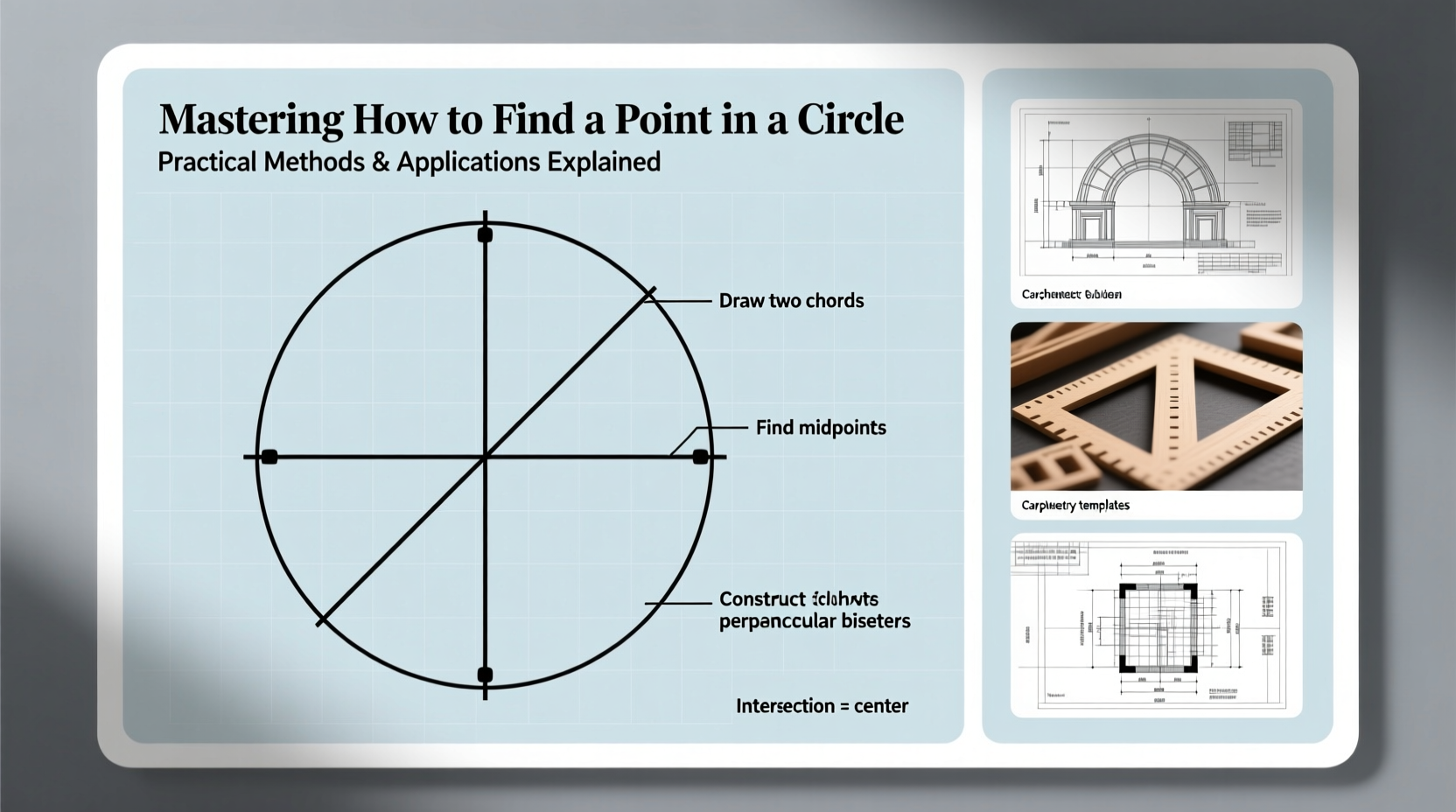
In Cartesian coordinates, a circle is defined by its center \\((h, k)\\) and radius \\(r\\). The standard equation is:
\\[(x - h)^2 + (y - k)^2 = r^2\\]
To determine the position of any point \\((x_0, y_0)\\), substitute its coordinates into the left-hand side of the equation:
\\[(x_0 - h)^2 + (y_0 - k)^2\\]
Compare the result to \\(r^2\\):
- If the result is less than \\(r^2\\), the point is inside the circle.
- If it is equal to \\(r^2\\), the point lies on the circle.
- If it is greater than \\(r^2\\), the point is outside.
Step-by-Step Method to Locate a Point Relative to a Circle
- Identify the circle’s center and radius. For example, a circle centered at (3, 4) with radius 5.
- Obtain the coordinates of the test point. Suppose we want to test point (5, 6).
- Calculate the squared distance from the point to the center: \\((5 - 3)^2 + (6 - 4)^2 = 4 + 4 = 8\\).
- Square the radius: \\(5^2 = 25\\).
- Compare: Since 8 < 25, the point lies inside the circle.
This method avoids computing square roots, which improves computational efficiency—especially important in real-time systems like video games or collision detection engines.
Practical Applications Across Industries
The ability to assess point-circle relationships isn’t limited to theoretical math. It plays a crucial role in various applied domains.
Navigation and Geofencing
In GPS-based applications, geofencing uses circular (or polygonal) zones to trigger actions when a device enters or exits a virtual boundary. For instance, a delivery app might notify a driver when they are within 500 meters of a drop-off location. This radius defines a circle, and the system continuously checks if the driver’s current coordinates fall within it.
Computer Graphics and Game Development
In 2D games, circular hitboxes are common for detecting collisions between characters and objects. By calculating whether the player’s position lies within an enemy’s detection radius, developers can simulate awareness or trigger events. Efficient point-in-circle checks enable smooth gameplay without lag.
Robotics and Autonomous Systems
Robots navigating environments often use proximity sensors that define circular safety zones. If an obstacle falls within a critical radius around the robot, path adjustments are made. These decisions rely on rapid geometric evaluations similar to point-in-circle logic.
“Geometric primitives like circles form the building blocks of spatial reasoning in AI navigation. Fast, accurate point classification is essential.” — Dr. Lena Torres, Robotics Researcher at MIT
Alternative Methods and Optimization Techniques
While the algebraic approach is standard, other strategies enhance performance or adapt to specific contexts.
Polar Coordinates Approach
In systems where angles and radial distances are already computed (such as radar displays), converting Cartesian points to polar coordinates simplifies the check. A point is inside the circle if its radial distance from the origin (center) is less than the radius.
Vector-Based Calculation
Using vector mathematics, the dot product of the vector from the center to the point with itself yields the squared distance. This integrates naturally into physics engines and 3D modeling software.
Bounding Box Pre-Check
Before performing a full distance calculation, a quick bounding box test can eliminate obvious outliers. If a point lies outside the square that circumscribes the circle (i.e., beyond \\(h \\pm r\\) or \\(k \\pm r\\)), it cannot be inside the circle. This reduces unnecessary computation in large datasets.
| Method | Use Case | Speed | Precision |
|---|---|---|---|
| Standard Distance Formula | General-purpose, educational | Moderate | High |
| Bounding Box Filter | Large-scale spatial queries | Fast (pre-filter) | Medium (used in tandem) |
| Vector Dot Product | Game engines, 3D software | Very Fast | High |
| Polar Coordinates | Radar, directional systems | Fast | Depends on conversion accuracy |
Mini Case Study: Optimizing a Location-Based Mobile App
A startup developing a fitness tracking app wanted to notify users when they entered a “hydration zone” near public water fountains. Each fountain was modeled as a circle with a 30-meter radius. Initially, the app checked every fountain against the user’s location using the full distance formula, causing battery drain and lag.
The development team implemented a two-step optimization:
- First, a bounding box filter excluded fountains more than 30 meters away in either x or y direction.
- Only remaining candidates underwent the precise distance check.
This reduced processing time by 70% and extended battery life significantly, all while maintaining accuracy. The solution exemplifies how efficient geometric logic scales real-world applications.
Frequently Asked Questions
Can this method work in three dimensions?
Yes. In 3D space, the equation becomes \\((x - h)^2 + (y - k)^2 + (z - l)^2 = r^2\\). The same comparison applies: if the sum is less than \\(r^2\\), the point is inside the sphere. This extension is vital in aerospace, medical imaging, and 3D modeling.
What if the circle is not centered at the origin?
No issue. The general equation accounts for any center \\((h, k)\\). Simply plug in the correct values for \\(h\\) and \\(k\\) when calculating the squared distance. Shifting the coordinate system does not affect the logic.
Is there a way to handle multiple circles efficiently?
For large sets, spatial data structures like quadtrees or k-d trees organize circles by region, minimizing the number of checks needed per query. These are standard in geographic information systems (GIS) and real-time strategy games.
Actionable Checklist: Implementing Point-in-Circle Logic
- ✅ Define the circle’s center \\((h, k)\\) and radius \\(r\\).
- ✅ Obtain the test point \\((x_0, y_0)\\).
- ✅ Compute \\((x_0 - h)^2 + (y_0 - k)^2\\).
- ✅ Compare result to \\(r^2\\) (not \\(r\\)) to avoid square root operations.
- ✅ Use a tolerance threshold for floating-point comparisons in code.
- ✅ Apply bounding box pre-checks for performance in bulk operations.
- ✅ Consider spatial indexing for systems with many circles or frequent queries.
Conclusion
Mastery of how to find a point in a circle bridges abstract mathematics and tangible innovation. From triggering smart notifications to enabling autonomous navigation, this deceptively simple concept underpins technologies we interact with daily. Whether you're a student, developer, or engineer, refining your understanding of this principle unlocks deeper insight into spatial systems and efficient algorithm design.




 浙公网安备
33010002000092号
浙公网安备
33010002000092号 浙B2-20120091-4
Comments
No comments yet. Why don't you start the discussion?