
Multiplying fractions is one of the foundational skills in mathematics that opens doors to more advanced topics like algebra, geometry, and real-world problem solving. While it may seem intimidating at first, the process is straightforward once you understand the logic behind it. Unlike addition or subtraction, multiplying fractions doesn’t require common denominators, making it often simpler than other operations. This guide breaks down the entire process into manageable steps, complete with practical examples, expert insights, and tips to avoid common mistakes.
Understanding the Basics of Fraction Multiplication
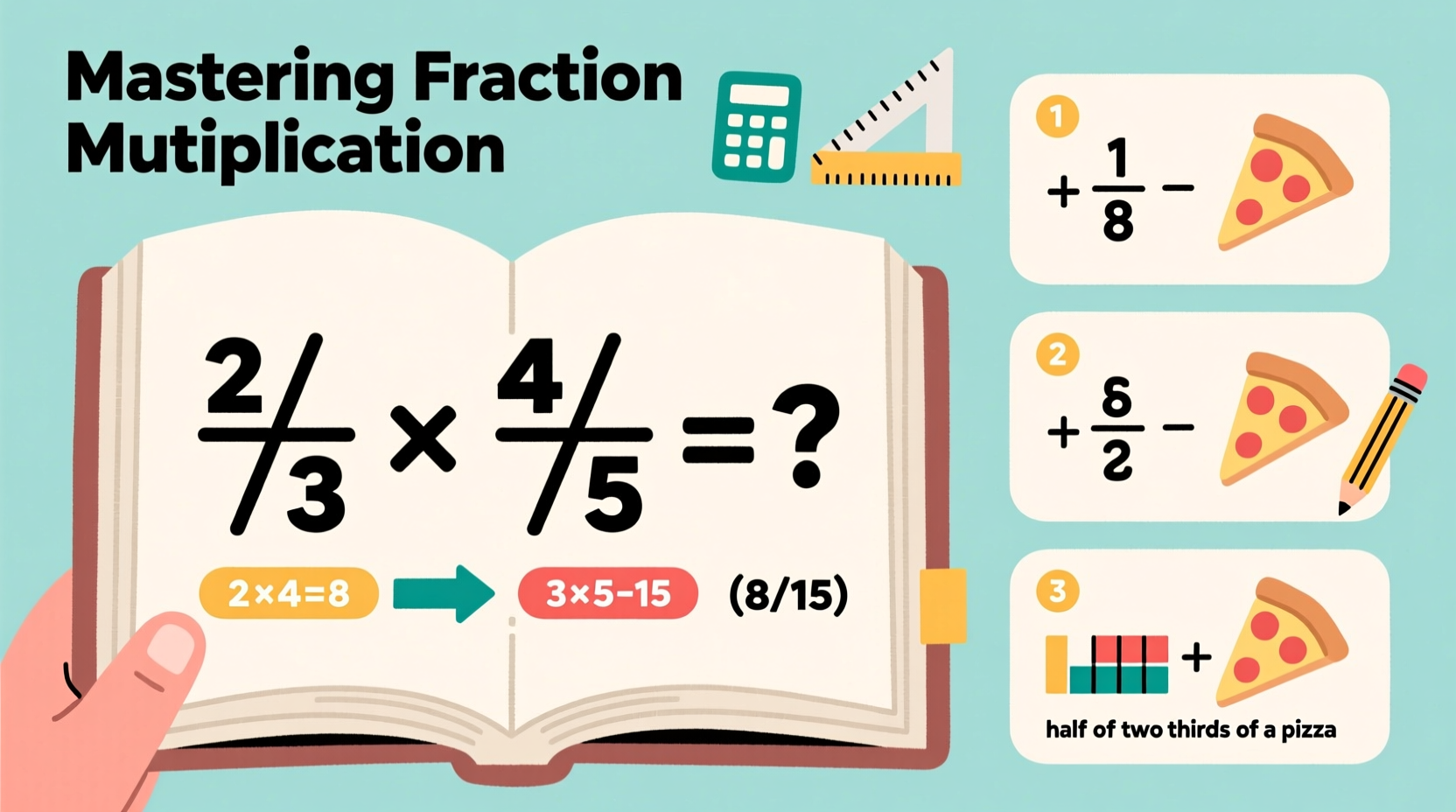
A fraction represents a part of a whole and consists of two parts: the numerator (top number) and the denominator (bottom number). When you multiply two fractions, you’re essentially finding a portion of a portion. For example, multiplying ½ by ¾ means “what is three-fourths of one-half?” The result will be smaller than both original fractions because you're taking a piece of a piece.
The core rule for multiplying fractions is simple:
“Multiply the numerators together, then multiply the denominators together.” — Dr. Alan Reeves, Mathematics Educator
This gives you a new fraction, which should then be simplified if possible. Let’s explore this process in detail.
Step-by-Step Guide to Multiplying Fractions
Follow these five essential steps to multiply any two fractions accurately and efficiently.
- Write down both fractions clearly. Make sure each has a numerator and denominator properly aligned.
- Multiply the numerators. Take the top number of the first fraction and multiply it by the top number of the second.
- Multiply the denominators. Do the same with the bottom numbers.
- Simplify the resulting fraction. Reduce it to its lowest terms by dividing both numerator and denominator by their greatest common divisor (GCD).
- Convert to a mixed number if needed. If the result is an improper fraction (numerator larger than denominator), convert it to a mixed number for clarity.
Example 1: Simple Fraction Multiplication
Multiply ⅔ × ¾.
- Numerator: 2 × 3 = 6
- Denominator: 3 × 4 = 12
- Result: ⁶⁄₁₂
- Simplified: Divide both by 6 → ½
So, ⅔ × ¾ = ½.
Example 2: Multiplying a Fraction by a Whole Number
To multiply a fraction by a whole number, write the whole number as a fraction over 1.
Example: ⁵⁄₈ × 4
- Write 4 as ⁴⁄₁
- Multiply: (5 × 4) / (8 × 1) = ²⁰⁄₈
- Simplify: ²⁰⁄₈ = ⁵⁄₂ (divide numerator and denominator by 4)
- Convert: ⁵⁄₂ = 2½
Therefore, ⁵⁄₈ × 4 = 2½.
Practical Applications and Real-World Examples
Fraction multiplication isn't just a classroom exercise—it appears in everyday life. From cooking to construction, understanding how to scale fractional quantities is crucial.
Mini Case Study: Baking with Halved Recipes
Sophia loves baking banana bread but only wants to make half the recipe. The original calls for ¾ cup of sugar. How much sugar does she need?
Solution: Multiply ¾ by ½.
- Numerator: 3 × 1 = 3
- Denominator: 4 × 2 = 8
- Result: ³⁄₈ cup of sugar
By applying fraction multiplication, Sophia knows she needs exactly ³⁄₈ cup—less than half a cup but more than a quarter. This precision ensures her bread turns out perfectly sweetened.
Construction Example: Cutting Wood Pieces
A carpenter needs to cut a board that is ⅝ inch thick into layers that are each ⅔ of the original thickness. What is the thickness of each layer?
- Multiply: ⅝ × ⅔
- Numerator: 5 × 2 = 10
- Denominator: 8 × 3 = 24
- Result: ¹⁰⁄₂₄ = ⁵⁄₁₂ inch
Each layer will be ⁵⁄₁₂ inch thick after simplification.
Common Mistakes and How to Avoid Them
Even experienced learners can stumble on fraction multiplication due to misconceptions. Here’s a checklist to help you stay accurate:
Checklist: Avoiding Errors in Fraction Multiplication
- ✅ Always multiply straight across—no need for common denominators.
- ✅ Convert mixed numbers to improper fractions before multiplying.
- ✅ Simplify early to avoid working with large numbers.
- ✅ Double-check your arithmetic, especially when reducing fractions.
- ✅ Label your final answer appropriately (fraction, mixed number, or decimal).
One frequent error is forgetting to simplify the final answer. For instance, leaving ⁶⁄₉ instead of reducing it to ⅔. Another mistake is trying to find a common denominator unnecessarily, which adds complexity without benefit.
| Do | Don’t |
|---|---|
| Multiply numerators and denominators directly | Find common denominators before multiplying |
| Simplify before or after multiplication | Leave answers in unreduced form |
| Convert mixed numbers to improper fractions | Multiply the whole number separately |
| Use cancellation (cross-simplifying) when possible | Multiply large numbers without simplifying first |
FAQ: Frequently Asked Questions
Can you multiply more than two fractions at once?
Yes. Multiply all numerators together and all denominators together, then simplify. For example: ½ × ⅔ × ¾ = (1×2×3)/(2×3×4) = ⁶⁄₂₄ = ¼.
What happens when you multiply a fraction by zero?
Any fraction multiplied by zero equals zero. For example, ⁷⁄₁₀ × 0 = 0. This follows the basic rule that anything times zero is zero.
Why don’t we need common denominators when multiplying fractions?
Because multiplication is about scaling, not combining parts of a whole. You’re not joining pieces like in addition—you’re finding a portion of a portion, so alignment of denominators isn’t required.
Conclusion: Build Confidence Through Practice
Multiplying fractions becomes intuitive with consistent practice and a solid understanding of the underlying principles. Whether you're adjusting recipes, calculating measurements, or solving complex equations, this skill empowers accuracy and confidence. Start with simple problems, apply the step-by-step method, and gradually tackle more complex scenarios involving mixed numbers or multiple fractions.
Remember, mastery comes not from memorization but from application. Use the checklist, learn from real-world examples, and avoid common pitfalls. With time, multiplying fractions will feel as natural as counting.




 浙公网安备
33010002000092号
浙公网安备
33010002000092号 浙B2-20120091-4
Comments
No comments yet. Why don't you start the discussion?