
Rounding numbers is a fundamental skill used in everyday life—from calculating tips and budgeting expenses to interpreting data and measuring distances. One of the most common forms of rounding involves adjusting a number to the nearest tenth. While it may seem straightforward, many people make small but significant errors when applying the rules. This guide breaks down the process clearly, offers real-world examples, and equips you with strategies to master rounding with precision and confidence.
Understanding Place Value: The Foundation of Rounding
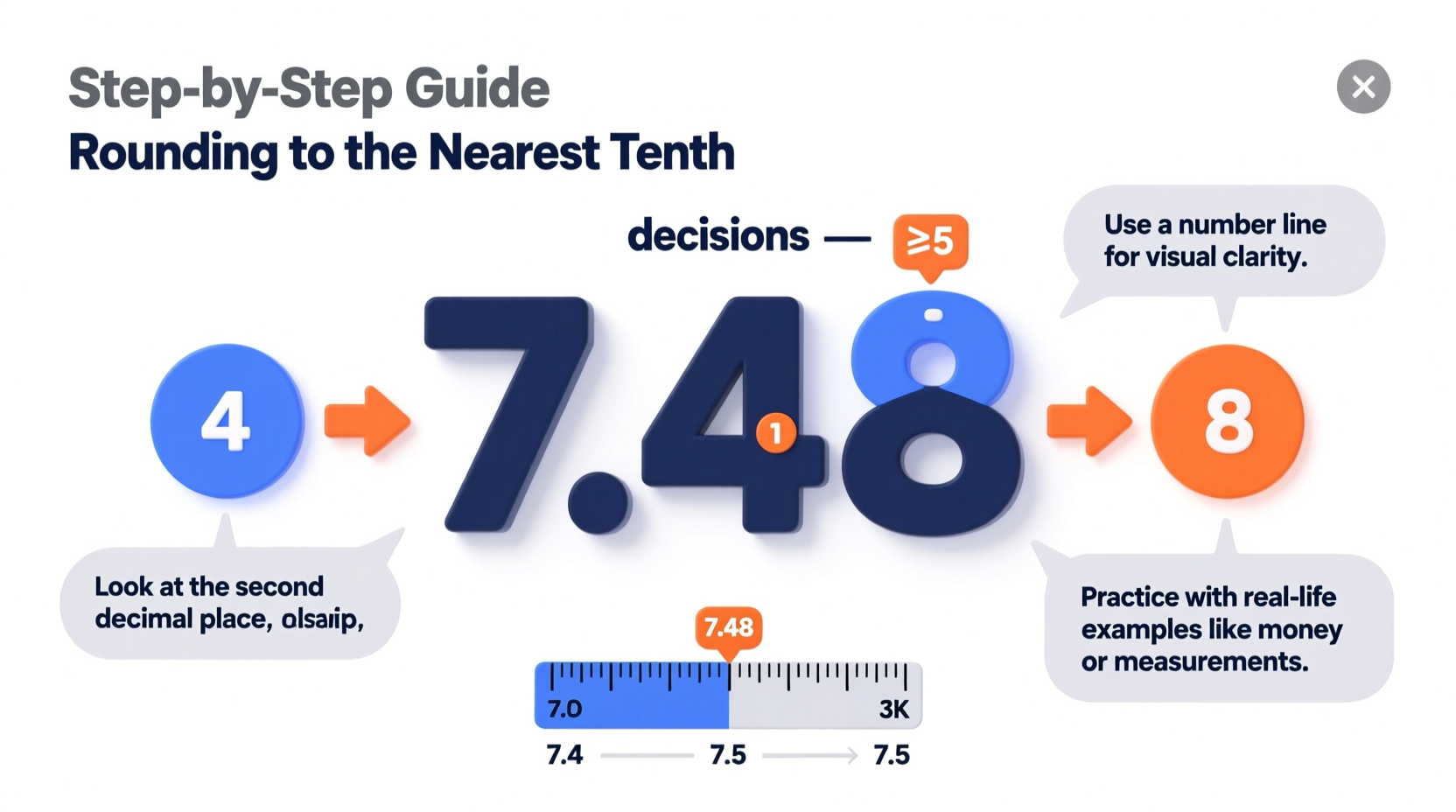
Before diving into the mechanics of rounding, it's essential to understand decimal place value. In a decimal number like 4.736, each digit has a specific position:
- 4 – ones place
- 7 – tenths place
- 3 – hundredths place
- 6 – thousandths place
When rounding to the nearest tenth, your focus should be on the digit in the tenths place (the first digit to the right of the decimal point) and the digit immediately after it—the hundredths place. The hundredths digit determines whether you round up or keep the tenths digit unchanged.
“Place value awareness is the cornerstone of accurate rounding. Without it, even simple calculations can go wrong.” — Dr. Alan Reyes, Mathematics Education Specialist
Step-by-Step Guide to Rounding to the Nearest Tenth
Follow this clear, five-step process to round any decimal number to the nearest tenth accurately every time.
- Identify the tenths digit – Locate the first digit to the right of the decimal point.
- Look at the hundredths digit – This is the second digit after the decimal.
- Apply the rounding rule:
- If the hundredths digit is 5 or greater, increase the tenths digit by 1.
- If the hundredths digit is 4 or less, leave the tenths digit unchanged.
- Drop all digits to the right of the tenths place.
- Write the rounded number.
Example: Round 8.649 to the nearest tenth.
- Tenths digit: 6
- Hundredths digit: 4
- Since 4 ≤ 4, we do not round up.
- Drop the digits after the tenths place.
- Result: 8.6
Another example: Round 3.275 to the nearest tenth.
- Tenths digit: 2
- Hundredths digit: 7
- Since 7 ≥ 5, round the 2 up to 3.
- Drop remaining digits.
- Result: 3.3
Common Mistakes and How to Avoid Them
Despite its simplicity, rounding errors are surprisingly common. Here are frequent pitfalls and how to prevent them:
| Mistake | Why It’s Wrong | How to Fix It |
|---|---|---|
| Looking beyond the hundredths place | Only the hundredths digit affects rounding to the tenth. | Ignore thousandths and beyond unless re-rounding. |
| Forgetting to drop extra digits | Leaving digits like .500 implies false precision. | Remove all digits after the tenths place. |
| Incorrectly handling whole numbers | Writing “7” instead of “7.0” loses context. | Keep one decimal place to show precision level. |
| Over-rounding in multi-step problems | Rounding too early introduces cumulative error. | Wait until the final answer to round. |
Practical Applications and Real-World Example
Rounding to the nearest tenth isn’t just an academic exercise—it has daily utility. Consider this scenario:
Mini Case Study: Maria is tracking her weekly water intake. On Wednesday, she drank 2.84 liters. To log her progress in a simplified journal that records only one decimal place, she needs to round this amount.
- Number: 2.84
- Tenths digit: 8
- Hundredths digit: 4
- Since 4 < 5, the tenths digit stays 8.
- Rounded result: 2.8 liters
This rounded figure gives Maria a clean, usable metric without sacrificing much accuracy. Over time, consistent use of proper rounding helps maintain reliable records while reducing clutter.
Other applications include:
- Calculating fuel efficiency (e.g., 26.7 miles per gallon)
- Reporting temperature readings (e.g., 98.6°F)
- Recording athletic performance (e.g., a 100m sprint time of 11.3 seconds)
- Budgeting monthly expenses to the nearest dollar and ten cents
Expert Tips for Mastering Rounding Accuracy
Building fluency in rounding requires more than memorizing rules. These expert-backed strategies help reinforce understanding and prevent careless errors.
“Students who connect rounding to measurement contexts develop stronger number sense and make fewer procedural errors.” — Lila Nguyen, STEM Curriculum Developer
Frequently Asked Questions
What happens when the tenths digit is 9 and you need to round up?
If the tenths digit is 9 and the hundredths digit is 5 or greater, rounding up increases the tenths place from 9 to 10. This carries over to the ones place. For example, rounding 4.98 to the nearest tenth: the 9 becomes 10, so 4.98 rounds to 5.0—not 4.10, which is invalid.
Should I round 7.50 to 7.5 or 8.0?
You should round 7.50 to 8.0 when rounding to the nearest tenth. The hundredths digit is 5, which triggers rounding up. Also, writing it as 8.0 maintains the correct decimal precision.
Is there a difference between rounding to the nearest tenth and one decimal place?
No, they mean the same thing. “Rounding to one decimal place” is simply another way of saying “rounding to the nearest tenth.” Both refer to keeping only the first digit after the decimal point, adjusted correctly based on the second digit.
Checklist: Mastering Rounding to the Nearest Tenth
Use this checklist whenever you're unsure or teaching someone else:
- ✅ Identify the tenths digit (first after the decimal)
- ✅ Locate the hundredths digit (second after the decimal)
- ✅ Apply the rule: 5 or higher → round up; 4 or lower → stay
- ✅ Adjust the tenths digit if needed
- ✅ Drop all digits beyond the tenths place
- ✅ Write the final number with one decimal place
- ✅ Double-check for carrying over when rounding 9 up
Conclusion: Build Confidence Through Practice
Rounding to the nearest tenth is a small skill with outsized importance. Whether you're managing personal finances, analyzing data, or helping a child with homework, mastering this technique ensures clarity and accuracy. The key lies not in memorization, but in understanding the logic behind each step and applying it consistently.
Start incorporating these strategies today. Practice with grocery receipts, mileage logs, or fitness trackers. Share what you’ve learned with others—teaching reinforces mastery. With deliberate practice and attention to detail, rounding will become second nature.




 浙公网安备
33010002000092号
浙公网安备
33010002000092号 浙B2-20120091-4
Comments
No comments yet. Why don't you start the discussion?