
Rounding numbers is a foundational skill in mathematics and everyday decision-making. Whether you're estimating budgets, simplifying data for reports, or helping a child with homework, knowing how to round to the nearest thousand efficiently and accurately makes life easier. While it may seem basic, misunderstanding the rules can lead to costly errors in finance, education, or planning. This guide breaks down the process into clear, actionable steps, offers practical tools, and provides real-life context so you can apply rounding with confidence.
Understanding the Basics of Rounding
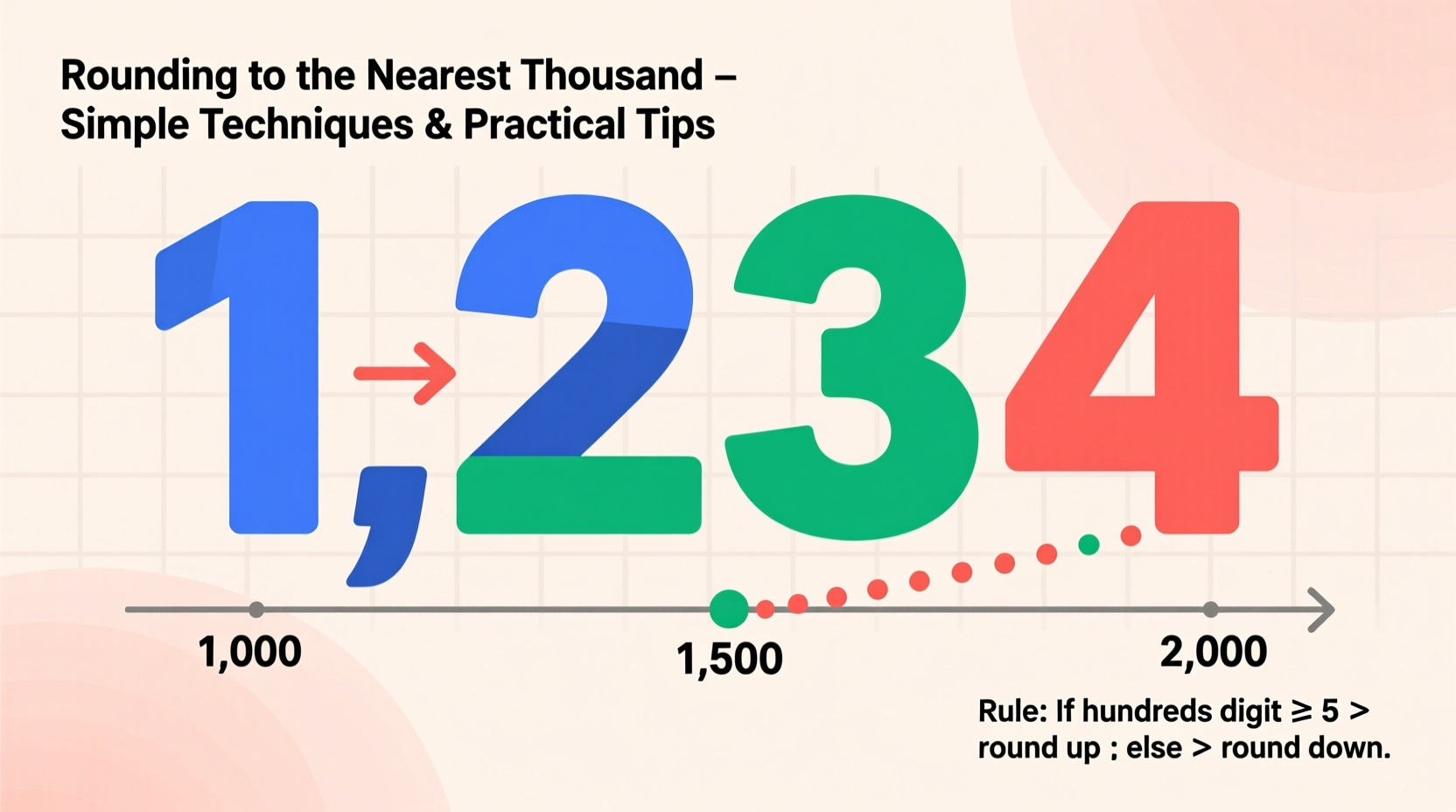
Rounding reduces the complexity of a number while keeping its value close to the original. When rounding to the nearest thousand, you’re approximating a number to the closest multiple of 1,000. For example, 4,375 becomes 4,000, while 4,650 rounds up to 5,000.
The key lies in identifying the digit in the **hundreds place**—this determines whether you round up or down:
- If the hundreds digit is **5 or greater**, round up.
- If the hundreds digit is **4 or less**, round down.
Once you decide, replace the hundreds, tens, and units digits with zeros. The thousands digit either stays the same (rounding down) or increases by one (rounding up).
Step-by-Step Guide to Rounding to the Nearest Thousand
- Identify the thousands digit. This is the fourth digit from the right. In 7,421, the thousands digit is 7.
- Look at the digit immediately to the right—the hundreds place. In 7,421, that’s 4.
- Determine whether to round up or down. Since 4 is less than 5, you round down.
- Replace all digits to the right of the thousands place with zeros. So, 7,421 becomes 7,000.
- If rounding up, increase the thousands digit by one. For example, 6,812 → look at 8 (hundreds digit), which is ≥5 → round up → 7,000.
This method works consistently across whole numbers of any size. For instance, 12,500 rounds to 13,000 because the hundreds digit is 5. Similarly, 99,499 rounds down to 99,000.
Common Mistakes and How to Avoid Them
Even experienced learners sometimes misapply rounding rules. Below are frequent errors and corrections:
| Common Mistake | Correct Approach |
|---|---|
| Looking at the tens digit instead of the hundreds | Always check the hundreds place first—this controls the rounding direction. |
| Forgetting to zero out lower digits | After rounding, the last three digits must be 000. |
| Rounding up incorrectly past 9,000 (e.g., 9,700 → 10,000) | Yes, this is correct! 9,700 rounds to 10,000. Don’t hesitate to carry over. |
| Applying decimal rounding rules to whole numbers | Stick to place value logic—no need for decimal points here. |
“Rounding isn’t about guessing—it’s about applying consistent rules. Mastery comes from repetition and attention to digit placement.” — Dr. Alan Prescott, Mathematics Education Specialist
Practical Applications in Real Life
Rounding to the nearest thousand isn't just for classrooms. It has real utility in various fields:
- Budgeting: When planning annual expenses, $4,789 for utilities becomes $5,000—a simpler figure for forecasting.
- Population estimates: A town with 23,482 residents might report “about 23,000 people” in summaries.
- Data reporting: Businesses often round sales figures to thousands for clarity in presentations.
- Shopping decisions: If a car costs $28,650, thinking of it as $29,000 helps assess affordability quickly.
Mini Case Study: Small Business Inventory Planning
Sarah runs a small electronics store. At year-end, she reviews her inventory and sees she sold 14,723 units. To present this to investors, she rounds to the nearest thousand: 15,000. This rounded figure simplifies discussions about growth trends without sacrificing meaningful accuracy. It also aligns with her quarterly reports, which use similar rounding for consistency. By mastering this technique, Sarah communicates more effectively and avoids overwhelming stakeholders with excessive detail.
Pro Tips for Teaching and Learning
Whether you're teaching children or relearning the concept yourself, these strategies enhance understanding:
- Break large numbers into parts. For 104,562, isolate “4,562” and focus on rounding that segment to the nearest thousand (5,000), resulting in 105,000.
- Practice with real data. Use grocery receipts, sports scores, or travel distances to make exercises engaging.
- Teach the “5 or above, give it a shove” rhyme as a memory aid—but emphasize understanding over memorization.
Checklist: Mastering Rounding to the Nearest Thousand
Use this checklist to ensure accuracy every time:
- ☑ Identify the thousands digit.
- ☑ Locate the hundreds digit (one place to the right).
- ☑ If hundreds digit is 5 or higher, add 1 to the thousands digit.
- ☑ If hundreds digit is 4 or lower, keep the thousands digit unchanged.
- ☑ Replace the hundreds, tens, and ones digits with zeros.
- ☑ Double-check your result using estimation (e.g., is 7,800 closer to 7,000 or 8,000?).
Frequently Asked Questions
What happens when the number ends in exactly 500?
When the hundreds digit is 5 and the rest are zero (e.g., 2,500), standard practice is to round up. So, 2,500 rounds to 3,000. This convention ensures consistency across mathematical applications.
Can you round negative numbers to the nearest thousand?
Yes. The same rules apply. For example, –4,620 rounds to –5,000 because the hundreds digit (6) is 5 or greater. Just remember: rounding makes the number more negative when rounding down in absolute terms, but the rule remains based on digit value.
Is rounding to the nearest thousand the same as truncating?
No. Truncating simply cuts off digits beyond the thousands place without adjusting the value. Rounding adjusts the number based on proximity. For example, truncating 4,899 gives 4,000, but rounding gives 5,000. Rounding is more accurate for estimation.
Conclusion: Apply These Skills with Confidence
Rounding to the nearest thousand is more than a classroom exercise—it's a practical tool for simplifying complexity in daily life and professional settings. With a clear understanding of place value, consistent application of rules, and regular practice, anyone can master this skill. Whether you're balancing a budget, interpreting statistics, or supporting a student’s learning, precision in rounding leads to better decisions and clearer communication.




 浙公网安备
33010002000092号
浙公网安备
33010002000092号 浙B2-20120091-4
Comments
No comments yet. Why don't you start the discussion?