
Simplifying math expressions is a foundational skill that unlocks success in algebra, calculus, and beyond. Yet many students struggle not because the concepts are inherently difficult, but because they lack a structured approach. When faced with parentheses, exponents, variables, and coefficients, confusion can quickly set in. The key to mastery lies not in memorization, but in applying consistent, logical strategies. This guide breaks down the process into manageable steps, offering practical techniques, real-world applications, and expert-backed insights to help you solve problems with clarity and confidence.
Understanding the Purpose of Simplification
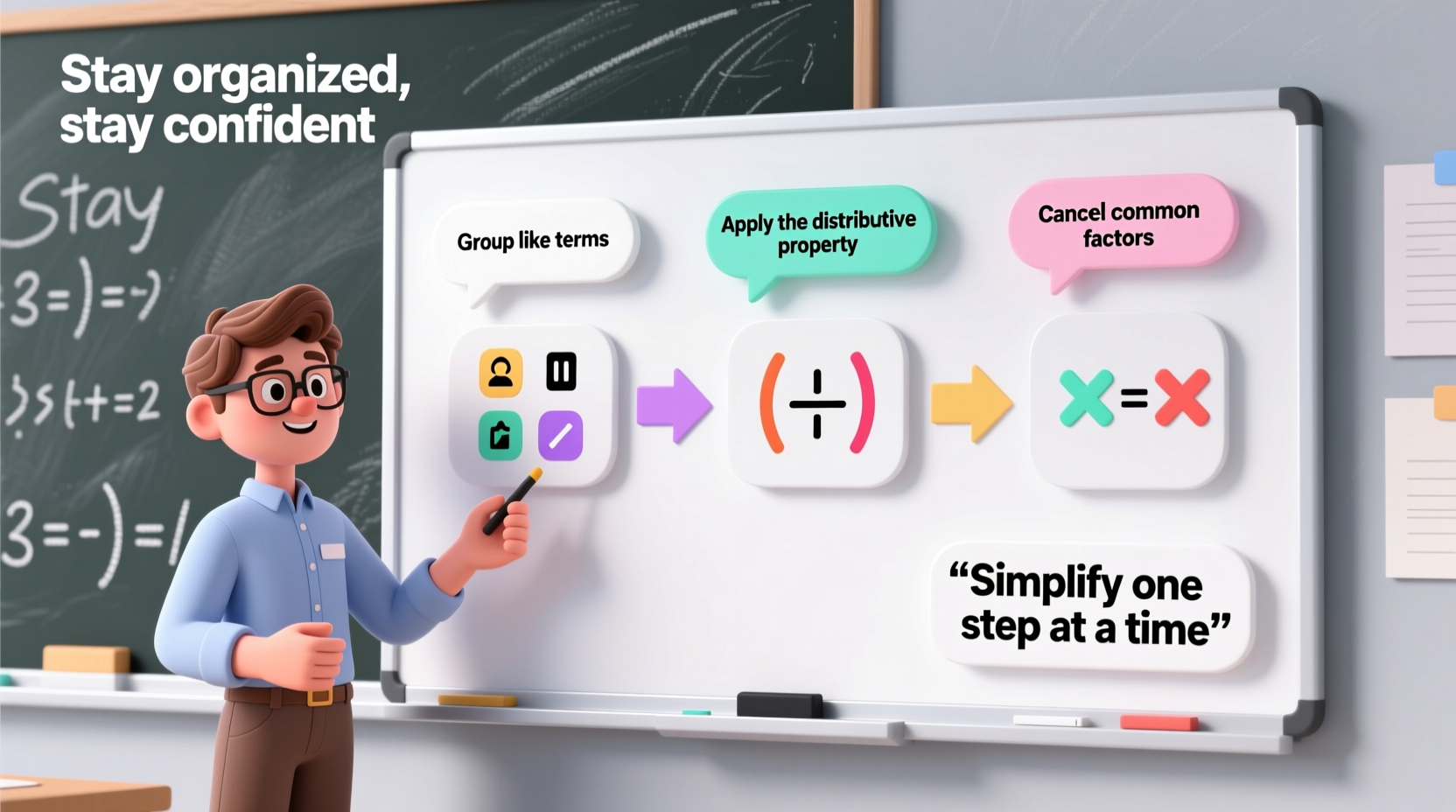
At its core, simplifying a mathematical expression means rewriting it in the most compact and efficient form without changing its value. This process reduces complexity, minimizes errors, and prepares the expression for further operations like solving equations or graphing functions.
For example, the expression \\( 3x + 5 - 2x + 7 \\) can be simplified to \\( x + 12 \\). While both forms are mathematically equivalent, the second is easier to interpret and use. Simplification doesn’t just make math look cleaner—it makes it more usable.
“Simplification isn’t about making things easy; it’s about making them clear. Clarity is the first step toward mastery.” — Dr. Alan Reyes, Mathematics Education Researcher
The Step-by-Step Framework for Simplifying Expressions
A reliable method ensures consistency across different types of problems. Follow this six-step sequence every time you encounter an algebraic expression:
- Remove grouping symbols using the distributive property.
- Apply exponent rules where applicable.
- Combine like terms within each part of the expression.
- Simplify constants through arithmetic operations.
- Rewrite in standard form (usually descending powers of variables).
- Double-check your work by substituting values if possible.
Example: Applying the Framework
Consider the expression: \\( 2(3x - 4) + 5x + 9 \\)
- Distribute: \\( 2 \\cdot 3x = 6x \\), \\( 2 \\cdot (-4) = -8 \\), so we get \\( 6x - 8 + 5x + 9 \\)
- No exponents to apply here.
- Combine like terms: \\( 6x + 5x = 11x \\), \\( -8 + 9 = 1 \\)
- Simplify constants: Already done.
- Rewrite: \\( 11x + 1 \\)
- Verify: Plug in \\( x = 1 \\): Original gives \\( 2(-1) + 5 + 9 = -2 + 14 = 12 \\); simplified gives \\( 11(1) + 1 = 12 \\). Match confirmed.
Common Pitfalls and How to Avoid Them
Even skilled students make predictable mistakes when simplifying expressions. Recognizing these early prevents frustration later.
| Mistake | Why It Happens | How to Fix It |
|---|---|---|
| Incorrectly distributing negatives: \\( -(x + 3) = -x + 3 \\) | Forgetting to distribute the negative sign to all terms inside parentheses | Treat the minus sign as multiplying by -1: \\( -(x + 3) = -x - 3 \\) |
| Combining unlike terms: \\( 3x + 5 = 8x \\) | Misunderstanding what \"like terms\" means | Only combine terms with identical variable parts: \\( 3x \\) and \\( 5 \\) cannot be combined |
| Ignoring order of operations during simplification | Jumping straight to combining terms without removing parentheses first | Follow PEMDAS strictly: Parentheses, Exponents, Multiplication/Division, Addition/Subtraction |
Mini Case Study: Maria’s Algebra Breakthrough
Maria, a high school sophomore, consistently scored below average on algebra quizzes despite understanding individual concepts. Her teacher reviewed her work and noticed a pattern: she would skip distribution steps and incorrectly combine terms across parentheses.
After being taught the six-step framework and practicing five problems daily for two weeks, Maria began checking each step systematically. She started writing out distribution explicitly and verifying results with substitution. On her next test, she scored 94%—her highest yet. “I realized I wasn’t bad at math,” she said. “I just needed a better system.”
Advanced Techniques for Complex Expressions
As expressions grow more complex—featuring fractions, multiple variables, or nested parentheses—the same principles apply, but require extra attention.
Simplifying Rational Expressions
When variables appear in denominators, factor both numerator and denominator before canceling common factors.
Example: Simplify \\( \\frac{2x^2 + 6x}{4x} \\)
- Factor numerator: \\( 2x(x + 3) \\)
- Denominator: \\( 4x \\)
- Cancel common factor \\( 2x \\): \\( \\frac{\\cancel{2x}(x + 3)}{2 \\cdot \\cancel{2x}} = \\frac{x + 3}{2} \\)
Note: \\( x \ eq 0 \\), since division by zero is undefined.
Dealing with Nested Groupings
Work from the innermost parentheses outward.
Example: \\( 3[2(x - 1) + 4] - 5 \\)
- Inner: \\( 2(x - 1) = 2x - 2 \\)
- Next: \\( 2x - 2 + 4 = 2x + 2 \\)
- Multiply by 3: \\( 3(2x + 2) = 6x + 6 \\)
- Subtract 5: \\( 6x + 6 - 5 = 6x + 1 \\)
Essential Checklist for Consistent Success
Before finalizing any simplification, run through this checklist:
- ✅ Have I removed all parentheses using distribution?
- ✅ Did I correctly handle negative signs and subtraction?
- ✅ Are all exponents simplified using appropriate rules?
- ✅ Have I combined only like terms?
- ✅ Are constants fully reduced?
- ✅ Is the final expression written in standard form?
- ✅ Can I verify the result by plugging in a test value?
This routine builds discipline and dramatically reduces careless errors.
Frequently Asked Questions
Can I simplify an expression without knowing the variable’s value?
Yes. Simplification relies on algebraic rules, not specific values. You’re rearranging the structure, not solving for unknowns. However, you can use sample values to check correctness after simplifying.
What’s the difference between simplifying and solving?
Simplifying rewrites an expression in a more compact form. Solving finds the value(s) of a variable that satisfy an equation. For instance, simplifying \\( 2x + 3x \\) gives \\( 5x \\); solving \\( 2x + 3 = 7 \\) gives \\( x = 2 \\).
Do I always need to write the final answer in standard form?
While not always required, writing polynomials in descending order of degree (e.g., \\( 3x^2 + 2x + 1 \\)) is standard practice. It improves readability and is expected in academic and professional settings.
Building Confidence Through Practice
Mastery comes not from occasional effort, but from deliberate, focused practice. Start with basic linear expressions, then gradually introduce exponents, multiple variables, and rational terms. Use spaced repetition—review old problems weekly—to reinforce learning.
One effective strategy is to create your own expressions, simplify them, and then ask a peer or tutor to verify. Teaching the process to someone else is another powerful way to solidify understanding.
“The best mathematicians aren’t the fastest—they’re the most persistent and reflective.” — Prof. Lila Nguyen, STEM Education Chair
Conclusion
Simplifying math expressions is more than a mechanical task—it’s a mindset. By adopting a step-by-step approach, avoiding common traps, and practicing with intention, you transform confusion into clarity. Each problem solved strengthens your analytical muscle, preparing you not just for exams, but for real-world decision-making that relies on logical precision.




 浙公网安备
33010002000092号
浙公网安备
33010002000092号 浙B2-20120091-4
Comments
No comments yet. Why don't you start the discussion?