
Understanding chemical equilibrium is a cornerstone of general and advanced chemistry. At the heart of this concept lies the equilibrium constant, a numerical value that reveals the extent to which a reaction proceeds before reaching balance. Whether you're preparing for exams or working through lab data, mastering how to calculate the equilibrium constant (K) is essential. This guide breaks down the process into actionable steps, equipping you with the tools to confidently tackle any K-related problem.
What Is the Equilibrium Constant?
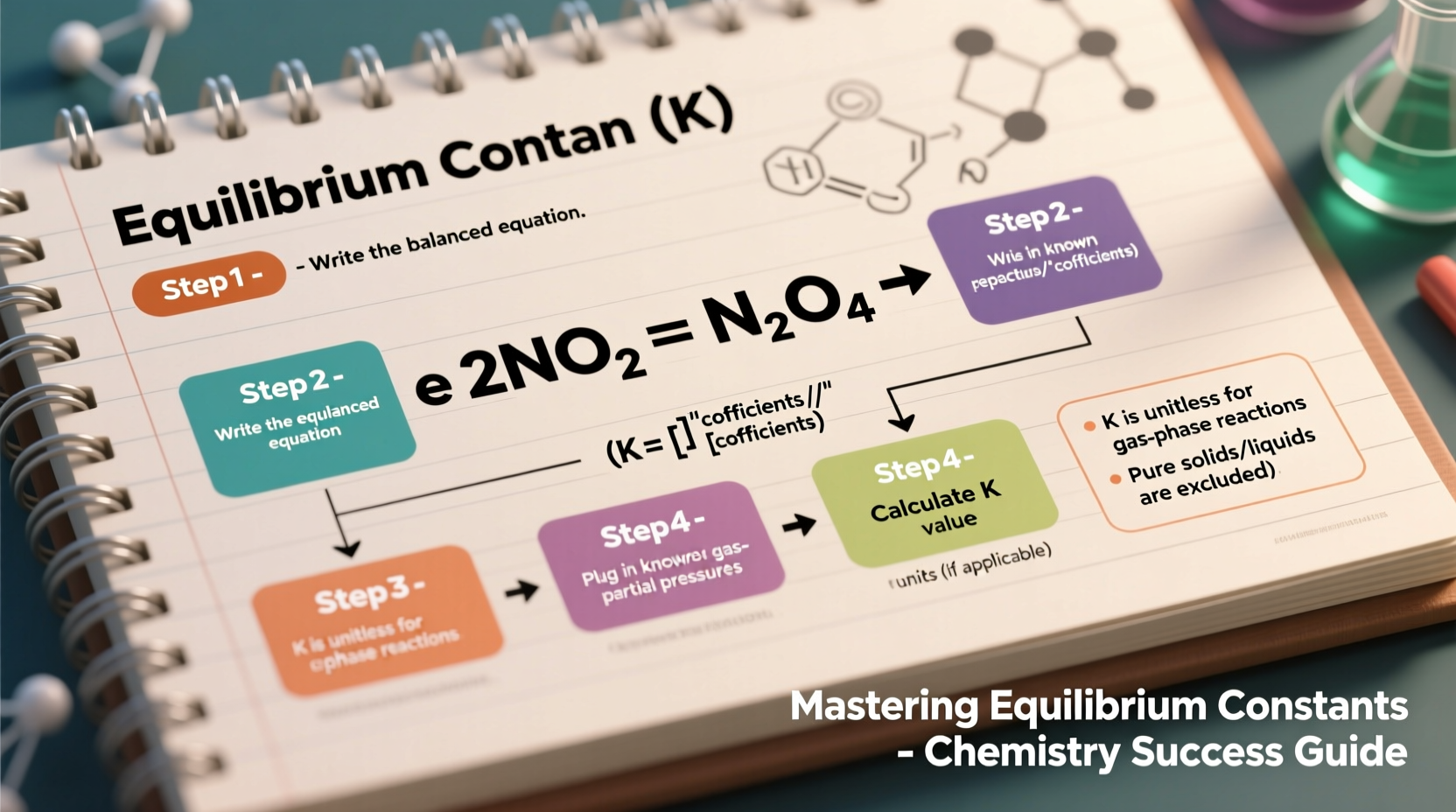
The equilibrium constant, denoted as K, quantifies the ratio of product concentrations to reactant concentrations at equilibrium, each raised to the power of their stoichiometric coefficients. For a generic reversible reaction:
aA + bB ⇌ cC + dD
The equilibrium constant expression is written as:
K = [C]c[D]d / [A]a[B]b
Here, square brackets represent molar concentrations (mol/L), and the exponents are derived from the balanced chemical equation. K values greater than 1 favor products; values less than 1 favor reactants. Importantly, pure solids and liquids are excluded from the expression because their concentrations remain constant.
“Mastery of equilibrium calculations separates students who memorize from those who truly understand chemical behavior.” — Dr. Linda Park, Physical Chemistry Instructor, University of Colorado
Step-by-Step Guide to Solving for K
Solving for the equilibrium constant requires a systematic approach. Follow these six key steps to ensure accuracy and deepen comprehension.
- Write the Balanced Chemical Equation
Ensure the reaction is balanced. Coefficients directly affect the exponents in the K expression. - Determine the Expression for K
Based on the balanced equation, write the K expression, omitting solids and pure liquids. - Identify Initial and Equilibrium Concentrations
Use given data or experimental results to list starting concentrations and known equilibrium values. - Set Up an ICE Table
ICE stands for Initial, Change, Equilibrium. This table organizes concentration changes over time. - Solve for Unknowns Using Stoichiometry
Apply mole ratios to express changes in terms of a variable (usually x). - Plug Values into the K Expression and Calculate
Substitute equilibrium concentrations into the K formula and compute the result.
Using the ICE Table Effectively
The ICE table is one of the most powerful tools in equilibrium calculations. Consider the following example:
N₂(g) + 3H₂(g) ⇌ 2NH₃(g)
Suppose 1.0 M N₂ and 3.0 M H₂ are mixed, and at equilibrium, [NH₃] = 0.20 M. The ICE table would look like this:
| N₂ | H₂ | NH₃ | |
|---|---|---|---|
| Initial (M) | 1.0 | 3.0 | 0 |
| Change (M) | -x | -3x | +2x |
| Equilibrium (M) | 1.0 - x | 3.0 - 3x | 2x = 0.20 |
From the table, 2x = 0.20 → x = 0.10. Substituting back:
- [N₂] = 1.0 – 0.10 = 0.90 M
- [H₂] = 3.0 – 3(0.10) = 2.70 M
- [NH₃] = 0.20 M
Now plug into the K expression:
K = [NH₃]² / ([N₂][H₂]³) = (0.20)² / [(0.90)(2.70)³] ≈ 0.0022
This shows the reaction favors reactants under these conditions.
Common Pitfalls and How to Avoid Them
Even skilled students make avoidable errors when solving for K. Recognizing these mistakes early improves accuracy.
| Mistake | Why It’s Wrong | How to Fix It |
|---|---|---|
| Forgetting to balance the equation | Leads to incorrect exponents in K | Always verify atom and charge balance first |
| Including solids or liquids in K | They don’t appear in the expression | Omit (s), (l); only include (g) and (aq) |
| Using initial instead of equilibrium concentrations | K depends on final, not starting values | Use ICE table to find true equilibrium levels |
| Ignoring units or mixing them up | Causes calculation errors | Convert all to mol/L before computing |
Real Example: Calculating K for a Weak Acid Dissociation
A common application of equilibrium constants is determining Ka for weak acids. Consider acetic acid (CH₃COOH), which partially ionizes:
CH₃COOH(aq) ⇌ H⁺(aq) + CH₃COO⁻(aq)
A 0.10 M solution has a measured pH of 2.87. What is Ka?
pH = 2.87 → [H⁺] = 10−2.87 ≈ 1.35 × 10⁻³ M
Since [H⁺] = [CH₃COO⁻] at equilibrium, and [CH₃COOH] ≈ 0.10 – 0.00135 ≈ 0.09865 M,
Ka = [H⁺][CH₃COO⁻] / [CH₃COOH] = (1.35×10⁻³)² / 0.09865 ≈ 1.85 × 10⁻⁵
This matches the accepted value closely, confirming the method's reliability.
Checklist: Key Steps to Solve Any K Problem
Before submitting your work or moving on, run through this checklist:
- ✅ Is the chemical equation balanced?
- ✅ Have I written the correct K expression (excluding solids/liquids)?
- ✅ Are all concentrations in mol/L?
- ✅ Did I set up an ICE table if initial and equilibrium values differ?
- ✅ Have I used stoichiometric ratios correctly in the change row?
- ✅ Did I substitute equilibrium concentrations—not initial ones—into K?
- ✅ Is my final answer reasonable? (e.g., very large or small K may indicate error)
Frequently Asked Questions
Can the equilibrium constant be negative?
No. The equilibrium constant is derived from concentrations or partial pressures, which are always positive. Therefore, K is always a positive number. A very small K (e.g., 10−10) indicates a reaction that barely proceeds, but it’s still positive.
Does changing concentration affect the value of K?
No. The equilibrium constant is temperature-dependent only. Altering concentrations shifts the position of equilibrium but does not change K. Only a change in temperature will alter the value of K.
How do I know when to use Kc vs. Kp?
Use Kc when dealing with molar concentrations in solution or gas-phase reactions where concentrations are given. Use Kp when all reactants and products are gases and partial pressures are provided. They are related by the formula Kp = Kc(RT)Δn, where Δn is the change in moles of gas.
Conclusion: Build Confidence Through Practice
Mastering how to solve for the equilibrium constant isn't about rote memorization—it's about understanding the logic behind chemical systems at balance. By following a structured method, using tools like the ICE table, and learning from real examples, you develop both skill and intuition. Each problem you solve strengthens your foundation for more complex topics like solubility, acid-base chemistry, and thermodynamics.




 浙公网安备
33010002000092号
浙公网安备
33010002000092号 浙B2-20120091-4
Comments
No comments yet. Why don't you start the discussion?