
Effective communication often hinges on precision—especially when it comes to dates and days. A misformatted date can lead to missed meetings, delayed shipments, or confusion in legal documents. Whether you're writing an email, drafting a report, scheduling international calls, or publishing content, knowing how to write the date and day correctly is essential. This guide breaks down best practices for clarity, accuracy, and contextual appropriateness across regions, industries, and formats.
Understanding Date Format Conventions by Region
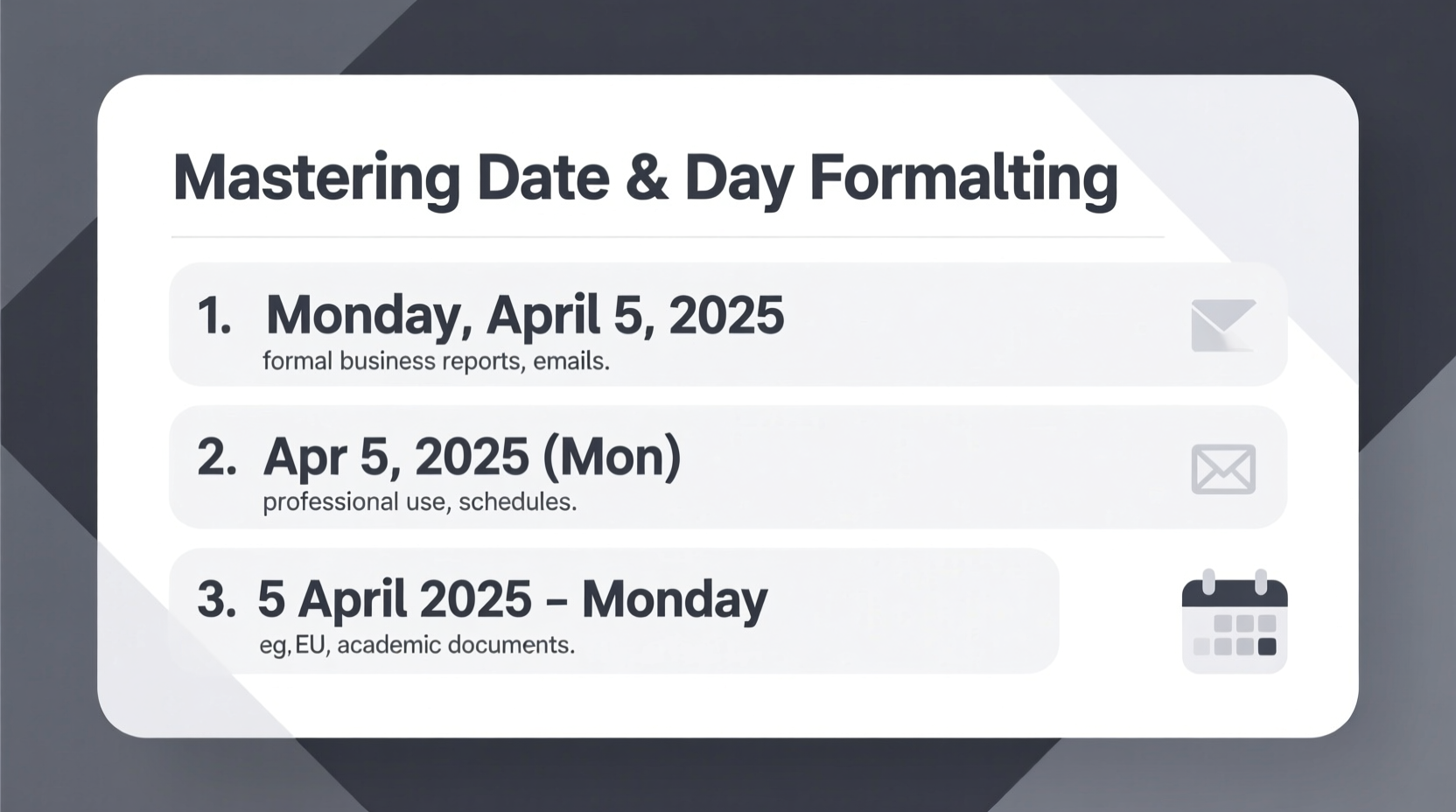
Different countries follow different conventions when writing dates. The most common formats are:
- MM/DD/YYYY – Predominant in the United States
- DD/MM/YYYY – Used in most of Europe, Asia, Africa, and Oceania
- YYYY-MM-DD – ISO 8601 international standard, ideal for databases and technical use
The variation can cause confusion. For example, \"03/04/2025\" could mean March 4th in the U.S. but April 3rd elsewhere. To avoid ambiguity, always consider your audience and choose a format that aligns with their expectations—or use unambiguous alternatives.
Best Practices for Clarity and Professionalism
Clarity should be the primary goal when writing dates. Ambiguity leads to errors. Here are key principles:
- Spell out the month in formal writing: “October 17, 2025” instead of “10/17/25.”
- Use leading zeros for single-digit days and months in digital formats: “2025-03-07” not “2025-3-7.”
- Include the day of the week when relevance is high: “The event will take place on Monday, June 2, 2025.”
- Follow industry standards: Legal documents often use formal phrasing like “this 15th day of May, 2025.”
Inconsistent formatting undermines professionalism. Always proofread dates in contracts, invitations, and announcements.
Choosing the Right Format for Your Context
The appropriate date format depends on context. Below is a comparison of recommended formats based on usage:
| Context | Recommended Format | Example |
|---|---|---|
| International Business Email | DD Month YYYY | 12 April 2025 |
| U.S. Internal Memo | Month DD, YYYY | April 12, 2025 |
| Data Logging / Programming | ISO 8601 (YYYY-MM-DD) | 2025-04-12 |
| Legal Document | Formal written style | this 12th day of April, 2025 |
| Scheduling (Global Teams) | Day, DD Month YYYY (with time zone) | Saturday, 12 April 2025 at 14:00 UTC |
Selecting the right format ensures your message is understood immediately, regardless of where the reader is located.
Step-by-Step Guide to Writing Clear Dates and Days
Follow this sequence to ensure your date entries are accurate and context-ready:
- Determine your audience: Are they primarily in the U.S., UK, or global? Adjust format accordingly.
- Identify the purpose: Is it technical, formal, casual, or legal? Match tone and structure.
- Choose the base format: Use ISO for systems, spelled-out months for letters, numeric only if space-constrained and audience is clear.
- Add the day of the week when helpful: Especially for events, deadlines, or travel plans.
- Include time zones if relevant: “Friday, 18 July 2025 at 10:00 AM EST” avoids confusion in cross-border coordination.
- Double-check for consistency: Ensure all dates in a document follow the same style.
Common Mistakes and How to Avoid Them
Even experienced professionals make date-related errors. The most frequent include:
- Using ambiguous slashes: “01/02/2025” could be January 2 or February 1.
- Mixing formats in one document: Switching between “Jan 5” and “05/01” confuses readers.
- Omitting the year: “See you on Monday” is unclear if the message spans weeks.
- Ignoring time zones: Scheduling a call without specifying time zones leads to missed connections.
To prevent these issues, establish a style guide for your team or organization. Consistency builds trust and reduces errors.
“Clear date formatting isn’t just about correctness—it’s about respect for the reader’s time and understanding.” — Dr. Lena Patel, Communication Specialist, MIT Sloan
Real-World Example: Global Project Coordination
A project manager in Berlin scheduled a product launch meeting using “05/07/2025” in the calendar invite. The U.S. marketing team assumed this meant May 7, while the German engineering team prepared for July 5. The result? A two-month planning gap and delayed deliverables.
After the incident, the company adopted a new rule: all internal communications must use “5 July 2025” format, and external invites include both date text and ISO format: “(2025-07-05).” This dual approach eliminated future confusion and improved cross-team alignment.
Checklist: Date and Day Writing Best Practices
Use this checklist before finalizing any document, email, or schedule:
- ✅ Confirm the audience’s regional date preferences
- ✅ Spell out the month in formal or international contexts
- ✅ Use YYYY-MM-DD for digital logs and programming
- ✅ Include the day of the week for time-sensitive events
- ✅ Specify time zones when coordinating globally
- ✅ Avoid ambiguous numeric-only formats unless context is clear
- ✅ Maintain consistent formatting throughout the document
- ✅ Proofread all dates before sending
Frequently Asked Questions
Should I use commas in dates?
Yes, in American English, use commas: “June 15, 2025.” In British English and many other variants, commas are typically omitted: “15 June 2025.” Choose based on your audience’s convention.
Is it acceptable to abbreviate months?
Yes, but sparingly. Abbreviations like “Jan,” “Feb,” “Mar” are acceptable in tables, charts, or space-limited contexts. In formal writing, spell them out. Never abbreviate May, June, or July—they don’t need it.
How do I handle dates in automated systems?
Always use ISO 8601 (YYYY-MM-DD) in databases, spreadsheets, and code. It sorts chronologically, avoids ambiguity, and is machine-readable. Convert to human-friendly formats only in display layers.
Final Thoughts: Precision Builds Professionalism
Writing dates and days correctly is more than a technical detail—it’s a mark of attention to detail and respect for your audience. Whether you’re confirming a meeting, filing a report, or launching a product, the way you present time reflects your credibility. By mastering format selection, avoiding common pitfalls, and adapting to context, you ensure your communication is not just understood, but trusted.




 浙公网安备
33010002000092号
浙公网安备
33010002000092号 浙B2-20120091-4
Comments
No comments yet. Why don't you start the discussion?