
A personal statement is often the most important piece of writing in an academic or professional application. It’s not just a summary of your resume—it’s your chance to show who you are beyond grades and credentials. Admissions committees read thousands of applications; a compelling personal statement can be the difference between blending in and standing out. Yet, many applicants struggle to articulate their motivations, experiences, and goals in a way that feels authentic and impactful. The key lies not in embellishment, but in clarity, purpose, and structure.
Why Personal Statements Matter More Than You Think
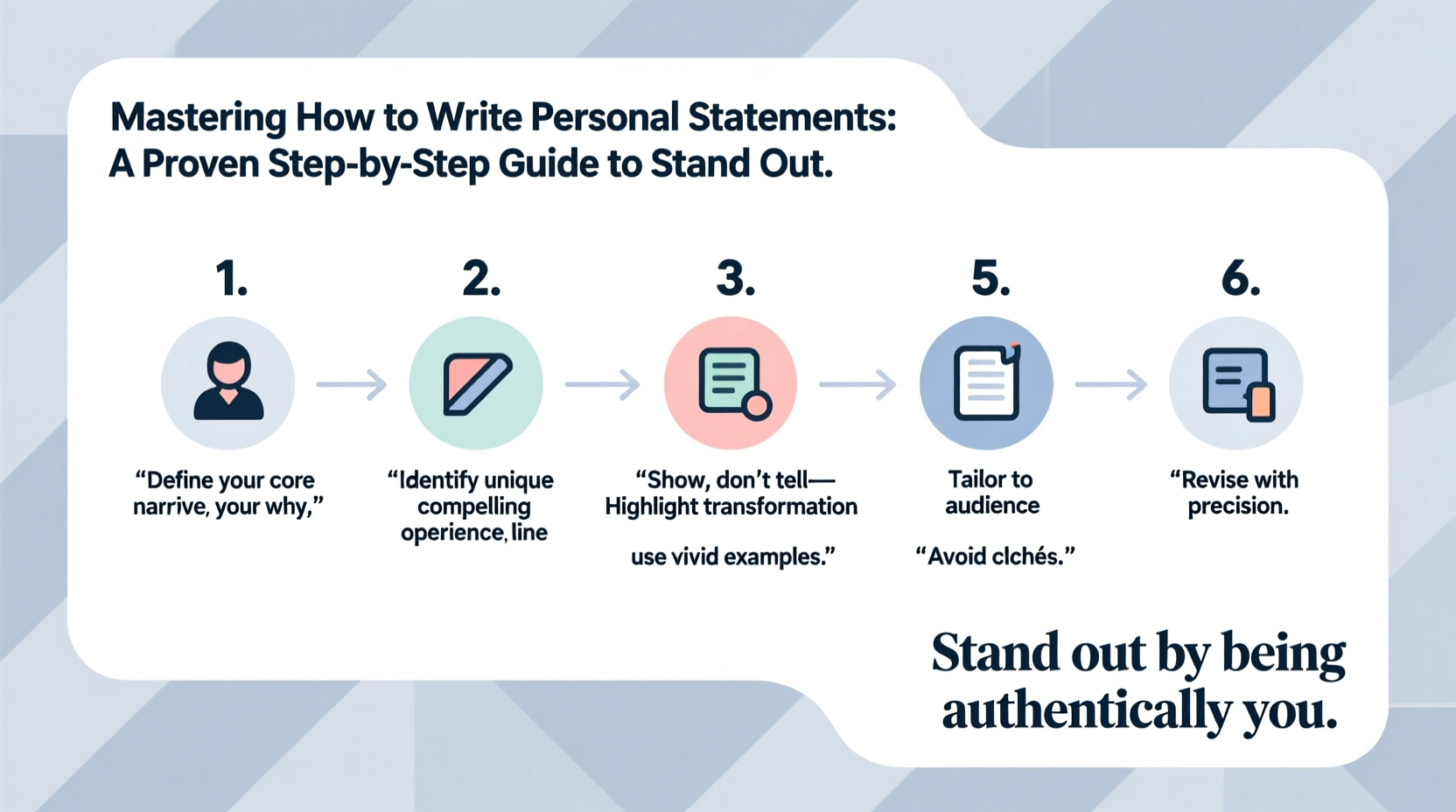
Your personal statement isn’t merely a formality—it’s a narrative tool that allows selection committees to assess your fit for a program, your communication skills, and your self-awareness. Unlike test scores or transcripts, it offers context. It explains why you’re pursuing this path, what experiences shaped your interests, and how you plan to contribute. A well-crafted statement reveals intellectual curiosity, resilience, and alignment with institutional values.
Consider this: two candidates may have similar GPAs and extracurriculars, but only one conveys a clear sense of direction and passion. That candidate is more likely to be remembered. As Dr. Rebecca Tran, Director of Graduate Admissions at a top-tier university, puts it:
“A strong personal statement doesn’t just list achievements—it tells a story of growth. We look for authenticity, reflection, and the ability to connect personal experience to future goals.” — Dr. Rebecca Tran, Admissions Director
The Step-by-Step Writing Process
Writing a standout personal statement isn’t about inspiration alone—it’s a structured process. Follow these steps to build a powerful, coherent narrative from start to finish.
- Reflect deeply on your 'why.' Before writing, spend time journaling about your motivations. What sparked your interest in this field? When did you first feel passionate about it? What challenges have shaped your journey?
- Gather key experiences. List academic projects, internships, volunteer work, or personal events that influenced your path. Don’t just list—ask yourself what each taught you.
- Identify a central theme. Your statement should revolve around a unifying idea—curiosity, service, innovation, resilience. This becomes the backbone of your narrative.
- Draft a compelling opening. Begin with a vivid moment, a question, or a brief anecdote that draws the reader in. Avoid clichés like “Since I was a child…” or “I’ve always loved…”
- Build the body with purpose. Connect experiences to your theme. Show progression: how each step prepared you for the next. Emphasize learning over achievement.
- Align with the program. Research the institution. Mention specific faculty, courses, or values that resonate with you—and explain why.
- Conclude with vision. End by looking forward. How will this opportunity help you achieve your long-term goals? What impact do you hope to make?
- Edit ruthlessly. Trim redundancy, tighten sentences, and eliminate jargon. Read aloud to catch awkward phrasing.
- Seek feedback—but stay true to your voice. Share drafts with mentors, but don’t let others rewrite your story.
- Final proofread. Check grammar, spelling, and formatting. One typo can undermine credibility.
Common Pitfalls and How to Avoid Them
Even thoughtful applicants fall into predictable traps. Recognizing them early improves your chances significantly.
| Pitfall | Why It Hurts | How to Fix It |
|---|---|---|
| Generic statements | Lacks specificity; could apply to anyone | Use concrete details: names, places, outcomes |
| Listing achievements | Feels like a CV repetition | Focus on reflection: what you learned, how you grew |
| Overly dramatic tone | Can seem insincere or exaggerated | Let the story speak for itself; avoid hyperbole |
| Ignoring the prompt | Misses evaluation criteria | Answer every part of the question directly |
| Rehashing adversity without insight | Focuses on trauma, not growth | Highlight resilience, coping strategies, and lessons learned |
A Real Example: From Draft to Final Statement
Sophia applied to public health graduate programs after working as a community health worker in rural Arizona. Her initial draft began:
“I am passionate about healthcare because everyone deserves access to medicine.”
It was well-intentioned but vague. With feedback, she revised her opening to:
“In the summer of 2021, I sat beside Maria, a diabetic patient, as she counted her insulin vials—one left for the next ten days. Her clinic was 70 miles away, and she had no car. That moment didn’t just reveal a gap in care; it showed me how policy shapes lives in ways textbooks never capture.”
The revised version grounded her motivation in a real experience, introduced a character, and linked personal observation to broader systemic issues. She went on to discuss her research on telehealth access, her collaboration with local nonprofits, and her desire to study health equity under Professor Lin, whose work aligned with her goals. Sophia was accepted into three competitive programs.
Actionable Checklist for a Winning Statement
- ✅ Defined a clear theme or narrative thread
- ✅ Opened with a strong, engaging hook
- ✅ Connected personal experiences to academic/professional goals
- ✅ Demonstrated knowledge of the program (faculty, curriculum, mission)
- ✅ Avoided clichés and generic language
- ✅ Included specific examples, not just generalizations
- ✅ Concluded with future aspirations and potential contributions
- ✅ Edited for clarity, flow, and conciseness
- ✅ Proofread for grammar and spelling errors
- ✅ Received feedback from 2–3 trusted reviewers
Frequently Asked Questions
How long should a personal statement be?
Most range from 500 to 800 words, but always follow the specific guidelines provided by the institution. If no limit is given, aim for one page (approximately 600–700 words). Brevity with substance is valued over length.
Can I use the same personal statement for multiple applications?
You can use a base draft, but each statement should be tailored to the specific program. Mentioning relevant faculty, courses, or institutional values shows genuine interest and effort. Generic statements are easily spotted and less persuasive.
Should I talk about challenges or failures?
Yes—but only if you reflect on what you learned. Adversity can demonstrate resilience, but the focus should be on growth, not victimhood. For example, discussing a research project that failed due to flawed methodology is powerful if you explain how it improved your analytical skills.
Final Thoughts: Make It Unforgettable
A personal statement is more than a requirement—it’s an invitation to share your journey. The best ones don’t try too hard to impress; they invite the reader into a moment, a realization, a turning point. They balance humility with confidence, detail with direction. When done well, your statement doesn’t just get you accepted—it sets the tone for how you’ll engage with your future studies or career.
Start early. Write boldly. Edit with precision. And remember: your story matters, not because it’s perfect, but because it’s yours.




 浙公网安备
33010002000092号
浙公网安备
33010002000092号 浙B2-20120091-4
Comments
No comments yet. Why don't you start the discussion?