
Little Alchemy is more than just a puzzle game—it’s a creative sandbox where logic meets imagination. At its core, the game challenges players to combine basic elements like air, water, fire, and earth to form increasingly complex objects and concepts. While the interface is simple, unlocking every element requires strategy, patience, and a methodical approach. This guide walks you through the foundational combinations, essential tips, and systematic techniques to master Little Alchemy by discovering all small elements before progressing to advanced creations.
The Foundation: Starting Elements and Core Principles
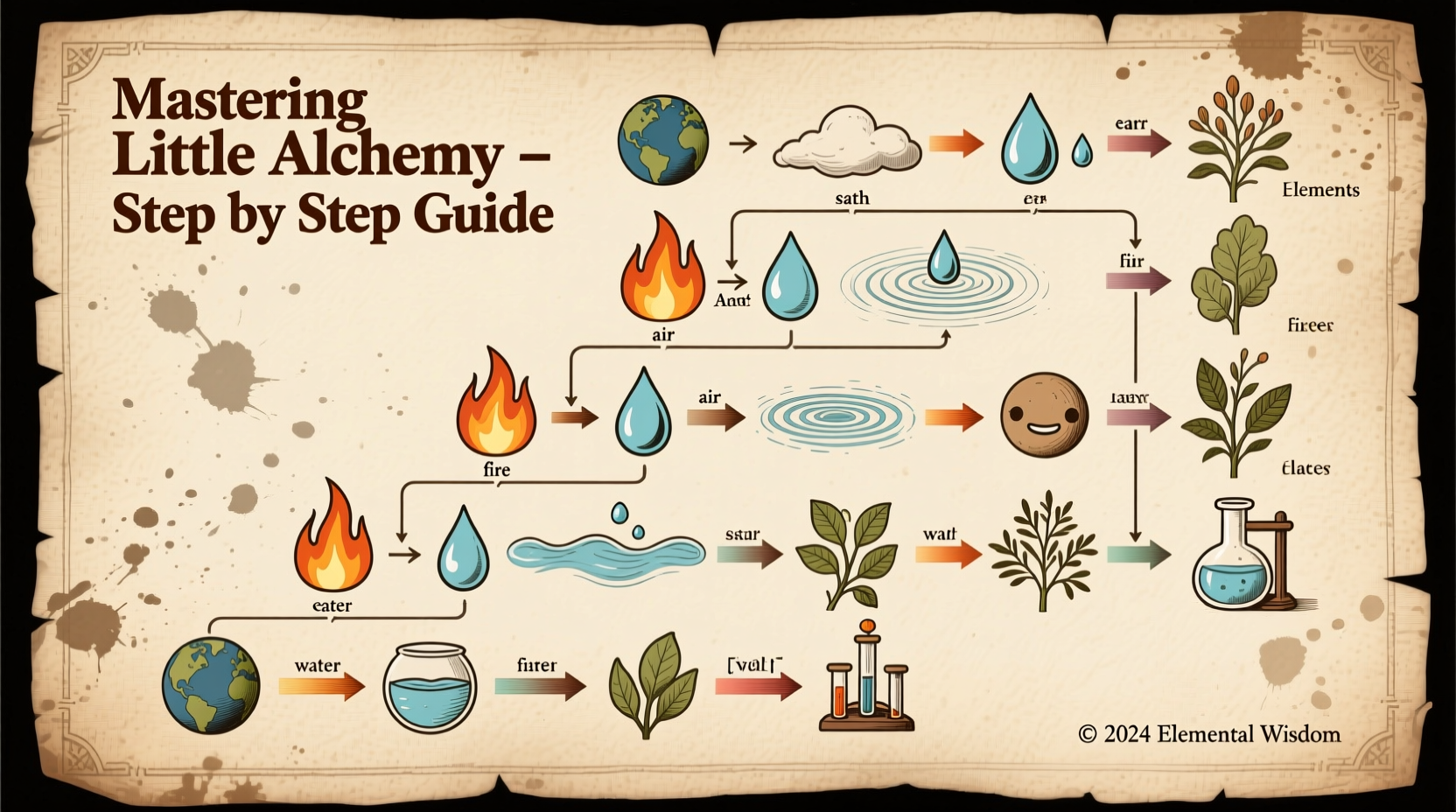
When you begin Little Alchemy, only four elements are available: Air, Earth, Fire, and Water. Every other item in the game—over 700 possible combinations—is derived from these basics. The key to success lies in understanding how these elements interact and recognizing patterns in their combinations.
The game operates on intuitive logic. For example, combining Fire and Water creates Steam, while Earth and Water yield Mud. These new elements can then be combined with others to unlock further discoveries. The process is recursive: each new creation expands your toolkit for future experiments.
Essential Early Combinations
Building a strong foundation early accelerates progress. Below are the first-tier combinations that open up major branches of discovery:
- Air + Fire = Energy
- Earth + Water = Mud
- Air + Water = Rain
- Earth + Fire = Lava
- Fire + Mud = Brick
- Water + Fire = Steam
- Earth + Rain = Plant
- Air + Lava = Stone
These initial results introduce critical secondary elements such as Plant, Stone, and Energy—each serving as gateways to dozens of additional items. For instance, Plant leads to Grass, Tree, and eventually Life, which unlocks the entire biological branch of the game.
Step-by-Step Guide to Unlocking Small Elements
Small elements—such as Tool, Metal, Glass, and Sand—are not end goals but crucial intermediaries. They enable access to higher-tier items like Machines, Electricity, and even Philosophers. Follow this structured progression to efficiently uncover them.
- Start with Base Pairings: Combine each original element with the others systematically. Record or mentally track outcomes to avoid repetition.
- Create Primary Derivatives: Focus on generating Mud, Steam, Energy, and Lava—these act as catalysts for further development.
- Introduce Life: Once Plant appears (from Earth + Rain), combine it with itself to get Grass, then combine Grass with Earth to make Field. Eventually, Life emerges when Energy meets Primordial Soup (a later combination).
- Unlock Tools: Combine Human (Life + Clay) with Metal (Fire + Stone) to create Tool—a pivotal moment in gameplay.
- Develop Materials: Use existing elements to craft fundamental materials like Glass (Fire + Sand), Sand (Stone + Air), and Alloy (Metal + Metal).
This sequence ensures steady momentum. Rushing ahead without securing small building blocks often leads to stagnation later.
Checklist: Must-Craft Small Elements Before Advancing
To maintain efficiency, confirm you’ve created these small but vital components before moving into complex territories:
- ✔️ Mud (Earth + Water)
- ✔️ Steam (Fire + Water)
- ✔️ Stone (Air + Lava)
- ✔️ Sand (Stone + Air)
- ✔️ Glass (Fire + Sand)
- ✔️ Metal (Fire + Stone)
- ✔️ Tool (Human + Metal)
- ✔️ Wire (Electricity + Metal)
- ✔️ Blade (Metal + Tool)
- ✔️ Clock (Tool + Time)
Each of these serves as a linchpin. For example, missing Metal halts progress toward Technology, Robots, and Space travel. Completing this checklist minimizes backtracking.
Common Pitfalls and How to Avoid Them
Even experienced players hit roadblocks due to oversight or misassumptions. Recognizing common errors improves problem-solving speed.
| Mistake | Why It Happens | Solution |
|---|---|---|
| Skipping elemental variations | Assuming one path covers all options | Recombine old elements with newly discovered ones regularly |
| Overlooking double uses | Using an element once and forgetting it | Treat every item as potentially reusable in multiple contexts |
| Ignoring abstract concepts | Focusing only on physical objects | Embrace combinations involving Time, Love, or Death—they lead to breakthroughs |
| Trying random pairs too early | Hoping for luck instead of logic | Stick to logical groupings: nature, tools, science, society |
Expert Insight: The Psychology Behind Successful Alchemy
Game designers have noted that Little Alchemy rewards lateral thinking. According to Dr. Lena Peterson, cognitive game researcher at Nordic Interactive Labs:
“Players who succeed fastest aren’t necessarily those with broader knowledge, but those who embrace experimentation and pattern recognition. The brain treats each successful combo like a mini-reward, reinforcing curiosity-driven learning.” — Dr. Lena Peterson, Cognitive Game Researcher
This insight underscores the importance of persistence. Each failed combination isn’t a dead end—it’s data. Over time, players develop an internal model of the game’s logic, making future discoveries faster and more intuitive.
Real Example: From Stuck to 100% Completion
Jamal, a casual player, reached 45% completion and stalled for weeks. He had created Humans, Houses, and Tools but couldn’t unlock Science or Electricity. After reviewing his inventory, he realized he hadn’t made Wire—missing because he skipped creating Metal earlier. Once he retraced his steps and combined Fire with Stone to produce Metal, the chain reaction began: Metal + Electricity = Wire, Wire + Battery = Circuit, Circuit + Idea = Computer.
This single correction opened over 30 new paths. His story illustrates a universal truth in Little Alchemy: mastery isn’t about speed—it’s about filling gaps in your elemental foundation.
Frequently Asked Questions
How do I know if I’ve missed a small element?
If you're unable to progress in a particular category—like Technology or Nature—review the prerequisites. Missing one small component (e.g., Blade, Sand, or Energy) can block entire branches. Use online checklists or in-game hints to audit your inventory.
Can I combine the same element twice?
Yes, and often should. For example, Plant + Plant = Garden, Human + Human = Society, and Metal + Metal = Alloy. Self-combinations are essential for social and industrial advancements.
Is there a limit to how many times I can combine elements?
No. You can reuse any created element indefinitely. This allows for parallel experimentation—for instance, using the same Tool to build both a Plow and a Hammer.
Conclusion: Your Alchemical Journey Begins Now
Mastering Little Alchemy isn’t about memorizing every possible pair—it’s about cultivating a mindset of curiosity, logic, and structured exploration. By focusing on small elements first, you lay a robust foundation capable of supporting grander creations like Cities, Time Machines, and even the Universe itself. The beauty of the game lies in its simplicity and depth: anyone can start, but true mastery comes from patience and attention to detail.




 浙公网安备
33010002000092号
浙公网安备
33010002000092号 浙B2-20120091-4
Comments
No comments yet. Why don't you start the discussion?