
Matrix multiplication is a cornerstone of linear algebra, widely used in computer graphics, machine learning, physics, and engineering. Despite its ubiquity, many students and professionals struggle with the mechanics and conceptual nuances behind it. Unlike scalar or vector multiplication, matrix multiplication follows strict rules and is not commutative—order matters. Mastering it requires more than memorization; it demands understanding, precision, and awareness of common errors.
This guide breaks down matrix multiplication into manageable steps, highlights frequent missteps, and provides practical strategies to ensure accuracy and confidence when working with matrices.
Understanding the Basics: What Is Matrix Multiplication?
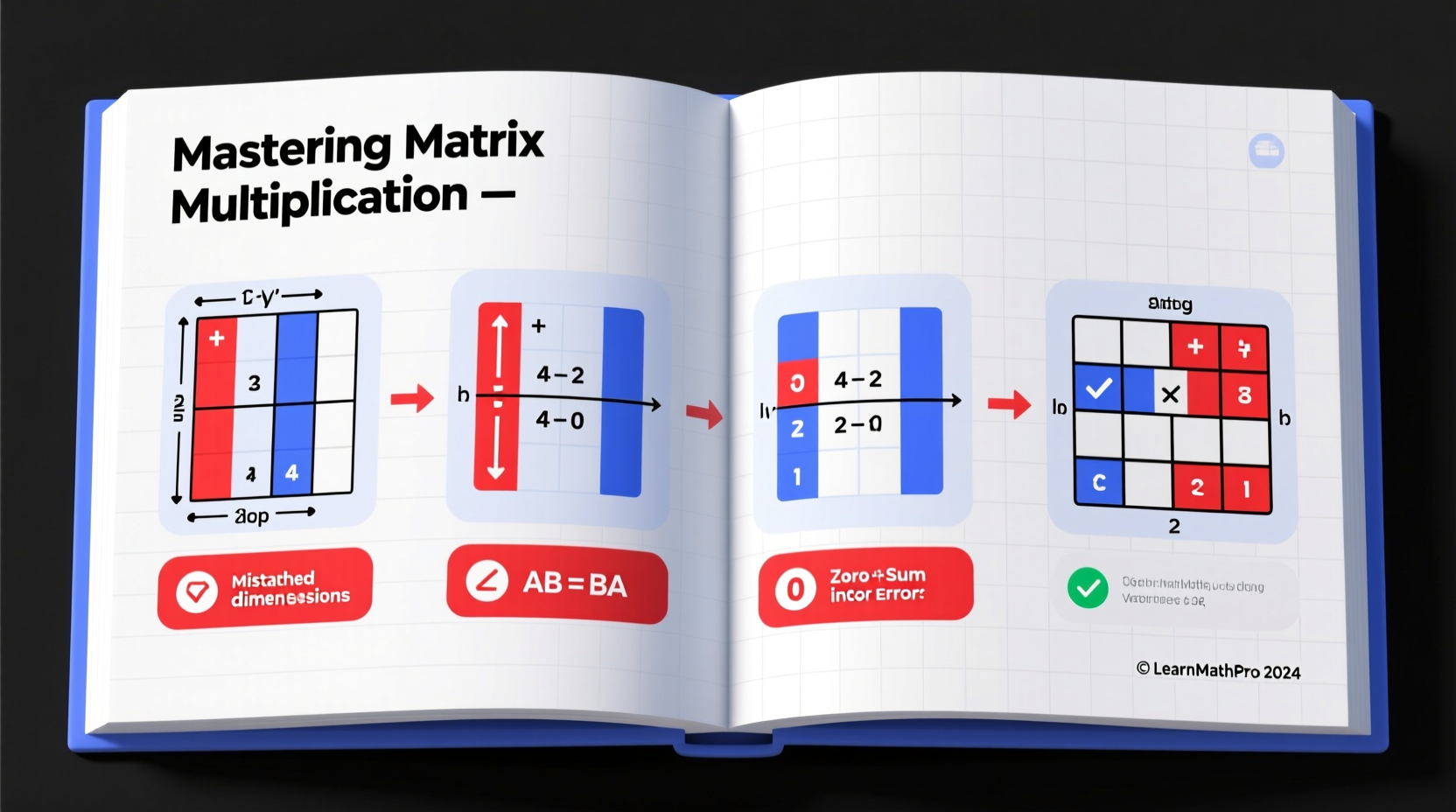
Matrix multiplication combines two matrices to produce a third, provided their dimensions are compatible. For two matrices \\( A \\) (of size \\( m \\times n \\)) and \\( B \\) (of size \\( n \\times p \\)), the product \\( C = AB \\) will be an \\( m \\times p \\) matrix. The number of columns in the first matrix must match the number of rows in the second.
The element \\( c_{ij} \\) in the resulting matrix is computed as the dot product of the \\( i \\)-th row of \\( A \\) and the \\( j \\)-th column of \\( B \\):
\\[ c_{ij} = \\sum_{k=1}^{n} a_{ik} b_{kj} \\]
This means each entry in the product is a sum of products—hence the name \"multiplication.\" It’s essential to note that \\( AB \\) is not necessarily equal to \\( BA \\), and in many cases, \\( BA \\) may not even be defined due to dimension mismatch.
Step-by-Step Guide to Multiplying Matrices
Follow this systematic approach to perform matrix multiplication accurately every time:
- Check Dimensions: Confirm that the number of columns in the first matrix equals the number of rows in the second.
- Set Up the Result Matrix: Create an empty matrix with dimensions matching the outer dimensions of the operands (rows from the first, columns from the second).
- Compute Each Entry: For each position \\( (i,j) \\) in the result, calculate the dot product of row \\( i \\) from the first matrix and column \\( j \\) from the second.
- Double-Check Arithmetic: Re-evaluate key entries, especially those involving negative numbers or fractions.
- Verify Sparsity Patterns (if applicable): In large or sparse matrices, check if expected zero patterns emerge.
Let’s walk through an example. Suppose:
\\[ A = \\begin{bmatrix} 1 & 2 \\\\ 3 & 4 \\\\ \\end{bmatrix}, \\quad B = \\begin{bmatrix} 5 & 6 \\\\ 7 & 8 \\\\ \\end{bmatrix} \\]
Since both are \\( 2 \\times 2 \\), multiplication is valid. Compute \\( AB \\):
- \\( c_{11} = (1)(5) + (2)(7) = 5 + 14 = 19 \\)
- \\( c_{12} = (1)(6) + (2)(8) = 6 + 16 = 22 \\)
- \\( c_{21} = (3)(5) + (4)(7) = 15 + 28 = 43 \\)
- \\( c_{22} = (3)(6) + (4)(8) = 18 + 32 = 50 \\)
Thus,
\\[ AB = \\begin{bmatrix} 19 & 22 \\\\ 43 & 50 \\\\ \\end{bmatrix} \\]
Common Pitfalls and How to Avoid Them
Even experienced practitioners can slip up when multiplying matrices under pressure. Here are the most frequent mistakes and how to prevent them:
| Pitfall | Description | How to Avoid |
|---|---|---|
| Multiplying incompatible matrices | Attempting to multiply matrices where inner dimensions don’t match (e.g., \\( 3\\times2 \\) times \\( 4\\times3 \\)) | Always write dimensions explicitly and confirm the inner numbers match. |
| Assuming commutativity | Thinking \\( AB = BA \\), which is generally false | Treat order as critical. If symmetry is needed, test both orders separately. |
| Element-wise confusion | Mistaking matrix multiplication for Hadamard (element-by-element) product | Remember: matrix multiplication involves dot products across rows and columns. |
| Arithmetic errors | Simple addition/multiplication slips during dot product calculation | Use scratch paper, double-check signs, and consider using parentheses. |
| Index misalignment | Using wrong row or column during computation | Highlight or label rows and columns visually while calculating. |
Real-World Example: Transformations in Computer Graphics
In 3D rendering, matrix multiplication applies geometric transformations such as rotation, scaling, and translation. Consider a 2D point \\( P = (2, 3) \\) represented as a column vector. To rotate it 90 degrees counterclockwise, we use the rotation matrix:
\\[ R = \\begin{bmatrix} 0 & -1 \\\\ 1 & 0 \\\\ \\end{bmatrix} \\]
Multiplying:
\\[ RP = \\begin{bmatrix} 0 & -1 \\\\ 1 & 0 \\\\ \\end{bmatrix} \\begin{bmatrix} 2 \\\\ 3 \\\\ \\end{bmatrix} = \\begin{bmatrix} (0)(2) + (-1)(3) \\\\ (1)(2) + (0)(3) \\\\ \\end{bmatrix} = \\begin{bmatrix} -3 \\\\ 2 \\\\ \\end{bmatrix} \\]
The transformed point is now \\( (-3, 2) \\), exactly what we expect from a 90-degree rotation. This demonstrates how precise matrix multiplication enables accurate modeling in real applications.
“Matrix multiplication isn’t just symbolic manipulation—it’s the engine behind modern data transformation.” — Dr. Lena Torres, Computational Mathematician, MIT
Expert Checklist for Error-Free Matrix Multiplication
Before finalizing any matrix product, run through this checklist:
- ✅ Are the matrices conformable? (Columns of first = Rows of second)
- ✅ Have I labeled my rows and columns clearly?
- ✅ Did I compute at least one dot product twice for verification?
- ✅ Am I treating multiplication as non-commutative?
- ✅ Have I checked for zero entries that might simplify calculations?
- ✅ If using software, have I confirmed input formatting (e.g., correct brackets, commas)?
Frequently Asked Questions
Can you multiply a matrix by itself?
Yes, provided it is a square matrix (same number of rows and columns). This operation, known as matrix squaring, is common in algorithms involving powers of matrices, such as Markov chains or eigenvalue computations.
What happens if I multiply a matrix by the identity matrix?
The result is the original matrix unchanged. The identity matrix \\( I \\) acts like the number 1 in scalar arithmetic: \\( AI = IA = A \\), assuming dimensions align.
Is there a shortcut for multiplying large matrices?
For manual work, block multiplication (partitioning matrices into submatrices) can help organize complex problems. In practice, numerical libraries like NumPy (Python) or MATLAB use optimized algorithms (e.g., Strassen’s algorithm) for speed, but understanding the standard method remains essential.
Conclusion: Build Confidence Through Practice
Mastering matrix multiplication is not about innate talent—it's about disciplined practice and attention to detail. By following structured steps, recognizing common traps, and verifying results systematically, anyone can achieve fluency. Whether you're solving systems of equations, training neural networks, or animating digital characters, the ability to multiply matrices correctly and efficiently is indispensable.




 浙公网安备
33010002000092号
浙公网安备
33010002000092号 浙B2-20120091-4
Comments
No comments yet. Why don't you start the discussion?