
In academic writing, credibility hinges on transparency. When you use someone else’s ideas, words, or research, giving proper credit isn’t just ethical—it’s essential. The Modern Language Association (MLA) style is one of the most widely used formats in the humanities, especially in literature, languages, and cultural studies. Yet, many students struggle with its nuances, leading to unintentional plagiarism or point deductions. This guide breaks down MLA citation into clear, manageable steps so you can cite sources accurately and confidently—every time.
Understanding the Purpose of MLA Style
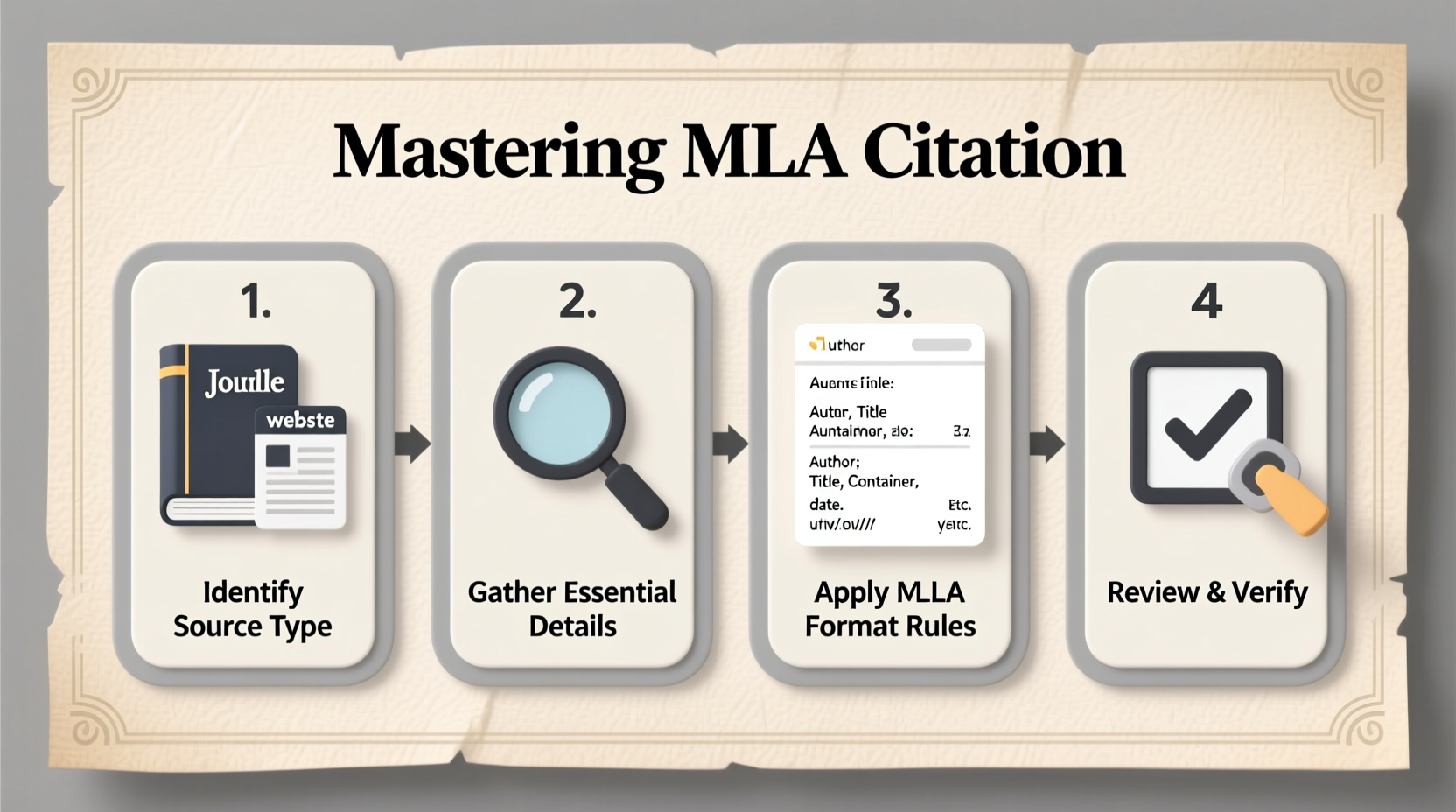
MLA format was developed to standardize scholarly writing, making it easier for readers to follow sources, evaluate evidence, and verify claims. Unlike other citation styles that prioritize dates or legal precision, MLA emphasizes authorship and readability. It assumes that your audience values clarity and intellectual honesty over rigid bureaucratic formatting.
The core components of MLA style are twofold: in-text citations and a Works Cited page. In-text citations briefly identify the source within your prose, while the Works Cited page provides full bibliographic details at the end of your paper. Both must align perfectly—one missing comma or incorrect title case can undermine your work’s professionalism.
“Proper citation is not about avoiding punishment; it's about joining an ongoing conversation.” — Dr. Laura Simpson, Professor of English, University of Toronto
Step-by-Step Guide to Creating In-Text Citations
In-text citations in MLA are concise and integrated directly into your sentences. Their purpose is to direct the reader to the full entry in the Works Cited list without disrupting the flow of your argument.
- Identify the author and page number. For print sources like books or journal articles, include the author’s last name and the page number in parentheses: (Smith 45).
- Integrate the author’s name into the sentence. If you mention the author in your sentence, only the page number goes in parentheses: Smith argues that narrative structure shapes reader interpretation (45).
- Handle multiple authors. Two authors: (Smith and Lee 22). Three or more: (Smith et al. 103).
- Cite sources without page numbers. Use only the author’s name if no pagination exists, such as web pages: (Johnson).
- Multiple works by the same author? Include a shortened title: (Smith, *Reading Theory* 78).
Building a Correct Works Cited Entry
The Works Cited page appears at the end of your paper, starting on a new page. Entries are listed alphabetically by the author’s last name and formatted with a hanging indent. Each entry follows a core template based on nine elements, though not all are required for every source.
The MLA Core Elements
- Author.
- \"Title of Source.\"
- Title of Container,
- Other Contributors,
- Version,
- Number,
- Publisher,
- Publication Date,
- Location (page numbers, URL, DOI).
These elements are separated by periods and commas according to specific rules. Let’s apply this to common source types.
Examples of Common MLA Citations
| Source Type | Works Cited Entry |
|---|---|
| Print Book | Smith, John. The Art of Reading. Penguin, 2020. |
| Journals Article (Print) | Lee, Anna. \"Narrative Voice in Modern Fiction.\" Journal of Literary Studies, vol. 12, no. 3, 2019, pp. 45–67. |
| Online Journal (with DOI) | Chen, Mei. \"Digital Literacy in the Classroom.\" Educational Review, vol. 8, no. 2, 2021, pp. 112–130. Project MUSE, doi:10.1353/edu.2021.0012. |
| Website Article | Adams, Rachel. \"How Algorithms Shape Culture.\" Digital Society Blog, 14 Mar. 2022, www.digitalsociety.org/algorithms-culture. |
| Film | Parasite. Directed by Bong Joon-ho, performances by Song Kang-ho and Choi Woo-shik, Neon, 2019. |
Important Formatting Rules
- Use italics for titles of self-contained works (books, journals, films).
- Use quotation marks for titles of shorter works (essays, articles, poems).
- Capitalize major words in titles (title case), not all words.
- Omit http:// or https:// from URLs; include DOIs when available.
- Do not add a period after a URL unless it ends the sentence.
Real Example: From Research to Citation
Imagine you’re writing a paper on climate change narratives in contemporary fiction. You read an article titled “Eco-Fiction and the Anthropocene” by Dr. Elena Torres, published in *Environmental Humanities*, volume 15, issue 1, 2023, pages 33–50. You quote her insight that “fiction serves as emotional infrastructure for ecological grief” (41).
In your essay, you write:
As Dr. Elena Torres observes, fiction “serves as emotional infrastructure for ecological grief,” offering readers a space to process environmental loss (41).
Your corresponding Works Cited entry would be:
Torres, Elena. \"Eco-Fiction and the Anthropocene.\" Environmental Humanities, vol. 15, no. 1, 2023, pp. 33–50.
This example shows how in-text citation and Works Cited entries work together to maintain academic integrity while supporting your argument with credible evidence.
Avoiding Common MLA Mistakes
Even experienced writers make small errors that can cost them points. Here’s a checklist to help you avoid the most frequent pitfalls.
MLA Citation Checklist
- ✅ Alphabetized entries in Works Cited
- ✅ Hanging indent applied to each entry
- ✅ Author names in “Last Name, First Name” format
- ✅ Correct use of italics vs. quotation marks
- ✅ Consistent punctuation (periods after elements, commas between container info)
- ✅ Page ranges use “pp.” only in containers (journals), not standalone books
- ✅ URLs simplified (no https://) and hyperlinks removed
- ✅ All in-text citations have matching Works Cited entries
- ✅ No bold, underlining, or font changes (unless required by instructor)
- ✅ Double-spaced throughout, including Works Cited
Do’s and Don’ts of MLA Formatting
| Do | Don’t |
|---|---|
| Use “et al.” for three or more authors | List all authors every time |
| Italicize journal titles | Put journal titles in quotes |
| Include access dates only when no publication date exists | Add “Retrieved from” before every URL |
| Shorten long titles logically in in-text citations | Use abbreviations like “ed.” or “vol.” in in-text citations |
| Use title case for all source titles | Capitalize only the first word and proper nouns |
FAQ: Common Questions About MLA Citation
Do I need to cite common knowledge?
No. General facts widely known and accepted (e.g., “Shakespeare wrote *Hamlet*”) do not require citation. However, if you’re unsure whether something qualifies as common knowledge, cite it. Better safe than sorry.
What if a source has no author?
Begin the Works Cited entry with the title of the source. In your in-text citation, use a shortened version of the title in quotation marks: (“Climate Trends”).
Should I include page numbers in my Works Cited?
Yes—for sources within containers like journal articles or book chapters, include the page range using “pp.” For standalone books, omit page numbers unless citing a specific edition or range.
Final Thoughts: Confidence Through Practice
Mastering MLA citation isn’t about memorizing every rule—it’s about understanding the logic behind them. Once you grasp the structure of the core elements and practice applying them consistently, citing sources becomes second nature. Think of your citations not as tedious formalities, but as bridges connecting your ideas to a broader scholarly conversation.
Every time you cite a source correctly, you strengthen your credibility, honor intellectual labor, and invite your readers to explore further. That’s the true power of accurate citation.




 浙公网安备
33010002000092号
浙公网安备
33010002000092号 浙B2-20120091-4
Comments
No comments yet. Why don't you start the discussion?