
Significant digits are more than just numbers—they represent the precision of a measurement. When multiplying values in scientific, engineering, or mathematical contexts, maintaining correct significant digits ensures accuracy and credibility in results. Missteps in rounding or digit retention can lead to misleading conclusions, especially in lab reports, financial calculations, or technical designs. This guide breaks down how to multiply numbers while preserving the appropriate number of significant figures, offering actionable rules, real-world examples, and expert-backed strategies.
Understanding Significant Digits: The Foundation
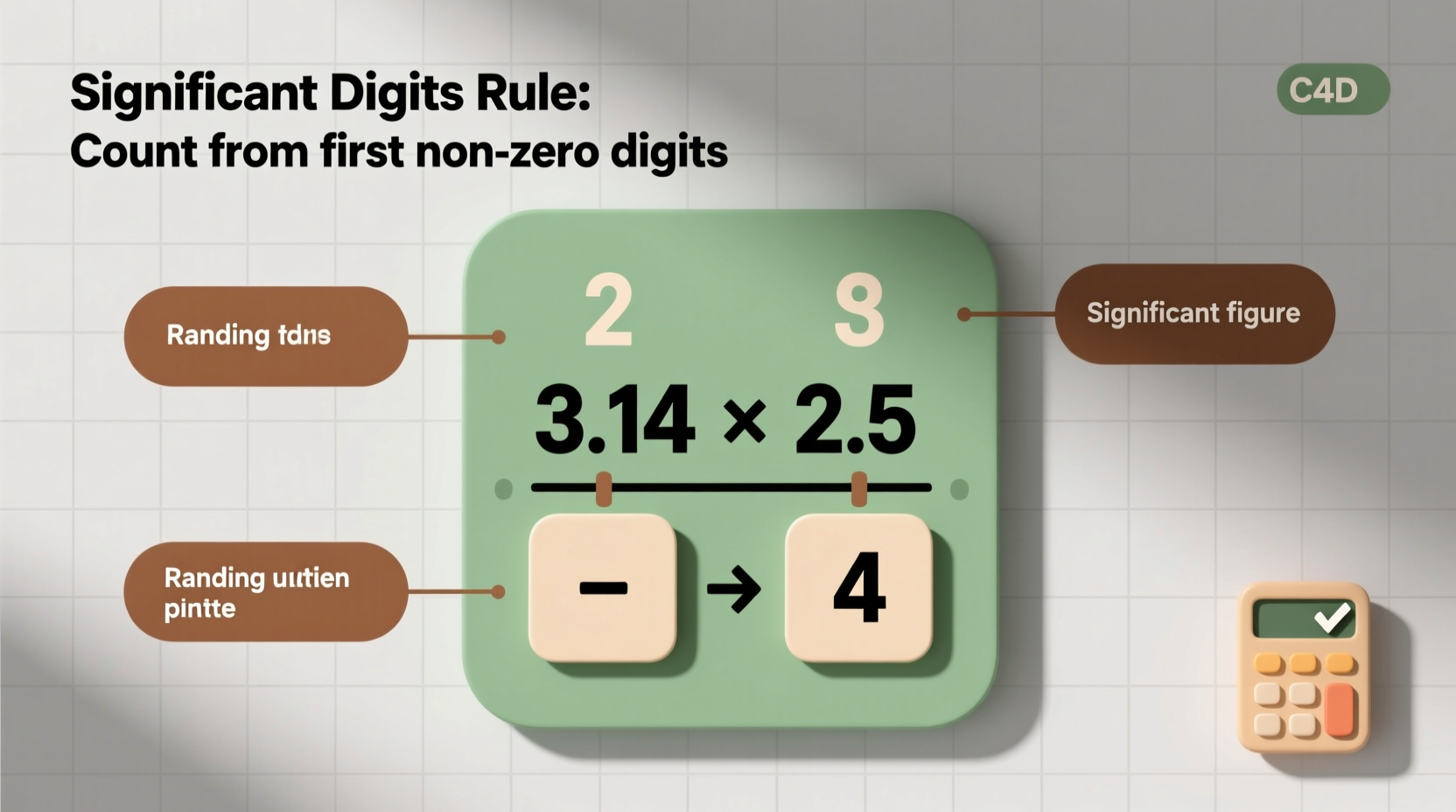
Before diving into multiplication, it's essential to understand what significant digits are. A significant digit is any non-zero digit, any zero between significant digits, or any trailing zero in a decimal number. Leading zeros are never significant. For example:
- 345 has 3 significant digits.
- 0.0045 has 2 significant digits (the leading zeros don’t count).
- 7.00 has 3 significant digits (trailing zeros after a decimal do count).
- 100 is ambiguous—it may have 1, 2, or 3 significant digits unless written in scientific notation (e.g., 1.00 × 10² clearly has 3).
The key idea is that significant digits reflect measurement precision. If you measure a length as 2.3 cm, it implies uncertainty at the hundredths place. Multiplying imprecise values without regard for significance compounds error.
The Rule for Multiplication with Significant Digits
When multiplying two or more numbers, the result should contain no more significant digits than the least precise measurement used in the calculation. In other words:
“The number of significant figures in the product is equal to the smallest number of significant figures in any of the factors.” — Dr. Alan Pierce, Physics Education Researcher
This rule ensures that your answer does not falsely suggest greater precision than your original data supports.
Step-by-Step Guide to Correct Multiplication
- Identify significant digits in each number being multiplied.
- Multiply the numbers using standard arithmetic.
- Round the final result to match the least number of significant digits among the inputs.
Let’s apply this process to a real example.
Real Example: Calculating Area with Measured Dimensions
A scientist measures the length and width of a rectangular plate:
- Length = 4.56 cm (3 significant digits)
- Width = 2.1 cm (2 significant digits)
To find the area: 4.56 × 2.1 = 9.576 cm².
However, since 2.1 has only 2 significant digits, the answer must be rounded to 2 significant digits. Therefore, the area is reported as 9.6 cm².
Note: Even though 9.576 rounds to 9.6, which appears to have two digits after the decimal, it actually has two significant digits—the '9' and the '6'. The zero before the decimal doesn't count, but here there isn’t one. This emphasizes that significant digits depend on the entire number, not just decimal places.
Common Pitfalls and How to Avoid Them
Many errors arise from confusing significant digits with decimal places or misidentifying zeros. Below is a comparison of common mistakes versus correct practices.
| Scenario | Incorrect Approach | Correct Approach |
|---|---|---|
| Multiplying 3.0 × 4.00 | Answer: 12.000 (5 sig figs) | Answer: 12 (2 sig figs—limited by 3.0) |
| Using 100 in a calculation | Assuming it has 3 sig figs | Treat as 1 sig fig unless specified otherwise |
| Rounding too early | Rounding intermediate steps | Keep extra digits during calculation; round only final answer |
| Confusing precision with accuracy | Reporting more digits because calculator shows them | Respect input precision regardless of calculator output |
One frequent mistake is over-relying on calculators. While tools provide exact numerical results, they don’t account for measurement limitations. A calculator might return 7.894325, but if your inputs justify only three significant digits, the answer must be 7.89.
Advanced Considerations: Scientific Notation and Mixed Operations
Scientific notation simplifies handling significant digits, especially with very large or small numbers. For instance:
- 5.67 × 10³ has 3 significant digits.
- 8.0 × 10⁻⁵ has 2 significant digits.
When multiplying these: (5.67 × 10³) × (8.0 × 10⁻⁵) = (5.67 × 8.0) × 10⁻² = 45.36 × 10⁻² = 4.536 × 10⁻¹.
Since 8.0 has only 2 significant digits, the result must be rounded to 2 significant digits: 4.5 × 10⁻¹.
In mixed operations (multiplication followed by addition), apply significant digit rules at each stage according to the operation. For multiplication/division, use the least number of significant digits. For addition/subtraction, use the least precise decimal place. Perform operations in order, keeping intermediate values slightly over-rounded to avoid cumulative error.
Mini Case Study: Laboratory Density Calculation
A chemistry student determines the density of an unknown liquid. They measure:
- Mass = 24.50 g (4 significant digits)
- Volume = 25.0 mL (3 significant digits)
Density = mass / volume = 24.50 / 25.0 = 0.980 g/mL.
Although the division yields 0.98, careful calculation gives 0.980. Since volume has 3 significant digits, the answer retains 3 significant digits: 0.980 g/mL. Reporting 0.98 would imply only two significant digits and lose precision.
This detail matters in identifying substances, where small differences in density distinguish materials. Proper handling of significant digits ensures reliable classification.
Practical Checklist for Error-Free Multiplication
Follow this checklist every time you perform multiplication involving measured values:
- ✅ Identify the number of significant digits in each factor.
- ✅ Perform the multiplication without rounding yet.
- ✅ Determine which input has the fewest significant digits.
- ✅ Round the final product to match that number.
- ✅ Express the result in proper form (use scientific notation if needed for clarity).
- ✅ Double-check zeros—especially trailing and leading—to avoid misclassification.
Frequently Asked Questions
Why can’t I keep all the digits my calculator gives me?
Your calculator assumes exact values, but real-world measurements have limits. Keeping extra digits implies false precision. Scientific integrity requires reporting only what your tools can justify.
What if both numbers have the same number of significant digits?
Then your answer should also have that many significant digits. For example, multiplying 2.50 × 4.75 (both with 3 sig figs) gives 11.875, which rounds to 11.9 (3 sig figs).
Do counting numbers have significant digits?
Exact counts (like 3 trials or 10 samples) are considered infinitely precise and do not limit significant figures. Only measured values constrain precision.
Conclusion: Precision Is Part of Professionalism
Mastering multiplication with significant digits isn’t about memorizing rules—it’s about respecting the limits of measurement and communicating results honestly. Whether you're analyzing experimental data, designing engineering models, or solving textbook problems, applying these principles consistently builds credibility and reduces errors.




 浙公网安备
33010002000092号
浙公网安备
33010002000092号 浙B2-20120091-4
Comments
No comments yet. Why don't you start the discussion?