
Questions are the foundation of understanding. Whether in conversation, research, teaching, or problem-solving, how we ask determines what we learn. A well-crafted question opens doors to insight; a poorly formed one leads to confusion or misdirection. Yet despite their importance, most people receive little training in how to construct effective questions. This article explores the principles of strong questioning, offering practical strategies to improve clarity, focus, and impact across personal, professional, and academic contexts.
The Power of a Well-Built Question
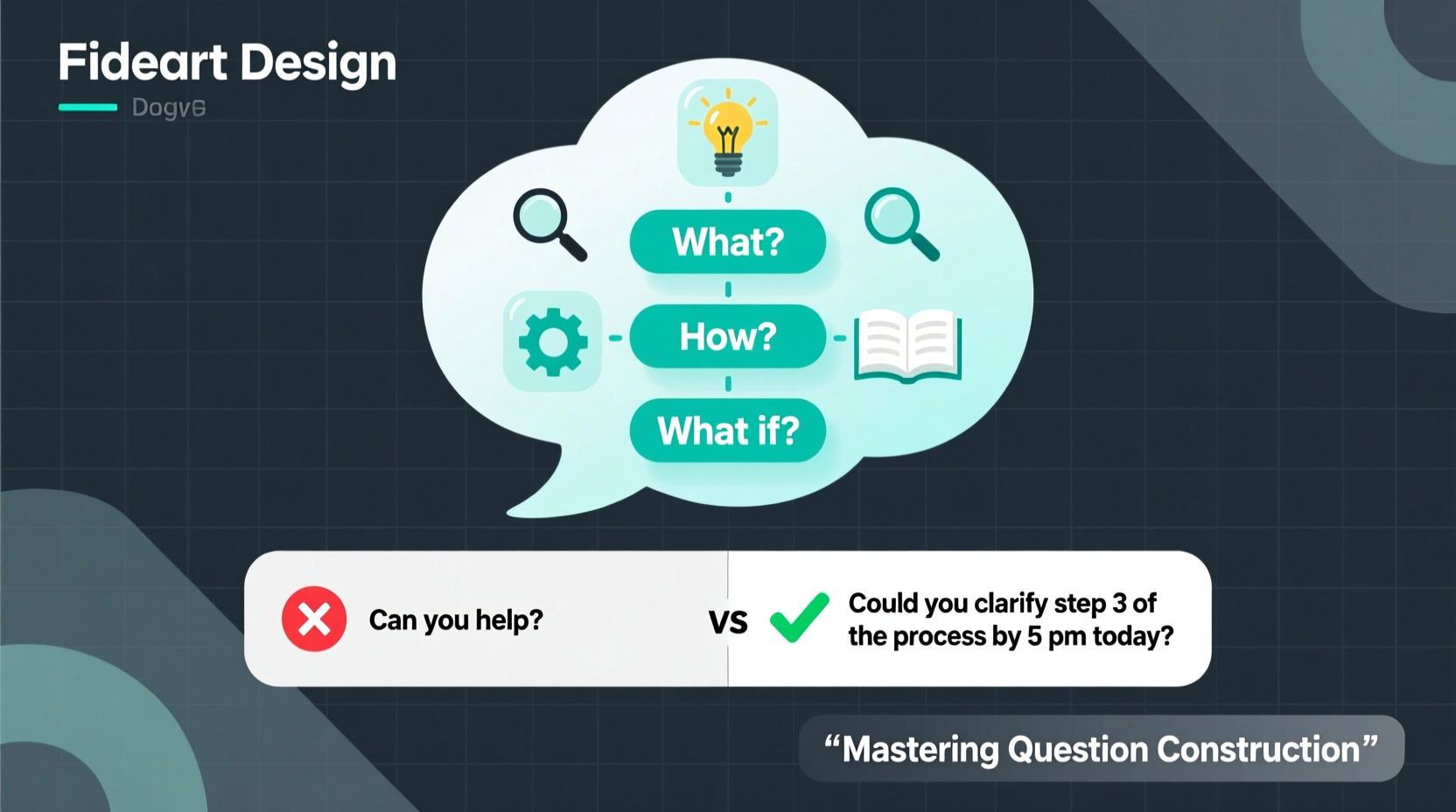
A question is more than a request for information—it’s a tool for shaping thought. In classrooms, precise questions prompt deeper student engagement. In meetings, they steer discussions toward solutions rather than circular debates. In interviews, they reveal not just facts but motivations and values. The quality of the answer often reflects the quality of the question.
Poorly constructed questions tend to be vague, leading, or overly broad. For example, asking “What do you think about that?” gives no direction and invites surface-level responses. Contrast this with “What part of the proposal concerned you most, and why?”—a question that guides reflection and elicits specific, meaningful feedback.
“Questions are the most powerful tools in human cognition. They define problems, frame thinking, and direct attention.” — Dr. Marsha Lovett, Cognitive Scientist, Carnegie Mellon University
Core Principles of Effective Question Construction
To build better questions, start with foundational principles that promote clarity and purpose:
- Clarity: Use simple, unambiguous language. Avoid jargon unless shared by your audience.
- Specificity: Focus on one idea at a time. Broad questions dilute attention and yield shallow answers.
- Neutrality: Avoid loaded terms or assumptions that pressure respondents toward a particular answer.
- Intent: Know what you’re trying to achieve—information gathering, problem-solving, or encouraging reflection?
- Structure: Organize the question logically so it’s easy to follow and respond to.
Common Question Types and When to Use Them
Different goals require different kinds of questions. Understanding these types helps you match form to function:
| Type | Description | Best Used For |
|---|---|---|
| Open-Ended | Invites elaboration (e.g., “How did you approach the project?”) | Exploration, interviews, brainstorming |
| Closed-Ended | Requires short, specific answers (e.g., “Did the system crash yesterday?”) | Fact-checking, surveys, quick confirmations |
| Probing | Follows up to dig deeper (e.g., “Can you say more about that challenge?”) | Clarifying ambiguity, uncovering root causes |
| Hypothetical | Explores possibilities (e.g., “What would happen if we delayed the launch?”) | Strategic planning, risk assessment |
| Rhetorical | Posed to make a point, not to get an answer | Persuasion, emphasis (use sparingly in dialogue) |
Effective communicators blend these types strategically. For instance, a manager might open a review with an open-ended question (“How do you feel the last quarter went?”), then use probing questions to explore specifics, and close with closed-ended ones to confirm action items.
Step-by-Step Guide to Crafting Strong Questions
Improving your questioning skills doesn’t have to be intuitive. Follow this structured process to build better questions deliberately:
- Define Your Purpose: Ask yourself: What do I want to learn or achieve? Is it clarification, decision-making, or relationship-building?
- Identify the Key Concept: Narrow your focus to one central idea. Instead of “Tell me about the project,” try “What was the biggest obstacle in phase two?”
- Choose the Right Type: Match the question format to your goal. Need details? Use open-ended. Confirming data? Closed-ended works best.
- Use Clear Language: Replace abstract terms with concrete ones. Instead of “efficiency,” specify “time saved per task.”
- Avoid Bias and Assumptions: Eliminate leading phrases like “Don’t you agree that…” or “Why haven’t you…?” These signal judgment and discourage honesty.
- Test the Question: Say it aloud. Would someone reasonably understand what you’re asking? Can it be answered directly?
- Refine Based on Feedback: After using the question, reflect: Did it yield useful answers? Adjust wording for future use.
Mini Case Study: Turning Around a Stalled Team Meeting
Sarah, a project lead at a tech startup, noticed her weekly team meetings were becoming unproductive. Discussions looped without resolution, and quieter members stayed silent. She realized the issue wasn’t participation but question design. Previously, she’d open with, “Any updates or concerns?”—a broad, low-stakes prompt.
She revised her approach. Now, she begins with: “Each of you, share one progress highlight and one blocker from the past week. We’ll address blockers after.” This small shift created structure, accountability, and focus. Within two weeks, meeting efficiency improved, and previously silent developers began contributing consistently.
The change wasn’t in the people—it was in the questions.
Avoiding Common Pitfalls
Even experienced professionals fall into traps when constructing questions. Watch out for these frequent errors:
- Double-Barreled Questions: Asking two things at once (e.g., “Was the timeline tight and the budget insufficient?”). Split them into separate queries.
- Jargon Overload: Using technical terms unnecessarily alienates audiences. Adapt language to the listener’s expertise.
- Leading Questions: Phrasing that suggests the “right” answer (e.g., “You found the training helpful, right?”) undermines authenticity.
- Overcomplication: Long-winded questions lose listeners. Trim excess words and get to the point.
- Assuming Knowledge: Questions like “What went wrong with the API integration?” assume everyone knows what happened. Add context when needed.
“The most common barrier to good questions isn’t lack of curiosity—it’s lack of discipline in phrasing.” — Neil Postman, author of *Teaching as a Subversive Activity*
Checklist: Building Better Questions
Use this checklist before posing important questions in conversations, surveys, or presentations:
- ✅ Is the purpose of the question clearly defined?
- ✅ Is it focused on a single idea?
- ✅ Is the language simple and free of jargon?
- ✅ Does it avoid bias or leading phrasing?
- ✅ Is it appropriate for the audience’s knowledge level?
- ✅ Can it be answered meaningfully with available information?
- ✅ Have I tested it for clarity?
FAQ: Frequently Asked Questions About Questioning
How can I ask better questions in job interviews?
Focus on behavioral and situational questions. Instead of “Are you a team player?” ask “Tell me about a time you resolved conflict within a team.” This invites real examples over rehearsed answers.
What’s the difference between a good and a bad open-ended question?
A good open-ended question has focus: “What strategies did you use to engage reluctant stakeholders?” A bad one is too broad: “Tell me about your experience.” The latter offers no guidance and often results in rambling.
Can too many questions be harmful?
Yes. An interrogation-style barrage can feel aggressive. Balance questions with active listening and allow space for full answers. Quality trumps quantity.
Conclusion: Make Questioning a Daily Practice
Mastery of question construction isn’t reserved for teachers or journalists—it’s a universal skill that enhances leadership, learning, and relationships. Every conversation is an opportunity to practice precision, empathy, and intellectual curiosity. Start small: revise one question per day. Notice how others respond. Refine your approach based on what works.
When you ask better questions, you don’t just get better answers—you deepen understanding, build trust, and unlock new possibilities. The next breakthrough idea might not come from having the right answer, but from daring to ask the right question.




 浙公网安备
33010002000092号
浙公网安备
33010002000092号 浙B2-20120091-4
Comments
No comments yet. Why don't you start the discussion?