
In a world where precision is often dictated by rulers, tape measures, and digital scales, there’s an overlooked skill that remains both timeless and essential: eyeballing. Whether you’re hanging a picture frame, portioning ingredients, or estimating distances during a hike, the ability to make accurate visual judgments without tools can save time, reduce frustration, and even enhance creativity. While not a substitute for exact measurement in critical applications, skilled estimation builds confidence and competence in everyday tasks.
Mastering eyeballing isn’t about guessing—it’s about training your perception, understanding spatial relationships, and using reliable reference points. With practice, anyone can improve their ability to judge length, volume, angles, and proportions accurately enough for most real-world situations.
The Science Behind Visual Estimation
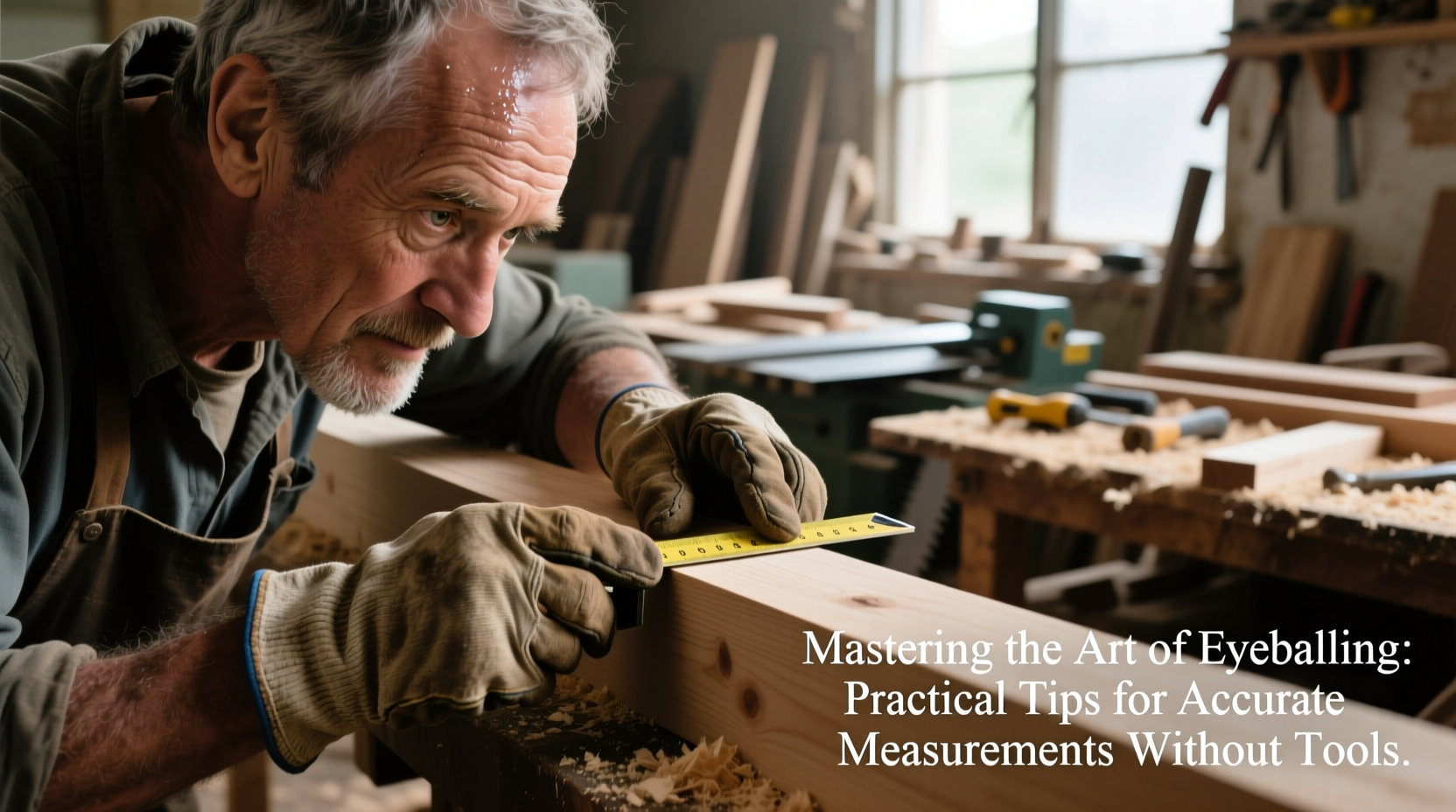
Human vision and spatial cognition are surprisingly adaptable. The brain constantly interprets depth, scale, and proportion based on context, experience, and environmental cues. When you estimate a distance or size, you're drawing from stored mental models—past experiences with similar objects or spaces. This cognitive process improves with repetition and feedback.
Studies in perceptual psychology show that people who regularly engage in hands-on work—carpenters, chefs, tailors, artists—develop stronger visual judgment skills than those who rely solely on instruments. Their brains internalize standard sizes and ratios through consistent exposure.
“Experienced builders don’t reach for a tape measure every time because they’ve trained their eyes to see symmetry, alignment, and proportion intuitively.” — Daniel Reeves, Construction Foreman with 25 years of field experience
Core Principles for Accurate Eyeballing
To develop reliable estimation abilities, focus on these foundational principles:
- Familiarity with common references: Know the approximate dimensions of everyday objects (e.g., a dollar bill is 6 inches long, a standard sheet of paper is 8.5 x 11 inches).
- Use body-based units: Your hand span, foot length, or arm span can serve as personal measuring tools.
- Break large estimates into smaller segments: Instead of judging 10 feet at once, visualize two 5-foot sections.
- Leverage symmetry and alignment: Our brains detect imbalance more easily than absolute size, so use centerlines and parallel edges as guides.
- Compare rather than guess: Place unknowns next to known objects to improve accuracy.
Practical Techniques by Category
Judging Length and Distance
Estimating linear measurements begins with calibration. Start by pacing out known distances—10 feet, 20 feet—and note how many steps it takes. Over time, your stride becomes a dependable yardstick.
For shorter spans, use your hand: a spread hand from thumb to pinky is roughly 9 inches for most adults; a fist is about 4 inches wide. These aren't precise, but they offer quick approximations when no tools are available.
| Body Reference | Average Measurement | Best Use Case |
|---|---|---|
| Hand span (thumb to pinky) | 8–10 inches | Measuring shelves, gaps |
| Fist width | 3.5–4.5 inches | Thickness of books, wood |
| Foot length | 9–12 inches | Floor spacing, tile counts |
| Arm span (fingertip to fingertip) | ~height of person | Room width, fabric length |
Estimating Volume and Portion Size
In cooking or storage, eyeballing volume is crucial. Professional chefs often skip measuring cups for routine tasks, relying instead on visual benchmarks.
- A clenched fist ≈ 1 cup
- Palm of hand ≈ 3 ounces of meat
- Thumb tip ≈ 1 teaspoon
- Whole thumb ≈ 1 tablespoon
This method works best when practiced consistently. For example, when dishing rice, compare the mound to the size of a tennis ball (about ½ cup) until your judgment sharpens.
Assessing Angles and Alignment
Perfect right angles and straight lines are easy to spot once you train your eye. Hold an object up to a corner—if light leaks through unevenly, it's not square. To check levelness, close one eye and align the top edge with a distant horizontal reference like a window sill or ceiling line.
For diagonal cuts or slope estimation, think in familiar fractions: a 45-degree angle splits a right angle in half. A 30-degree incline rises one unit for every three units forward—roughly the pitch of a steep roof.
Step-by-Step Guide to Improving Your Eyeballing Skills
Becoming proficient at visual estimation takes deliberate practice. Follow this weekly plan to build accuracy over four weeks:
- Week 1 – Build Reference Points: Measure common household items (remote control, mug height, table thickness) and memorize their sizes. Test yourself daily by guessing before checking.
- Week 2 – Practice Segmenting: Estimate longer distances by breaking them into 1-foot or 1-meter chunks. Walk them off and refine your mental unit.
- Week 3 – Compare and Contrast: Place an unknown object beside one you know. Guess the ratio (e.g., “this box is about 1.5 times wider than my phone”) and verify.
- Week 4 – Apply Under Constraints: Cook a recipe using only visual portioning, hang two pictures evenly spaced without a tape measure, or sketch a room layout from memory.
After each task, validate your estimate with a tool. The gap between guess and reality is where learning happens.
Real-World Example: The Framed Art Dilemma
Sarah wanted to hang two identical picture frames symmetrically above her sofa. She didn’t have a measuring tape, but she needed them centered and level. Using the principles of eyeballing, she began by locating the center of the wall visually—splitting it into halves mentally, then quarters. She held one frame against the wall and adjusted its position until the space on either side looked balanced.
To ensure equal spacing between the frames, she used the width of her smartphone as a spacer. After positioning both, she stepped back 10 feet and squinted to assess alignment. Minor adjustments were made until the setup appeared harmonious. Finally, she checked levelness by aligning the top edges with the baseboard molding across the room. The result? A professionally arranged display—no tools required.
Common Mistakes and How to Avoid Them
Even experienced estimators fall into traps. Awareness helps prevent recurring errors:
| Mistake | Why It Happens | How to Fix It |
|---|---|---|
| Standing too close | Limited perspective distorts proportion | Step back to view the whole scene |
| Ignoring lighting | Shadows alter perceived depth | Check from multiple angles and light conditions |
| Overestimating verticals | Vertical lines appear longer due to gravity bias | Cross-check with horizontal references |
| Trusting memory over sight | Recall is less accurate than real-time observation | Always re-evaluate in context |
FAQ
Can eyeballing ever be as accurate as using tools?
Not in engineering or scientific contexts, but for everyday decisions—hanging shelves, dividing food, arranging furniture—trained eyeballing is often accurate enough. The goal isn’t perfection but functional precision.
Is eyeballing skill innate or learned?
While some individuals have a natural aptitude, the vast majority of proficiency comes from practice and feedback. Like any perceptual skill, it improves dramatically with deliberate training.
What if I’m consistently off in my estimates?
Keep a log. Record your guess, then measure the actual value. Over time, patterns will emerge—perhaps you always overestimate short distances. Adjust your mental model accordingly.
Final Checklist: Become a Confident Estimator
- ✔ Memorize 5 common object dimensions
- ✔ Use your hand and foot as portable measuring tools
- ✔ Practice segmenting large spaces into manageable units
- ✔ Validate guesses with tools to calibrate accuracy
- ✔ Apply techniques in real tasks weekly
- ✔ Step back and squint to assess overall balance
Conclusion
Mastering the art of eyeballing empowers you to act decisively without dependency on gadgets. It sharpens spatial awareness, enhances problem-solving agility, and fosters a deeper connection to your environment. From kitchen counters to construction sites, the ability to estimate with confidence turns uncertainty into opportunity.




 浙公网安备
33010002000092号
浙公网安备
33010002000092号 浙B2-20120091-4
Comments
No comments yet. Why don't you start the discussion?