
In a world where information evolves faster than ever, the ability to learn efficiently is no longer optional—it’s essential. Whether you're acquiring a new language, mastering a technical skill, or preparing for exams, how you learn often matters more than what you learn. The most successful learners aren’t necessarily the smartest; they’re the ones who’ve mastered the process of learning itself. This article explores actionable, research-supported techniques that transform passive studying into active mastery.
The Science Behind Effective Learning
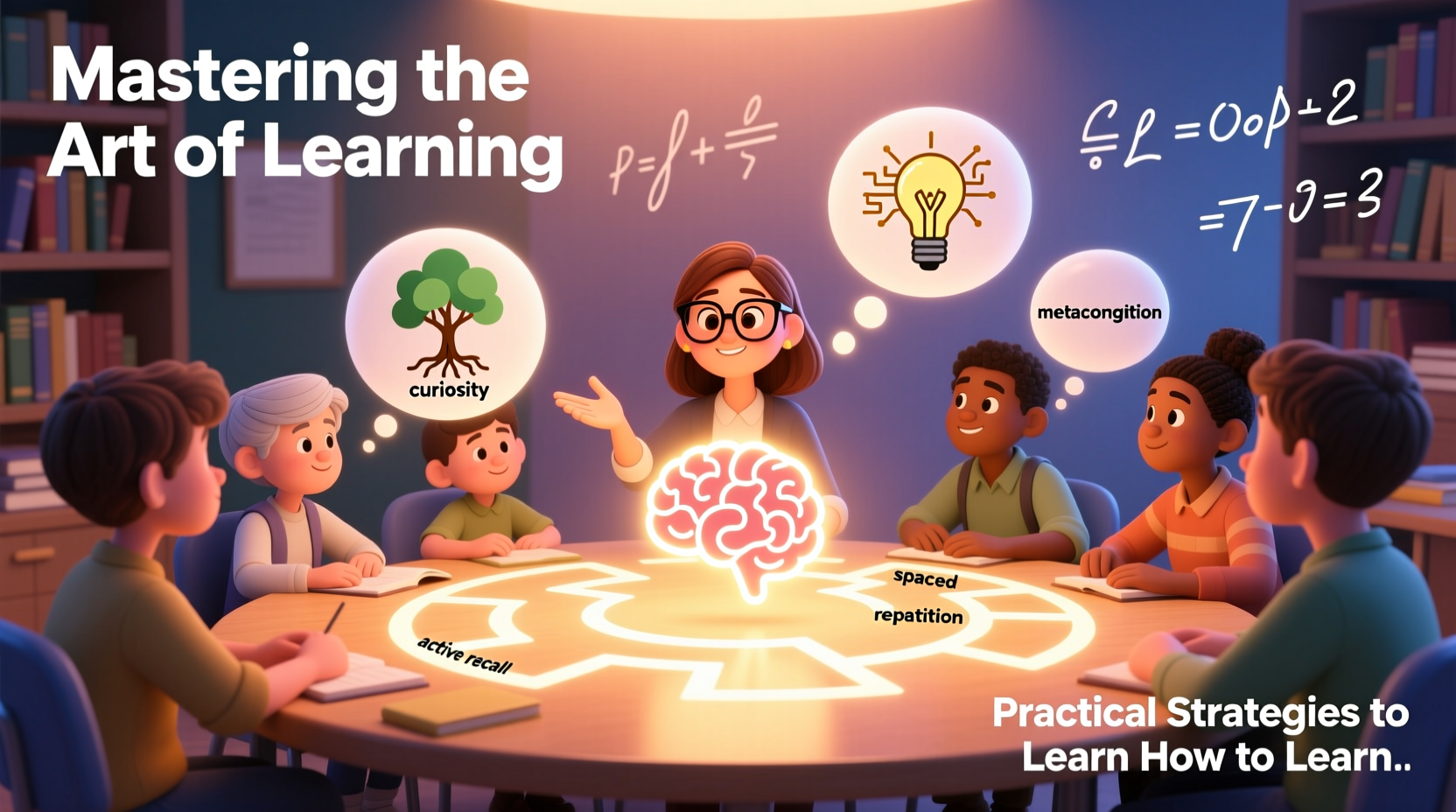
Learning isn’t just about time spent reading or highlighting text. Cognitive psychology reveals that effective learning hinges on engagement, retrieval, and spaced repetition. Passive review—rereading notes or textbooks—creates an illusion of competence. In contrast, active recall and spaced exposure solidify knowledge in long-term memory.
One key concept is the spacing effect: spreading out study sessions over time leads to stronger retention than cramming. Another is interleaving, which involves mixing different topics or skills during practice. For example, alternating between algebra, geometry, and statistics problems strengthens discrimination and application.
“Learning is not about accumulating facts but building mental models that allow you to adapt and apply knowledge.” — Dr. Barbara Oakley, Professor of Engineering and Author of *A Mind for Numbers*
Core Strategies for Learning How to Learn
To become a more efficient learner, shift from passive consumption to active engagement. Below are foundational techniques grounded in neuroscience and educational research.
1. Use Active Recall Regularly
Instead of reviewing notes, test yourself. Close the book and ask: What were the main points? Can I explain this concept aloud? Active recall forces your brain to retrieve information, strengthening neural pathways.
2. Apply Spaced Repetition
Review material at increasing intervals—after one day, three days, one week, then two weeks. Tools like Anki or Quizlet automate this process using algorithms that optimize review timing based on your performance.
3. Embrace the Power of Sleep
Sleep isn’t downtime—it’s when your brain consolidates memories. Pulling all-nighters undermines retention. Aim for 7–9 hours nightly, especially after intense learning sessions.
4. Alternate Between Focus and Diffuse Thinking
The brain operates in two modes: focused (concentrating directly on a problem) and diffuse (relaxed, background processing). When stuck, take a walk or switch tasks. The diffuse mode often delivers sudden insights.
5. Teach What You Learn
Explaining concepts to someone else—or even to yourself—reveals gaps in understanding. The “Feynman Technique” involves simplifying complex ideas into plain language, ensuring true comprehension.
Step-by-Step Guide to Building a Learning System
Adopting these strategies requires structure. Follow this timeline to build a sustainable learning routine:
- Day 1: Define Your Goal – Be specific. Instead of “learn Spanish,” aim for “hold a 5-minute conversation within 60 days.”
- Day 2: Break It Down – Divide the goal into weekly milestones (e.g., vocabulary: 20 words/week, grammar: one tense per week).
- Day 3: Schedule Study Blocks – Use 25–30 minute focused sessions with 5-minute breaks (Pomodoro technique). Limit daily deep work to 2–3 sessions.
- Day 4: Create Retrieval Tools – Make flashcards, mind maps, or self-tests. Avoid passive note-taking.
- Day 5: Begin Spaced Review – Schedule first review in 24 hours, second in 3 days, third in 1 week.
- Ongoing: Reflect Weekly – Ask: What worked? Where did I struggle? Adjust methods accordingly.
Common Pitfalls and How to Avoid Them
Even motivated learners fall into traps that hinder progress. Awareness is the first step toward correction.
| Pitfall | Why It’s Harmful | Better Approach |
|---|---|---|
| Rereading and highlighting | Creates familiarity without real understanding | Replace with self-quizzing and summarizing from memory |
| Cramming before exams | Leads to rapid forgetting after the test | Distribute study over weeks using spaced repetition |
| Multitasking during study | Divides attention and reduces retention | Work in distraction-free zones; use apps to block notifications |
| Avoiding difficult topics | Leaves critical gaps in knowledge | Use interleaving—mix easy and hard topics to build resilience |
Real Example: From Struggling Student to Top Performer
Carlos, a computer science undergrad, consistently scored below average despite spending hours studying. He reread chapters, highlighted heavily, and pulled all-nighters before exams. Frustrated, he discovered the concept of active recall and spaced repetition through an online course.
He changed his approach: after each lecture, he wrote down three key ideas from memory. He used flashcards for coding syntax and reviewed them daily using Anki. Within six weeks, his quiz scores improved by 40%. By finals, he ranked in the top 15% of his class—not because he studied more, but because he studied smarter.
Checklist: Build Your Personal Learning Framework
- ✅ Set a clear, measurable learning goal
- ✅ Break the goal into manageable sub-tasks
- ✅ Schedule regular, short study sessions (25–30 min)
- ✅ Replace passive review with active recall (self-testing)
- ✅ Implement spaced repetition (review at increasing intervals)
- ✅ Use sleep strategically—avoid late-night cramming
- ✅ Practice explaining concepts in simple terms (Feynman Technique)
- ✅ Track progress weekly and adjust tactics as needed
Frequently Asked Questions
How long does it take to see results from these techniques?
Most learners notice improvements in focus and retention within 2–3 weeks. Deeper mastery takes consistent application over months, but early wins—like better quiz scores or clearer recall—often appear quickly.
Can these strategies work for non-academic skills like music or coding?
Absolutely. The principles of deliberate practice, spaced repetition, and active feedback apply universally. Musicians use spaced practice to master scales; developers use project-based recall to reinforce syntax and logic.
Is multitasking ever acceptable during learning?
True multitasking—such as checking messages while studying—is detrimental. However, alternating between types of learning (e.g., reading, then practicing, then teaching) can enhance engagement when done sequentially, not simultaneously.
Conclusion: Take Control of Your Learning Journey
Learning how to learn is the ultimate meta-skill. It empowers you to adapt, grow, and thrive in any field. No longer must you rely on willpower or endless hours of grinding. With evidence-based strategies like active recall, spaced repetition, and deliberate reflection, you gain control over your intellectual development.




 浙公网安备
33010002000092号
浙公网安备
33010002000092号 浙B2-20120091-4
Comments
No comments yet. Why don't you start the discussion?