
Understanding how to convert fractions to decimals is a foundational math skill that applies across everyday life—from calculating discounts at the store to interpreting data in reports. While it may seem intimidating at first, the process is straightforward once you grasp the underlying principles. This guide breaks down the mechanics of fraction-to-decimal conversion, offering clear explanations, practical strategies, and real-world applications to help you master the skill with confidence.
The Basics: What Are Fractions and Decimals?
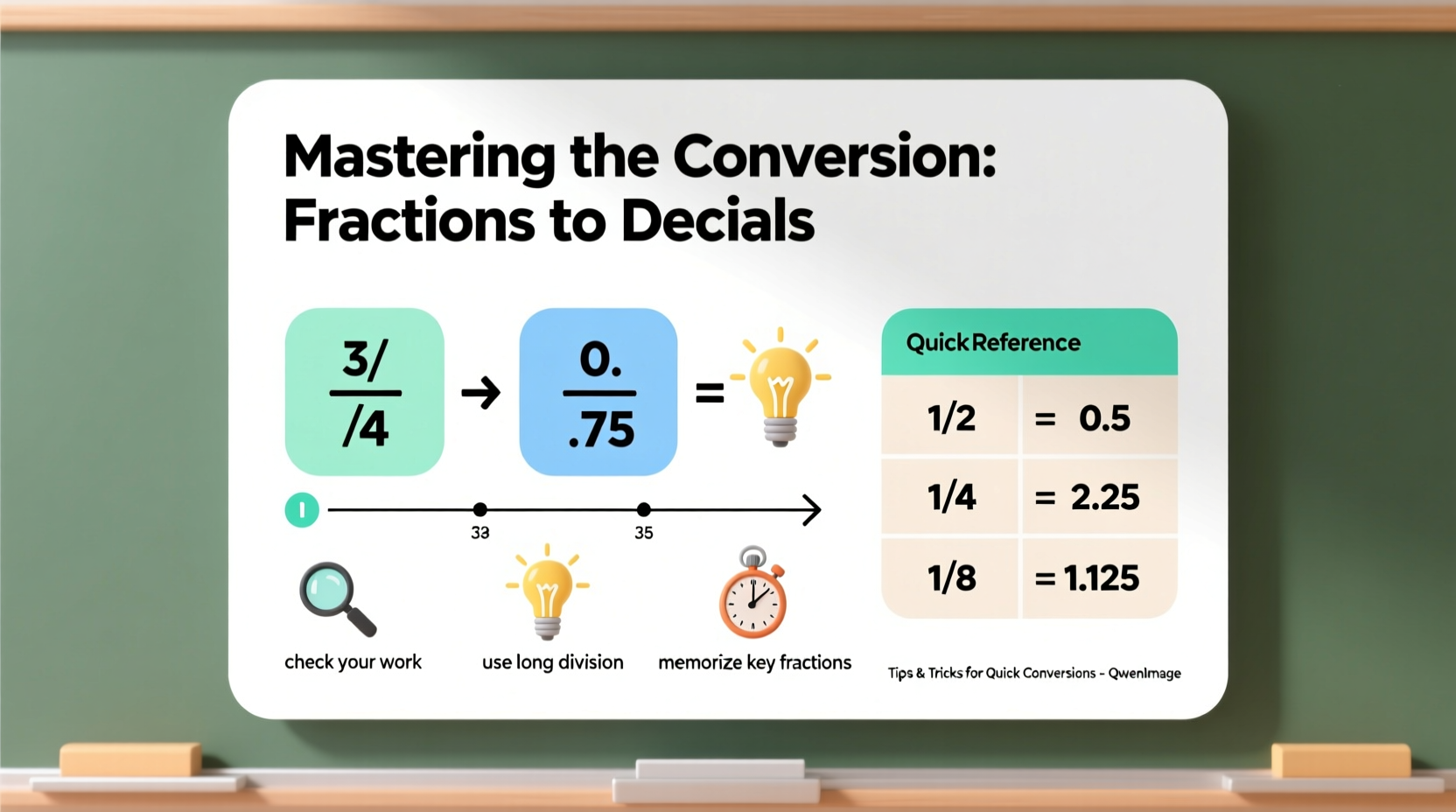
A fraction represents a part of a whole and consists of two numbers: the numerator (top) and the denominator (bottom). For example, in the fraction 3/4, 3 is the part being considered, and 4 is the total number of equal parts. A decimal, on the other hand, expresses the same idea using a base-10 system. The decimal equivalent of 3/4 is 0.75, which means 75 hundredths.
The key to converting between these forms lies in division: the numerator divided by the denominator. This relationship is consistent across all proper and improper fractions. Mixed numbers—like 2 1/2—require an extra step but follow the same logic.
Step-by-Step Guide to Converting Fractions to Decimals
Follow this five-step method to convert any fraction into its decimal form accurately.
- Identify the numerator and denominator. For example, in 5/8, 5 is the numerator and 8 is the denominator.
- Set up the division problem. Divide the numerator by the denominator: 5 ÷ 8.
- Add a decimal point and zeros if necessary. Since 5 is smaller than 8, add a decimal point and a zero to make it 5.0.
- Perform long division. 8 goes into 50 six times (6 × 8 = 48), leaving a remainder of 2. Bring down another zero to make 20. 8 goes into 20 twice (2 × 8 = 16), remainder 4. Continue until the remainder is zero or a repeating pattern emerges.
- Write the result. In this case, 5 ÷ 8 = 0.625.
This method works universally. Whether dealing with simple fractions like 1/2 or complex ones like 7/16, the process remains consistent.
Common Decimal Equivalents to Memorize
Memorizing frequently used fraction-to-decimal conversions saves time and builds number sense. Here’s a reference table of essential equivalents:
| Fraction | Decimal | Fraction | Decimal |
|---|---|---|---|
| 1/2 | 0.5 | 3/4 | 0.75 |
| 1/3 | 0.333… | 2/3 | 0.666… |
| 1/4 | 0.25 | 3/8 | 0.375 |
| 1/5 | 0.2 | 1/10 | 0.1 |
| 1/8 | 0.125 | 5/8 | 0.625 |
Knowing these values allows for quick mental math. For instance, if you’re splitting a $24 bill among three people, recognizing that 1/3 ≈ 0.333 helps estimate each share as roughly $8.
Tips and Tricks for Faster, More Accurate Conversion
Beyond standard long division, several techniques can streamline the process.
- Use equivalent fractions with powers of 10. If the denominator can be converted to 10, 100, or 1000, the decimal form becomes obvious. For example, 3/5 = 6/10 = 0.6.
- Leverage known benchmarks. Knowing that 1/2 = 0.5 helps estimate nearby fractions. 3/7 is slightly more than 0.4 because 3/7 ≈ 0.428.
- Recognize repeating decimals. When a remainder repeats during division, so does the decimal. 1/3 = 0.333…, written as 0.\\overline{3}.
- Double and halve strategically. To convert 5/16, halve 5/8 (which is 0.625) to get 0.3125.
Real-World Example: Baking with Precision
Sarah is following a cookie recipe that calls for 3/4 cup of brown sugar. She only has a digital scale that measures in grams and decimals. Knowing that 1 cup of brown sugar weighs approximately 200 grams, she calculates:
3/4 of 200 = (3 ÷ 4) × 200 = 0.75 × 200 = 150 grams.
By converting 3/4 to 0.75, Sarah ensures her measurements are accurate, leading to perfectly textured cookies. This scenario illustrates how fraction-to-decimal conversion supports precision in practical situations.
Expert Insight on Numeracy Skills
“Fluency in converting between fractions and decimals isn’t just about math class—it’s a life skill. From managing finances to understanding probabilities, this ability enhances decision-making and analytical thinking.” — Dr. Alan Reyes, Mathematics Education Specialist
Checklist: Master Fraction-to-Decimal Conversion
Use this checklist to build and reinforce your skills:
- ☑ Simplify the fraction before converting.
- ☑ Set up the division: numerator ÷ denominator.
- ☑ Use long division with added zeros when needed.
- ☑ Recognize repeating patterns and round appropriately.
- ☑ Memorize common conversions (e.g., 1/4 = 0.25).
- ☑ Apply shortcut methods for denominators like 5, 20, or 25.
- ☑ Verify results using estimation or a calculator.
Frequently Asked Questions
What if the decimal repeats forever?
Some fractions produce repeating decimals, like 1/3 = 0.333… or 5/6 = 0.8333…. These are written with a bar over the repeating digit(s), such as 0.\\overline{3}. In practical use, they are often rounded to two or three decimal places unless exact precision is required.
Can all fractions be converted to terminating decimals?
No. Only fractions whose denominators (in simplest form) have prime factors of 2 and/or 5 will terminate. For example, 1/8 (denominator 2³) terminates as 0.125, but 1/3 (denominator 3) does not.
How do I convert mixed numbers to decimals?
First, convert the fractional part to a decimal, then add it to the whole number. For example, 2 1/4 = 2 + (1 ÷ 4) = 2 + 0.25 = 2.25.
Conclusion: Build Confidence Through Practice
Converting fractions to decimals is more than a classroom exercise—it's a tool for clearer thinking and better decisions. With a solid understanding of division, memorization of key equivalents, and application of smart shortcuts, anyone can perform these conversions quickly and accurately. The more you practice, the more intuitive it becomes. Start with simple fractions, challenge yourself with complex ones, and apply the skill in daily scenarios like cooking, shopping, or budgeting.




 浙公网安备
33010002000092号
浙公网安备
33010002000092号 浙B2-20120091-4
Comments
No comments yet. Why don't you start the discussion?