
Even experienced writers sometimes hesitate when choosing between \"then\" and \"than.\" These two small words sound nearly identical but serve entirely different grammatical roles. Using one in place of the other can confuse readers, weaken your message, or undermine your credibility—especially in formal writing. The good news? Once you understand their distinct functions, the confusion disappears. This guide breaks down the rules clearly, provides real examples, and equips you with tools to use \"then\" and \"than\" correctly—every single time.
Understanding the Core Difference
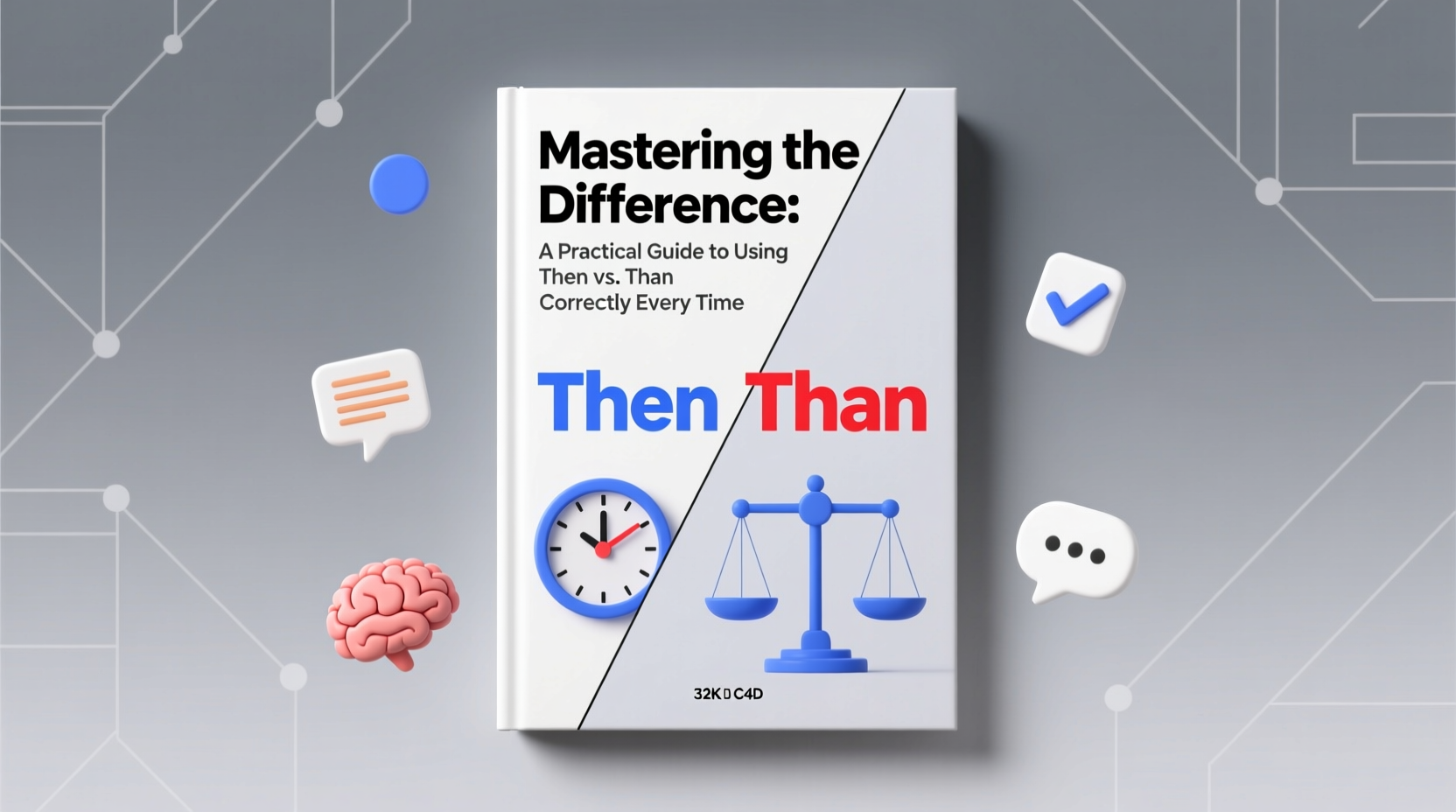
The simplest way to distinguish \"then\" from \"than\" is by function. Than is used for comparisons. Then relates to time, sequence, or consequence.
Consider these basic examples:
- She is taller than her brother. (comparison)
- We went to dinner, and then we saw a movie. (sequence)
Mixing them up changes the meaning—or creates nonsense. Saying “I like coffee more then tea” implies a timeline (“coffee, then tea”), not a preference. That’s not what the speaker intends.
“Misusing ‘then’ and ‘than’ is one of the most common errors in professional writing. It’s a small slip with an outsized impact on clarity.” — Dr. Laura Simmons, Linguistics Professor, University of Chicago
When to Use “Than”: The Comparison Word
Than introduces comparisons between two people, things, actions, or qualities. It typically follows comparative adjectives or adverbs like better, faster, more, less, smarter, fewer.
Examples:
- This phone is lighter than the previous model.
- He runs faster than anyone on the team.
- I’d rather walk than drive in heavy traffic.
It also appears in phrases involving “other,” “anything,” or “everyone” to clarify the comparison group:
- She earns more money than anyone else in her department.
- This solution works better than anything we’ve tried before.
When to Use “Then”: Time, Sequence, and Consequence
Then has multiple uses, all related to timing or logical progression. Its role shifts slightly depending on context, but the core idea remains: it signals “at that time,” “next,” or “as a result.”
1. Indicating Sequence
Use “then” to show the order of events.
- First, preheat the oven. Then, mix the ingredients.
- We checked into the hotel, and then headed straight to the beach.
2. Referring to a Specific Time
“Then” can point to a moment in the past or future.
- In 2015, I was living in Paris. Then, I moved to Berlin.
- If it’s 3 PM here, it’s already 8 PM then in London.
3. Showing Logical Consequence
In conditional statements, “then” often follows “if” to indicate a result.
- If you finish your work early, then you can leave.
- If he won’t attend, then we should reschedule.
Note: In casual speech, “then” after “if” is often omitted (“If you’re ready, let’s go”). But including it adds clarity, especially in formal or instructional writing.
Common Mistakes and How to Avoid Them
Despite their differences, “then” and “than” are frequently swapped—especially in fast writing or under pressure. Here’s a table summarizing typical errors and corrections:
| Incorrect | Correct | Reason |
|---|---|---|
| This route is faster then the highway. | This route is faster than the highway. | Comparing speed → use “than” |
| She is smarter then her sister. | She is smarter than her sister. | Comparison of intelligence → “than” |
| Set the timer, and than stir the mixture. | Set the timer, and then stir the mixture. | Sequence of actions → “then” |
| If you’re tired, then you should rest. | (Acceptable as written) | Logical consequence → “then” is optional but correct |
Step-by-Step Guide to Choosing Correctly
Follow this simple decision tree whenever you're unsure which word to use:
- Step 1: Identify the purpose of the word in your sentence. Are you comparing two things? Or indicating time/sequence?
- Step 2: If comparing (e.g., better, worse, more, less), use than.
- Step 3: If showing order, time, or consequence, use then.
- Step 4: Test it: Replace “then” with “next” — does it still make sense? Replace “than” with “compared to” — does the sentence hold?
- Step 5: Proofread aloud. Often, the wrong word will sound awkward.
This process takes seconds but prevents embarrassing errors in emails, reports, essays, or social media posts.
Real-World Example: A Business Email Gone Wrong
Consider this scenario: A marketing manager sends a client update:
“We analyzed last quarter’s results and found our campaign performed better then the previous one.”
The client pauses. “Better then?” They expected “better than.” Instantly, the professionalism of the message drops. The error suggests carelessness—even if the rest of the email is flawless.
Revised version:
“We analyzed last quarter’s results and found our campaign performed better than the previous one.”
Now the comparison is clear, and the writer appears detail-oriented. One letter makes a measurable difference in perception.
Frequently Asked Questions
Can “then” ever be used in a comparison?
No. “Then” has no role in comparisons. Even in phrases like “more now than then,” “than” is the comparison word, and “then” refers to a past time. They work together but serve separate purposes.
Is it okay to omit “then” after “if”?
Yes, in informal contexts. For example, “If you’re hungry, eat something” sounds natural without “then.” However, in technical writing, instructions, or formal communication, including “then” improves clarity: “If the system fails, then initiate backup protocol.”
Are there any homophones similar to “then” and “than” that cause confusion?
Yes. Words like “there/their/they’re” and “your/you’re” are also commonly misused due to sound-alike patterns. Like “then/than,” mastering these requires understanding function, not just sound.
Final Checklist for Confident Usage
Before hitting send on any important message, run through this quick checklist:
- ✅ Am I making a comparison? → Use than
- ✅ Am I talking about time, order, or result? → Use then
- ✅ Did I test the sentence by substituting “next” or “compared to”?
- ✅ Does the sentence sound natural when read aloud?
- ✅ Have I proofread specifically for “then” and “than”?
Building this habit takes practice, but within weeks, correct usage becomes automatic.
Conclusion: Precision Builds Credibility
Grammar isn’t about rigid rules—it’s about clear communication. Choosing the right word between “then” and “than” might seem minor, but it reflects attention to detail, respect for your reader, and command of language. Whether you’re drafting an essay, sending a job application, or posting online, getting these small things right compounds over time. You’ll write with greater confidence, earn trust, and avoid distractions caused by preventable errors.




 浙公网安备
33010002000092号
浙公网安备
33010002000092号 浙B2-20120091-4
Comments
No comments yet. Why don't you start the discussion?