
Expressing emotions is a universal human need, but not everyone communicates them through speech. In American Sign Language (ASL), emotion is conveyed as much through facial expression and body movement as it is through handshape and motion. One of the most fundamental emotional signs—and one of the first many learners pick up—is \"happy.\" While it may appear simple at first glance, mastering the sign for happy involves more than just mimicking hand movements. It requires understanding context, nuance, and cultural authenticity within the Deaf community.
The sign for happy isn’t merely a gesture; it’s an embodiment of inner feeling made visible. Whether you're learning ASL for personal growth, professional development, or communication with a loved one, getting this sign right lays the foundation for authentic emotional expression.
The Basics of the Sign for Happy
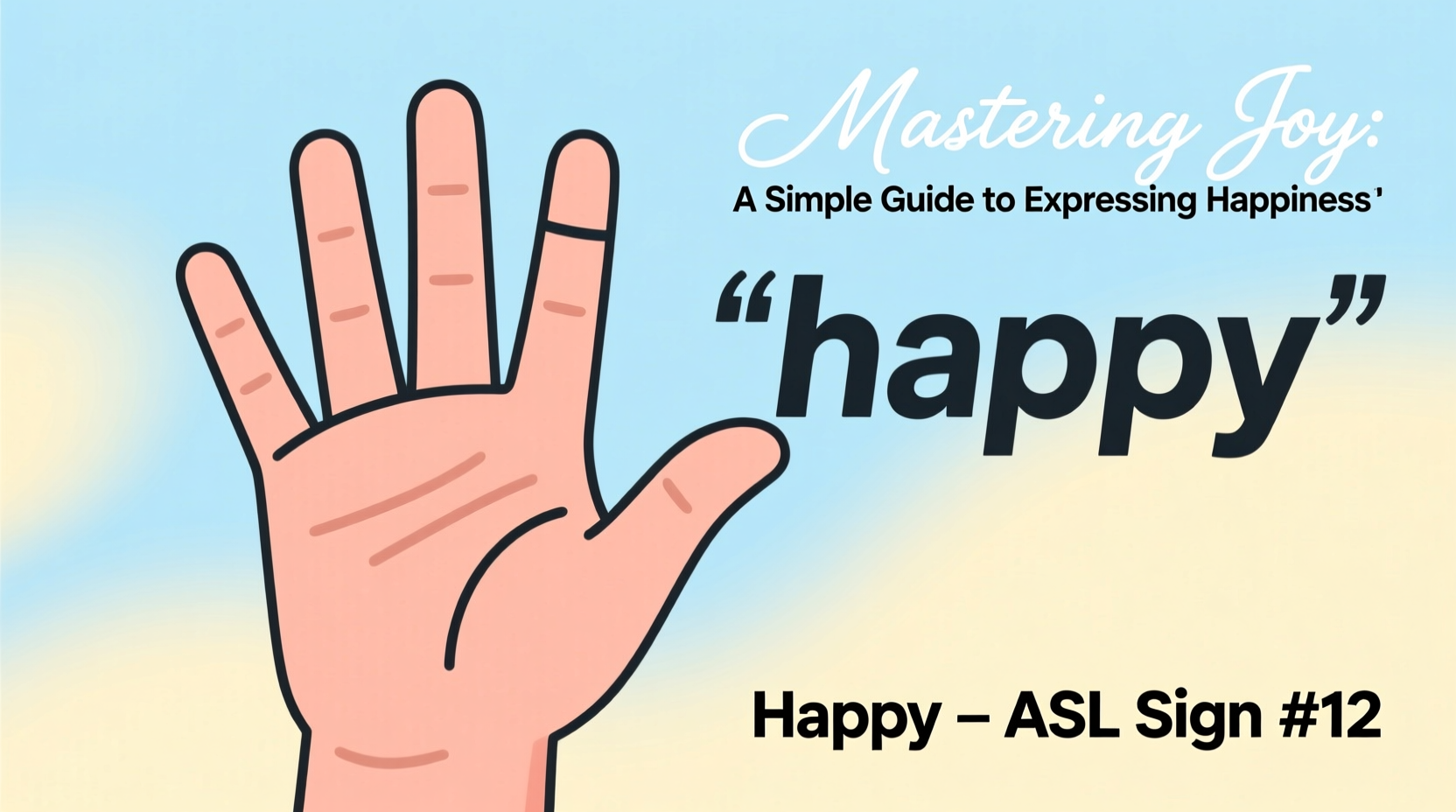
In ASL, the sign for \"happy\" uses both hands and incorporates facial expression to convey genuine emotion. The dominant hand starts near the chest, palm facing inward, fingers together. It then moves upward in a small arc, brushing lightly against the upper chest or sternum area before rising slightly. This motion mimics the physical sensation of warmth or lightness associated with joy.
Crucially, the sign is not performed silently. Facial grammar plays a vital role: a natural smile, raised eyebrows, and open eyes are all part of conveying true happiness. Without these non-manual markers, the sign can come across as flat or even sarcastic.
Step-by-Step Guide to Signing “Happy” Correctly
- Position Your Hand: Place your dominant hand near the center of your chest, about two inches below your collarbone. Fingers should be together, palm facing inward toward your body.
- Initiate the Motion: Begin by making gentle contact with your chest—this tactile element grounds the emotion physically.
- Move Upward: Slide your hand upward in a short, curved path, ending just above chest level. The motion should feel light and bouncy, not rigid or mechanical.
- Add Facial Expression: As you make the sign, allow your face to reflect joy—genuine smile, slightly raised eyebrows, and relaxed cheeks.
- Use Both Hands (Optional): For emphasis or in storytelling, both hands may perform the sign simultaneously, especially when describing intense feelings.
This sequence may take a few repetitions to feel natural. Unlike spoken words, signs carry kinetic memory—the way they feel in your body matters as much as how they look.
Common Mistakes and How to Avoid Them
Learners often struggle with overemphasizing the hand motion while neglecting facial grammar. Others confuse \"happy\" with similar signs like \"excited\" or \"glad,\" which have different movements and intensities.
| Mistake | Why It’s Wrong | How to Fix It |
|---|---|---|
| Hand moves too far upward | Resembles “think” or “idea” signs | Keep motion small and close to the chest |
| No facial expression | Lacks emotional truth; may seem insincere | Practice with exaggerated expressions until natural |
| Fingers spread apart | Looks like “feel” or “emotion” without specificity | Keep fingers tightly together throughout |
| Starting from chin or neck | Confused with “proud” or “confident” | Always initiate near the sternum |
Understanding Context: When and How to Use the Sign
The sign for happy changes subtly depending on context. A quiet moment of contentment uses a softer, slower version of the sign. In contrast, overwhelming joy might include bouncing shoulders, wider smiles, and repeated motions.
In narrative signing, such as telling a story or sharing news, the sign often appears in clusters: “I was so happy, I couldn’t stop smiling.” Here, rhythm and pacing matter. Repeating the sign twice with increasing intensity can express growing emotion without needing additional vocabulary.
“Emotion in ASL isn’t added—it’s embedded. You don’t just sign ‘happy,’ you become happy in that moment.” — Dr. Lydia Chen, Linguist and ASL Educator
This principle underscores why mechanical repetition won't suffice. True mastery comes from internalizing the feeling behind the sign.
Real-Life Application: A Mini Case Study
Sarah, a high school teacher, began learning ASL to better communicate with a deaf student named Jordan. During their first week, she signed “I am happy to meet you” using textbook-perfect handshape—but her face remained neutral out of concentration. Jordan paused, then gently tapped his cheek and smiled, shaking his head playfully.
It took Sarah a moment to understand: he wasn’t correcting her hand, but her expression. After practicing in front of a mirror and recording herself, she rephrased the sentence with a warm, spontaneous smile. Jordan responded immediately with a broad grin and signed back, “Me too!”
That exchange marked the beginning of a trusting relationship. It also taught Sarah that in ASL, emotional honesty isn’t optional—it’s essential.
Tips for Long-Term Mastery
- Pair the sign with real moments of joy—when something makes you laugh, sign “happy” aloud and in motion.
- Watch native ASL users on educational platforms or Deaf-led content to observe how they modulate the sign.
- Record yourself regularly to track improvements in fluidity and expression.
- Learn related signs like “sad,” “angry,” and “excited” to build emotional contrast and depth.
- Engage with the Deaf community respectfully—attend events, ask questions, and accept feedback graciously.
Checklist: Mastering the Sign for Happy
- ✅ Hand starts near sternum, palm inward
- ✅ Smooth, arcing upward motion
- ✅ Light touch or brush against chest
- ✅ Natural, unforced smile accompanies the sign
- ✅ Eyebrows raise slightly to show sincerity
- ✅ Motion stops above chest—no overextension
- ✅ Practice with variations: soft joy vs. intense happiness
- ✅ Use in full sentences: “I am happy,” “She looks happy,” “We were happy”
FAQ
Is the sign for “happy” the same in all sign languages?
No. While many sign languages use chest-touching motions to represent emotion, the exact formation varies. British Sign Language (BSL), for example, uses a tapping motion on the chest with a flat hand, while ASL uses a sliding arc. Always learn the sign within the context of the specific language you’re studying.
Can children learn this sign early?
Absolutely. Many parents teach “happy” as one of the first signs in baby sign language programs. Its tactile nature—touching the chest—makes it intuitive for young learners. Pairing it with songs or joyful activities reinforces recognition and use.
Do I need to use both hands?
Typically, only the dominant hand is used for the standard sign. However, using both hands can add emphasis, especially in storytelling or poetic signing. In conversational ASL, single-hand execution is standard unless greater intensity is intended.
Conclusion: Bring Joy Into Your Signing
Mastering the sign for happy goes beyond memorizing a gesture—it’s about learning to express inner states with authenticity. Every time you sign it with intention, you honor the richness of nonverbal communication and deepen your connection to the Deaf community.
Language is alive, and emotion is its heartbeat. Start today: stand in front of a mirror, place your hand on your chest, and let your joy rise—not just in words, but in motion, face, and spirit.




 浙公网安备
33010002000092号
浙公网安备
33010002000092号 浙B2-20120091-4
Comments
No comments yet. Why don't you start the discussion?