
Accurate timekeeping is more than a convenience—it's a mark of reliability, professionalism, and attention to detail. Whether you wear a vintage mechanical heirloom, a sleek modern quartz piece, or the latest smartwatch, knowing how to adjust your watch correctly ensures precision and longevity. Many people overlook proper time-setting techniques, leading to inaccurate readings, unnecessary strain on internal mechanisms, or even premature wear. This comprehensive guide walks through the correct methods for adjusting time across all major watch types, offering practical insights, expert-backed advice, and actionable steps to master this essential skill.
Understanding Your Watch Type
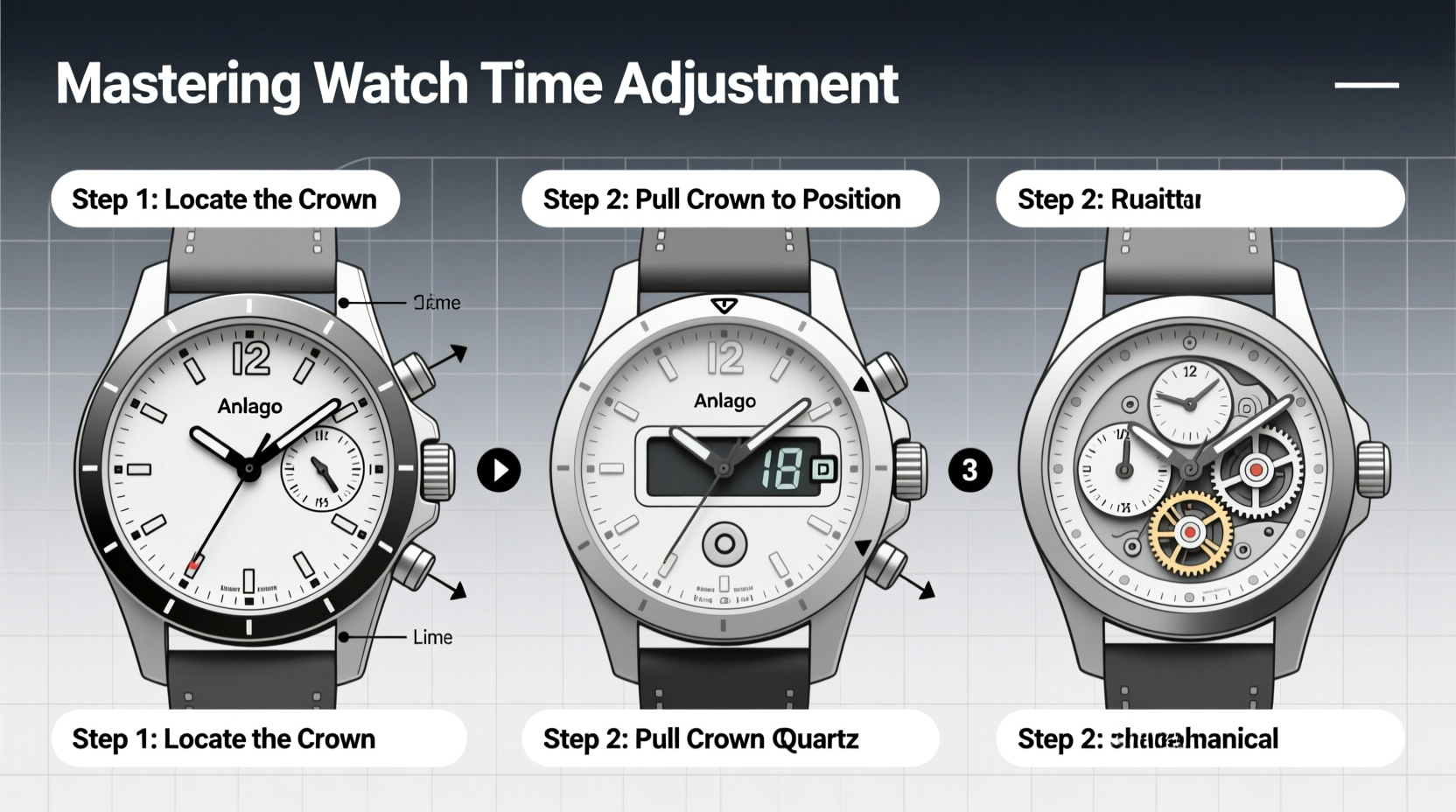
Before adjusting the time, it’s crucial to identify your watch’s movement type. Each category—mechanical (manual and automatic), quartz, and smartwatch—requires a different approach. Missteps can result in misalignment, damage to gears, or battery drain. Here’s a quick breakdown:
- Mechanical Watches: Powered by a wound spring; includes manual-wind and self-winding (automatic) variants.
- Quartz Watches: Battery-powered with precise electronic oscillators.
- Smartwatches: Digital devices synced via Bluetooth to smartphones.
Each functions differently, and so does the process of setting the time.
Step-by-Step Guide to Adjusting Time by Watch Type
1. Mechanical Watches (Manual & Automatic)
Adjusting a mechanical watch requires care. These watches contain delicate components that respond poorly to abrupt movements or incorrect handling.
- Pull the crown gently: Rotate the crown until it clicks into the first or second position. On most watches, the first click adjusts the date; the second allows time adjustment.
- Set the date (if needed): Turn the crown clockwise in the first position to advance the date. Avoid changing the date between 9 PM and 3 AM when the mechanism is engaged.
- Adjust the hands: Pull the crown fully out and rotate it to move the hour and minute hands. Move past 12 o’clock to ensure the AM/PM cycle is correct.
- Push the crown back: Once set, gently push it in to resume normal operation.
2. Quartz Analog Watches
Quartz watches are generally simpler but still require precision.
- Pull the crown out fully: Most quartz watches have two positions. The outermost position sets the time.
- Turn the hands: Rotate the crown to align the hour and minute hands with the correct time.
- Reset the date (if applicable): If your model has a date window, rotate past midnight to update it automatically.
- Press the crown back in: Ensure it’s fully seated to maintain water resistance.
Note: Some quartz watches require resetting the seconds hand to zero for optimal accuracy. Refer to the user manual for specific instructions.
3. Smartwatches (Apple Watch, Samsung Galaxy Watch, etc.)
Smartwatches typically sync time automatically, but manual override is possible.
- Open settings: Navigate to “Clock” or “Date & Time” in the device menu.
- Disable auto-sync (optional): Toggle off automatic time zone detection if setting manually.
- Adjust time and date: Use touchscreen controls to set the correct values.
- Re-enable sync: For ongoing accuracy, turn auto-sync back on after manual correction.
If time remains inaccurate, check Bluetooth connectivity and ensure the paired smartphone has the correct time enabled.
Common Mistakes to Avoid
Even experienced users make errors when adjusting their watches. These mistakes can affect performance and reduce lifespan.
| Mistake | Why It’s Harmful | Solution |
|---|---|---|
| Setting time during 9 PM – 3 AM | Risks damaging the date change mechanism in mechanical watches | Always adjust the date before 9 PM or after 3 AM |
| Forcing the crown | Can break stem or gaskets, compromising water resistance | Use gentle pressure; if stiff, consult a professional |
| Ignoring synchronization delays in smartwatches | Leads to persistent time drift | Restart the device or re-pair with the phone |
| Adjusting chronograph subdials incorrectly | May misalign stopwatch functions | Use dedicated pushers; refer to manual for reset procedures |
“Proper time adjustment isn’t just about accuracy—it’s about respecting the engineering inside your watch. A few seconds spent doing it right can preserve decades of craftsmanship.” — Daniel Reeves, Master Watchmaker at Horologe Atelier
Expert Tips for Long-Term Accuracy
Consistent timekeeping depends not only on correct adjustment but also on maintenance habits.
For quartz watches, replace batteries every 1–2 years—even if they’re still running. Old batteries can leak and damage internal components. Smartwatches benefit from regular software updates, which often include clock calibration improvements.
Mini Case Study: Correcting a Vintage Heirloom
James inherited a 1965 Omega Seamaster from his grandfather. Excited to wear it, he pulled the crown and began turning it counterclockwise to save time. Within days, the date stopped advancing. He brought it to a specialist who explained that reversing the crown stressed the calendar gear train. After a minor repair, James learned to always move the hands forward, adding a full 24-hour cycle if needed. The watch now runs flawlessly, preserving both function and family history.
Essential Checklist for Safe Time Adjustment
Follow this checklist every time you adjust your watch to ensure safety and precision:
- ✅ Identify the watch type (mechanical, quartz, smart)
- ✅ Check the current time on a reliable reference (atomic clock or smartphone)
- ✅ Ensure the watch is clean and dry before handling
- ✅ Avoid adjusting between 9 PM and 3 AM (for mechanical watches with date)
- ✅ Pull the crown gently—never force it
- ✅ Set the date first (if separate), then the time
- ✅ Confirm AM/PM by passing the hour hand past 12
- ✅ Push the crown fully back in to restore water resistance
- ✅ Verify accuracy over the next 24 hours
Frequently Asked Questions
How often should I adjust my watch?
Mechanical watches may gain or lose a few seconds daily and should be checked weekly. Quartz watches are accurate for months but benefit from a monthly verification. Smartwatches rarely need manual adjustment due to automatic syncing.
Can I adjust the time on a water-resistant watch?
Yes, but only when the crown is fully sealed. Never pull out the crown while the watch is wet or underwater, as this can allow water ingress. Always dry the watch first.
Why does my automatic watch lose time overnight?
If not worn regularly, automatic watches unwind and stop. Try wearing it daily or using a watch winder. If it consistently loses time while worn, it may need servicing or regulation by a professional.
Conclusion: Take Control of Your Time
Mastering watch time adjustment is a small act with lasting impact. It reflects respect for craftsmanship, personal discipline, and attention to detail. Whether you're winding a family heirloom, syncing a digital companion, or fine-tuning a precision instrument, the way you treat your watch speaks volumes. Apply these steps consistently, avoid common pitfalls, and your timepiece will reward you with years of reliable service. A well-adjusted watch doesn’t just tell time—it enhances your relationship with it.




 浙公网安备
33010002000092号
浙公网安备
33010002000092号 浙B2-20120091-4
Comments
No comments yet. Why don't you start the discussion?