
A chronograph watch is more than a stylish accessory—it’s a precision instrument capable of measuring elapsed time, distance, and even speed. Among its most intriguing features is the tachymeter scale, typically etched around the bezel or on the dial. While it looks like mere decoration, this scale enables wearers to calculate speed based on travel time over a fixed distance. Despite its utility, many owners rarely use it correctly, if at all. This guide demystifies the tachymeter, offering a clear, practical method for harnessing its power in everyday scenarios—from timing laps to estimating vehicle speed.
Understanding the Tachymeter: What It Is and How It Works
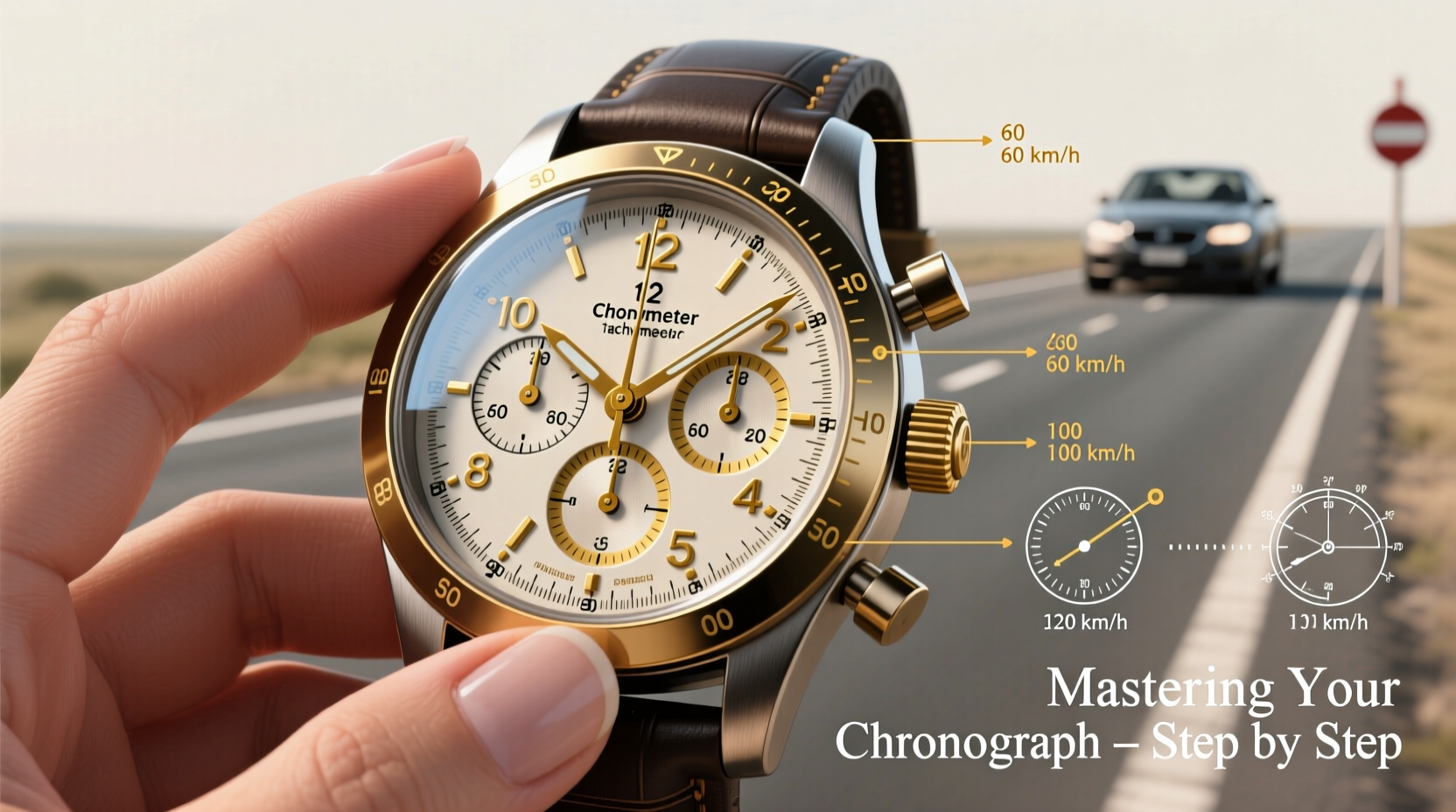
The tachymeter is a scale that converts elapsed time (in seconds) into speed units per hour, assuming a constant distance of one kilometer or one mile. It operates on a simple principle: speed = distance ÷ time. The scale is logarithmic, meaning the numbers are not evenly spaced. Once you start the chronograph and pass a known distance, the second hand points to a value on the tachymeter that indicates average speed over that distance.
For example, if a car travels one mile in 30 seconds, the tachymeter will show 120—meaning 120 miles per hour. This calculation happens instantly without mental math, provided the distance used is exactly one unit (mile or kilometer).
Step-by-Step Guide to Using the Tachymeter for Speed Measurement
- Choose a measured distance. Identify a stretch of road or track that is exactly one mile or one kilometer long. Highway mile markers or GPS-verified segments work well.
- Position yourself at the starting point. Align the vehicle or moving object with the beginning of the measured distance.
- Start the chronograph as the object passes the start line. Press the top pusher to begin timing the moment the front of the vehicle crosses your reference point.
- Stop the chronograph as the object reaches the end. When the same part of the vehicle crosses the one-mile or one-kilometer mark, press the pusher again to stop the timer.
- Read the tachymeter value where the second hand points. That number is the average speed in units per hour (mph or km/h) over the measured distance.
This process requires no additional tools, calculations, or smartphone apps—just precise timing and a known distance. With practice, users can achieve results within 5% of radar-measured speeds.
Practical Applications and Real-World Example
Consider a motorsports enthusiast timing laps at a local racetrack. The straightaway is precisely 1 kilometer long. As a sports car enters the straight, she starts the chronograph. When the car exits the straight, 24 seconds have passed. The second hand points to “150” on the tachymeter scale—indicating the car averaged 150 km/h during that segment.
This information helps evaluate performance across different sessions or compare vehicles under similar conditions. Similarly, a pilot might use the tachymeter during ground checks to estimate taxi speed when electronic systems are offline. Even hikers can apply it: by timing how long it takes to walk one kilometer, they can determine their average pace in km/h using the same scale.
“Mechanical watches with tachymeters offer a tactile, immediate way to engage with physics and motion. They turn abstract concepts like velocity into something readable on your wrist.” — Dr. Alan Reyes, Horology Instructor at Geneva Watchmaking School
Common Mistakes and How to Avoid Them
Despite its simplicity, improper use leads to inaccurate readings. Below is a table summarizing key dos and don’ts:
| Do | Don’t |
|---|---|
| Use a precisely measured distance (1 mile or 1 km) | Estimate distance or assume road signs are exact |
| Start and stop the chronograph at consistent reference points | React too early or late due to anticipation error |
| Ensure the event lasts between 7 and 60 seconds | Try to measure speeds below 60 mph/km/h (tachymeter won’t display) |
| Practice timing stationary objects (e.g., passing lampposts) | Rely solely on first attempts without calibration |
| Clean and service your chronograph regularly | Ignore sticking hands or delayed reset functions |
Troubleshooting and Accuracy Tips
Human reaction time introduces the greatest source of error. Studies suggest average visual reaction time is around 0.25 seconds—negligible at high speeds but significant over short distances. To minimize this:
- Use longer distances when possible (though still limited to 1 unit for direct tachymeter reading).
- Practice with consistent targets, such as buses or trains on fixed routes.
- Take multiple readings and average them for better reliability.
- Use a flyback chronograph if available, allowing rapid resets and re-timing.
If the measured time exceeds 60 seconds, the tachymeter cannot display a result. In such cases, divide both distance and time proportionally. For instance, if an object takes 90 seconds to travel 1.5 km, treat it as 1 km in 60 seconds—equivalent to 60 km/h. Alternatively, manually calculate speed using (distance ÷ time in hours).
Frequently Asked Questions
Can I use the tachymeter to measure anything besides speed?
Yes. While designed for speed, the tachymeter can also measure frequency or output rate. For example, if a factory machine completes a cycle every 20 seconds, the tachymeter reads “180,” meaning 180 cycles per hour. This application is useful in industrial or logistical settings.
Does the tachymeter work with kilometers and miles interchangeably?
No. The tachymeter assumes a fixed distance of one unit. If your reference distance is 1 mile, the reading is in mph. If it’s 1 kilometer, the reading is in km/h. Mixing units without conversion will yield incorrect results.
What if my chronograph doesn’t have a tachymeter scale?
Many modern chronographs omit the scale for aesthetic reasons. You can still measure elapsed time and calculate speed manually: divide 3600 by the number of seconds taken to travel one mile or kilometer. For example, 3600 ÷ 45 = 80 mph/km/h.
Essential Checklist for First-Time Users
- Verify your watch has a functioning chronograph and tachymeter scale.
- Select a safe, measurable distance (use GPS or verified markers).
- Rehearse starting and stopping the chronograph with non-moving cues.
- Time an object traveling the known distance with precision.
- Read the tachymeter where the second hand stops.
- Repeat the test to confirm consistency.
- Record results for comparison in future measurements.
Making the Most of Your Chronograph
The tachymeter transforms a wristwatch from a passive timekeeper into an active tool for observation and analysis. Whether you're evaluating athletic performance, monitoring delivery vehicle speeds, or simply exploring horological functionality, mastering this feature deepens your connection to the mechanics of time and motion. Unlike digital tools that automate everything, the analog tachymeter demands engagement—rewarding patience and precision with immediate, tangible insight.
Regular use keeps the chronograph mechanism lubricated and responsive. Experts recommend activating the stopwatch function at least once a month, even briefly, to prevent oil settling and component stiffness in mechanical movements.
Conclusion
Using a tachymeter is a blend of skill, timing, and understanding. It’s not merely a relic of pre-digital navigation but a functional feature that remains relevant in today’s world. By following these steps and practicing consistently, you unlock a unique capability built into many classic and modern timepieces. Don’t let that scale go unused—take your chronograph for a test run the next time you’re near a measured mile or kilometer. See how fast—or how steadily—you can capture motion with nothing more than a glance at your wrist.




 浙公网安备
33010002000092号
浙公网安备
33010002000092号 浙B2-20120091-4
Comments
No comments yet. Why don't you start the discussion?